Author: David Williams

  • Do You Give 16.8 Hours Per Week Of Your Time To God?

    Now that I have your attention with the title, where did I come up with 16.8 hours and does it really matter? I’ll get to that in a moment.

    Being raised Pentecostal ( later becoming Baptist – Now Catholic ), I was brought up in the Pentecostal church with the teaching of 10% tithing which was financially focused. Although I believe my late grandfather was likely a faithful tithe giver, I don’t remember me personally ever tithing very often at all. However, I did give financially and also as an adult felt that I gave of my time.

    But did I ( do I ) give 10% of my time? Do you give 10% of your time?

    This past week a Catholic friend and I were having coffee and as usual were talking about numerous topics. One of them was giving financially but also giving of time. That’s where the 16.8 hours came in.

    I mentioned to my friend that there are 168 hours in a week and that 10% of our time in one week is 16.8 hours. That made him think of 2 1/2 hours per day which is about what 10% of 24 hours works out to be. With all that said, it’s interesting to stop and think for a moment that 10% of our time back to God each week is far beyond checking off “I attended Sunday Mass” as a Catholic or for a Protestant “I went to Sunday School and Sunday worship.”

    It’s really interesting to reflect on this past week and think about “Did I give 10% of my time this past week to God?” I’m not saying that God says we have to give 10% of our time. I’m simply stating something that can come up when comparing 10% tithe of money vs. time. For example, “If I cannot give 10% financially, can I just give 10% of my time?” or “I cannot afford to give financially, but I do give of my time.”

    There are likely many Christians who exceed the 16.8 hours per week. There are others who barely give any of their time. I’m not here to judge anyone of how much time he or she gives or doesn’t give. My premise for this article is to get ALL of us thinking that 10% of our time in one week is 16.8 hours and compare that to other things we ALL ( or some ) likely do each week and to reflect on what it might take to actually give 16.8 hours per week to God.

    Do you watch an average of 16.8 hours per week ( 2 1/2 hours per day ) of NON-Christian related TV?

    Do you spend an average of 16.8 hours per week ( 2 1/2 hours per day ) of NON-Christian related Internet?

    Do you spend an average of 16.8 hours per week ( 2 1/2 hours per day ) in your car listening to NON-Christian related radio or other types of audio?

    I’m not saying any of these things are wrong. However, I am saying that if we want to give God 10% ( or even more ) of our time that we have to be conscience of how we spend our time. What’s more important God or TV? God or Internet? God or Secular Radio? OR God and _____ ? ( fill in the blank ).

    For me personally…

    I likely spend about 90 minutes per day on average in a vehicle. Actually, it’s probably more than that over a full week. I can choose to give that time to God or listen to secular radio?

    I’m not a huge TV watcher. It’s mostly spent on things like MASH, the Andy Griffith Show and older shows like Matlock, Murder She Wrote, etc. with maybe a movie or two per week; however, I’d still say that I likely spend an average of 90 minutes per day over the course of a week with the TV on.

    If you do the math on the two items above, I’m estimating a minimum of 3+ hours per day or 21+ hours per week that I can choose how to use. I choose to use more ( most ) of my car time for God. I still use most of my TV time for mindless thought.

    As for Social Media, I have maybe spent an hour per month on Facebook over the last 6 months and deactivated it just recently. The majority of my Social Media time is spent on the Instagram account for Catholic Transformation. As for the Internet in general, I do use it a lot for Catholic related stuff.

    I’m not saying God requires 10% of our time. But is there anything wrong with giving God 17 hours per week? Is there anything wrong with striving to do that?

    Jesus gave his life on the cross for us. We have the hope of eternity in heaven through Jesus. We should all give time to God.

    1% is less than 2 hours per week and 10% is almost 17 hours per week: You’ll have to decide what works for you. That’s between you and God. I simply thought that this article might give you something to think about like it did me.

  • Transitioning Into Living The Catholic Life

    A lot of people outside of Catholicism may think that all that Catholic stuff is just a waste of time or even unnecessary, but I have found that it brings me closer to God and keeps me focused on my Christian faith. Sadly, there are likely many Catholics that do not truly embrace the Catholic faith and treat it like a checklist of “I went to church ( Mass ) on Sunday, so I’m good. Now, let’s go to the lake and get on the boat.”

    I love attending weekday Mass when I can. I love wearing my crucifix necklace to remind me of my faith. I love going to adoration and try to spend a full hour rather than just a few minutes. I could go on and on about all the things that many faithful Catholics who embrace the faith do often like say the Rosary, make the sign of the cross and much more, but the important thing about all of it is bringing one closer to Jesus Christ who is the same Jesus Christ that Protestant Christians love so much.

    The key reason to pray often is to bring one closer to God. Catholics just have a lot more of those things in their toolbox ( Catholic friend shared toolbox analogy ) and it doesn’t bother me. If you have never fully embraced the Catholic faith and lived it daily, you likely have no clue what I’m talking about.

    Why Be Catholic?

    For me, being Catholic truly is embracing the fullness of the Christian faith. After studying early Church history, what the Catholic Church teaches about itself, getting self out of the way and much more, I had no choice but to become Catholic or reject the TRUTH. But how can anyone knowingly reject the TRUTH?

    I think most of us can talk ourselves into rejecting what we believe is TRUE by letting self get in the way. By having too much pride to change ones way of thinking, it can be easy to reject something that’s right in front of your face. Other people can get in the way as well. All of us have had times that we think “most my friends and family are ________ ( in this case Protestant would be a good example).” How can I become Catholic and face all the people I know? FYI, get over it.

    Hint: Let go of self and let go of what others might think and let God take control no matter where that leads you even if it’s becoming, oh no, a CATHOLIC CHRISTIAN.

    I became Catholic at 51 years old. I had never, ever, never that I can remember considered becoming Catholic in all of my life until I was 50 years old. I simply just never thought much about it and sadly, I never had a Catholic share their joy, the beauty of Catholicism, their enthusiasm for their Catholic faith and I do believe those Catholics exist.

    I don’t know if my father, mother and sister will read this or not, but they all know about the site. I said that because I hope all 3 of them will be willing to do whatever God wants for their life even if that is one day becoming Catholic. Rejecting something because it might be a stigma or go against what you have believed all your life is like a sinner rejecting Jesus to live for self. A sinner cannot see the beauty of a Christian life through sinful eyes. Likewise, a non-Catholic Christian cannot see what they are missing in Catholicism by rejecting it due to stigma or self getting in the way.

    I wish that I had discovered Catholicism many years ago, but God’s timing is not my timing. I’m where God wants me to be. I’m embracing and living the Catholic life.

    Are you where God wants you to be?

  • Perpetual Adoration: Weekly Holy Hour At 4 a.m. Every Thursday

    By LaRedCultural – Own work, CC BY-SA 3.0

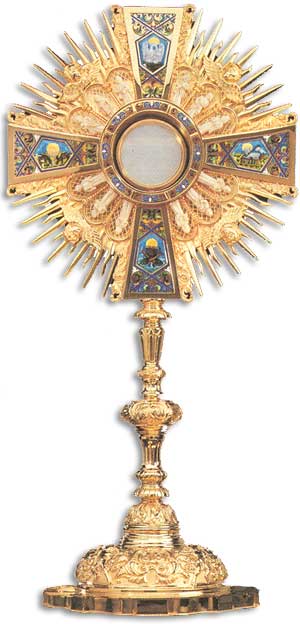
    Although we are members at the Holy Name of Jesus Cathedral in Raleigh, we live closer to St. Catherine of Siena in Wake Forest, NC which has perpetual adoration. I believe perpetual adoration is now in the 10th year at St. Catherine’s which is amazing when you think about 168 hours in a week and having two prayer partners for all of those hours with currently fewer than 10 spots needing double coverage.

    If you are not a Catholic and/or do not understand the REAL PRESENCE, it may be challenging to understand perpetual adoration and how much of a blessing a holy hour in a small chapel can be at any hour of the day: I love the silence. I love the peace. I love the prayer time. I love kneeling. I love the beauty. I love the real presence in the blessed sacrament.

    Not everything in Christianity can be completely understood from human comprehension. Some things are accepted by faith ( Virgin Birth, Christ Resurrection, etc. ). Others like the real presence in the eucharist may be more of a mystery even with Jesus saying, “This is MY body.” Jesus didn’t say “This is symbolic of MY body.” Jesus said, “This is MY body.”

    I have spent several 1 hour blocks known as a Holy Hour in the Chapel at St. Catherine’s. There was a time recently when I prayed the Anima Christi prayer listed here that I could barely get through it because of the tears and emotion flooding my soul: “Soul of Christ, sanctify me. Body of Christ, save me. Blood of Christ, inebriate me. Water from the side of Christ, wash me. Passion of Christ, strengthen me. O good Jesus, hear me. Within your wounds conceal me. Do not permit me to be parted from you. From the evil foe protect me. At the hour of my death call me. And bid me come to you, to praise you with all your saints for ever and ever. Amen”

    This past Thursday, first Thursday after Easter Sunday 2018, was my first 4 a.m. committed weekly hour with a prayer partner. The goal is to have every hour covered by two prayer partners. There was an opening and I decided to be a part of the coverage needed. In addition to unplanned time, I now have something to look forward to at 4 a.m. every Thursday except the rare times that I cannot be there for one reason or another.

    Read This: Perpetual Adoration: Uninterrupted adoration of the Blessed Sacrament

  • Easter 2018: Yes, We Are Now At Home In The Catholic Church

    Saturday, March 31st, 2018, Brenda and I were confirmed in the Catholic Church ( see confirmation here ) and received the Eurcharist as Catholic Christians for the first time in our lives ( me at age 51 and Brenda at age 49 ). It has been a journey full of ups and downs, but I have NO DOUBT that I’m ( we ) where God wants me to be: I’m proud to be a Catholic Christian.

    What a joyous time for Brenda and I to be officially at home in the Catholic Church on Easter Sunday, April 1st 2018 as I write this article on a beautiful Easter Sunday afternoon.

    I don’t know what background you have when it comes to faith or maybe you are an atheist, but I can tell you that I am excited about what the future holds for us as a Catholic couple. I hope that you will truly LET GO AND LET GOD in your own life. Be open to what God has in store for you even if that is becoming Catholic, reverting to your Catholic faith or renewing your Catholic faith to live for Jesus Christ like never before as not just a Christian but in the fullness of the Catholic Christian faith.

    I am more focused on serving Christ and serving others. I have fought with self many times in the last 14 months as I really dove into understanding the Catholic faith. I’ll share some of that with you in this article.

    I had to DIE TO SELF to get through this journey. I’ll share more about dying to self after the story below from Father Larry Richards ( huge impact on my life over the last year or so ).

    “God, God please help me, help me. I can’t take this demon of lust.” So God sends an angel. And the angel says, “What is the problem?” He said, “It is this demon of lust. I can’t stand it. It makes me do these horrible things. I hate it. I hate myself because of this demon.” And the angel looks at him and says, “May I kill it?” And the man says, “Oh I don’t know if you want to kill it. Maybe you could just wound it a little bit. Or take the chain it has around my neck. Maybe you could just do something like that.” And the angel looks at him and says, “May I kill it?” And the guy says, “Oh that is not very politically correct you know to kill things nowadays. Maybe you could just do this.” And the angel says, “May I kill it?” And finally the man says, “Yes, yes, yes. Kill it!” And the angel reaches out and he takes that demon of lust and he crushes it and he kills it. And the demon is transformed into a beautiful white stallion. The man jumps on the stallion and the stallion takes him home to heaven.” ( see PDF here )

    All of us have struggled with something in our lives. In my journey to becoming Catholic, self was my worst enemy. I had MY BELIEFS. The ones that I held dear. Here are some paraphrase examples: “It’s Christ on the cross with a simple plan of Salvation. Catholic Salvation is complicated.” – “Many Catholics don’t know their faith.” – “I don’t agree with the Catholic Church on this or that.” However, I could accept some things about Catholicism. I just couldn’t accept them all. Like many Christians, I wanted to pick and choose what DAVID WILLIAMS ( SELF ) would believe and would reject.

    I, unlike some Christians, believed that Catholics were fellow Christians. I didn’t think they worshipped Mary. I was NOT an anti-Catholic that thought Catholics need to leave the Catholic Church to really be saved. Although I didn’t have those battles to fight, there were still plenty of barriers along the way.

    Brenda and I attended our first Mass on January 21st, 2017. By then, I had about 3 weeks of pretty in depth time into Catholicism ( plus some time in late 2016 ). Brenda and I continued attending Mass pretty faithfully for several weeks. Then, sometime after Easter 2017 which fell on Sunday, April 16th, 2017 things began to slip a little. The demon of SELF raised it’s ugly head and David Williams was bigger than the Catholic Church ( overstated to make a point about SELF ).

    Brenda wasn’t as on board as I was in those early weeks, so when I decided sometime around May 2017 that we were not going to continue the Catholic journey ( at least for the time being ), Brenda didn’t fight me on it. For about the next 12 to 14 weeks or so, we took a break. I did minimal Catholic reading, minimal Catholic study, minimal Catholic radio and pretty well just about threw in the towel. However, I still loved Jesus. Honestly, I think that I overdid it by frying myself with information overload.

    I estimate that I had about 200 hours or so of time invested by the time this 2017 break happened. That much time in a relatively short period can be a system shock to someone at age 50 with Protestant beliefs since childhood. For example, the Protestant beliefs of private interpretation of scripture and as long as we can agree that it’s all about Christ on the cross and salvation through Jesus that it really wasn’t all that important that we disagreed on a lot of other things as Christians.

    But, thankfully, during this break, we were still on the RCIA email list and I got an email that got me thinking about Catholicism again. It was an email concerning the upcoming 6 inquiry sessions that were taking place. It was 6 sessions with a short break in between to make a decision whether we wanted to continue with the full RCIA class or decide that we would not continue on after the inquiry sessions. I decided to not say anything to Brenda for a few days. When I did, we both ended up agreeing that there was no harm in seeing what the inquiry sessions were about because there was no commitment to become Catholic.

    This got me back on track of diving deep into Catholicism. I picked back up with consuming myself with Catholic media. The difference from earlier in 2017 was that I quickly got self out of the way. I needed to be open to trying to wrap my head around Catholicism and see if it was where God wanted me ( us ) to be.

    Although we ended up only attending 1 or 2 of the 6 inquiry classes, it became more about diving into RCIA. I had mentioned to Brenda that there was still no commitment even if we attended RCIA. Brenda was willing to attend with an open mind and see if RCIA changed anything. I think the first official class was sometime in mid to late October of 2017 or maybe early November just to get you up to speed of a timeline. For me, I was in deep into absorbing information. I truly wanted to know that I know that I know that becoming Catholic was what Brenda and I were supposed to be doing.

    If you think about the timeline above, by the time mid-October 2017 hit, there had been 41 weeks in 2017 and only 12 to 14 of them had not been part of our Catholic journey. So by the mid-October, we had roughly 27 to 29 weeks into Catholicism in 2017 with me spending hours and hours every week diving in through all types of media.

    I was getting a desire in my soul to become Catholic. FYI, if you have not studied Catholicism from a Catholic view point, you should be open to understanding Catholicism from a Catholic perspective not an anti-Catholic ( what you might think ) perspective.

    Brenda’s position was that she’d attend the class ( RCIA ) and make a decision. This was a time of difficulty for us because I was so deep into what I was learning that my passion continued to grow for the Catholic faith.

    I believe that it was sometime in early December 2017 that I came to conclusions on some key questions:

    1) Was the Catholic Church the TRUTH or not? If it was True, I needed to be a part of it.

    2) Was the Catholic Church bigger than David Williams? In other words, is there an authority that the Catholic Church has to interpret scripture and stand on a 2,000 history that I could not stand on as an individual trying to interpret scripture privately.

    3) Could I accept ALL Catholic Church teachings and not be a Cafeteria ( pick what I want ) Catholic? If I was going to pick and choose, I might as well remain Protestant.

    4) The most difficult one of All: Would I join the Catholic Church without Brenda? I had said many times that I wanted us to become Catholic together or that I would likely not move forward without her.

    The answers to all 4 of the above were YES, YES, YES and a difficult YES.

    I waited a week or maybe even two weeks to share with Brenda that I hoped that we can become Catholic together at the 2018 Easter Vigil, but that I had to move forward and become Catholic with or without her. Brenda appeared to take it well but wasn’t ready to make a firm decision to become Catholic.

    During the first week of January 2018, Brenda told me that she had decided to become Catholic at the 2018 Easter Vigil. It was a glorious time that my wife of 28 years was moving forward with me. God had a plan and it was coming together.

    Although there were still some struggles, things went fast from Brenda’s decision time to the 2018 Easter Vigil.

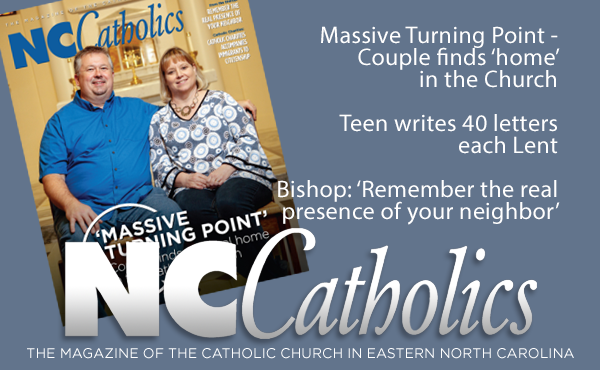
    Brenda and I ended up being on the cover of NC Catholics Magazine for the March/April 2018 issue as seen below:

    Holy week 2018 came quickly and we were part of the Chrism Mass on Tuesday, March 27th, 2018: I carried a 20 pound ( or so ) bottle of oil up to the front of the Cathedral with Brenda by my side. It was one of many that was blessed by the Bishop. We attended service Thursday evening March 29th at 7 p.m. at the Cathedral. We attended Good Friday service at the Cathedral at 3 p.m. with the veneration of the Cross which was amazing. Then, Saturday, March 31st, 2018 came around. It was the date of the Easter Vigil.

    We met with other RCIA class members from around 9 a.m. to Noon. We arrived at the Cathedral early for the 8:30 p.m. Easter Vigil service and had time to greet our two adult daughters and a friend and his wife that drove all the way from the Atlanta area just to see us become Catholic.

    Our sponsors, Barry and Liz, who have been a huge part of the journey were there with us as we were confirmed on March 31st, 2018. We received the Eucharist for the first time just a few minutes later.

    BRENDA AND I ARE GLAD TO BE AT HOME IN THE CATHOLIC CHURCH.

  • I Asked A Question On EWTN OPEN LINE: Hear Fr. Larry’s Reply

    Brenda and I have enjoyed listening to Fr. Larry Richards on our journey from Protestant Christians to becoming Catholic Christians at the March 31st, 2018 Easter Vigil.

    You can find my call to ETWN Open Line in the video clip above at 15 minutes and 36 seconds into the program and it ends at 19 minutes and 7 seconds.

    Fr. Larry provided some great advice and I will likely listen to his answer several times as a reminder to keep the joy going and the desire to share that joy with others.

  • WFNE – Divine Mercy Radio – Small Coverage Area – Huge Impact

    WFNE (103.5 FM) is a Divine Mercy Radio station that has a small coverage area in Wake Forest, NC of just a few miles. However, the station played a role in my conversion from being a lifelong Protestant Christian to being in full communion with the Catholic Church as of the March 31st, 2018 Easter Vigil at the tender young age of 51.

    Although there were small seeds planted roughly 15 to 20+ years ago initially by occasionally seeing Mother Angelica on TV for a few brief minutes and listening to a Catholic Radio Station over a 2 or 3 month period around 15 years ago because of the contemporary Christian music they played, my real journey to Catholicism didn’t begin until after our company was hired to produce the 2017 BAA video ( View 2018 BAA Video ). That first meeting was in July 2016 if I’m not mistaken. However, my interest in Catholicism became greater in the Fall of 2016 as I began to see some footage and talked more with our video editor about the video.

    So where does WFNE fit into all of this? I’m glad you asked.

    Although we have a Franklinton NC address, our business is in North Raleigh off of Six Forks Road which means that Wake Forest is along the usual drive to and from the office. My wife and I often drive separately.  At some point around the Fall of 2016, I somehow stumbled upon WFNE. I truly don’t remember if someone told me how to find the station or that I knew some other way that it even existed. Regardless, I’m glad that I found the station.

    Since the station only has a few miles of coverage, I found myself searching for it on the way home as I would get closer and I’d listen to it as far as it would reach which I remember on at least one occasion that being into our neighborhood which is actually closer to Youngsville NC than Franklinton. For some reason, I don’t recall searching for the station in the mornings, I believe the afternoon and evenings became appealing because of learning about Catholic teachings vs. Protestant teachings based on shows like Catholic Answers Live.

    Listening to WFNE opened me up to wanting to learn more about Catholicism. I was open to hearing about Catholic teachings. In the beginning, I didn’t believe everything, but I was open to learning why Catholic’s believed certain things that were different than my Protestant beliefs like Purgatory for example.

    This new beginning via WFNE Catholic radio and production on the BAA video led to me buying Catholic CD’s, Catholic MP3’s and soon after buying Catholic book after book and more CD’s and MP3’s overtime.

    Now, fast forward about 18 months and take a look:

    1) I own over 100 Catholic CD’s and MP3’s. It could be closer to 125 or 150.
    2) I own around 75 ( not sure ) books by Catholic authors plus numerous Catholic Bibles ( with all 73 books ).
    3) My wife and I are the featured cover story on NC Catholics Magazine ( March / April 2018 ).
    4) I’ve spent over 400 hours embracing Catholicism.
    5)
    I accept Catholic Teachings. I don’t want to be a Cafeteria Catholic. I want the fullness of the faith.

    Although all of this is not 100% WFNE, I can honestly say that WFNE played a role in my journey into the Catholic Church that began around 18 months ago: My wife and I will be in full communion with the Church this coming Saturday at the Cathedral in Raleigh at the Easter Vigil on March 31st, 2018.

    To find other Catholic Radio stations around the country, you can view a PDF document here. To support WFNE in their efforts to buy a much larger station, you can learn more about donating here. The call letters for the Wake Forest station on 103.5 FM are WFNE which stands for Wake Forest New Evangelization.

  • Tim Staples: Part 1 & 2 – Is There a Queen in the Kingdom of Heaven?

    Photo Credit – Catholic.com

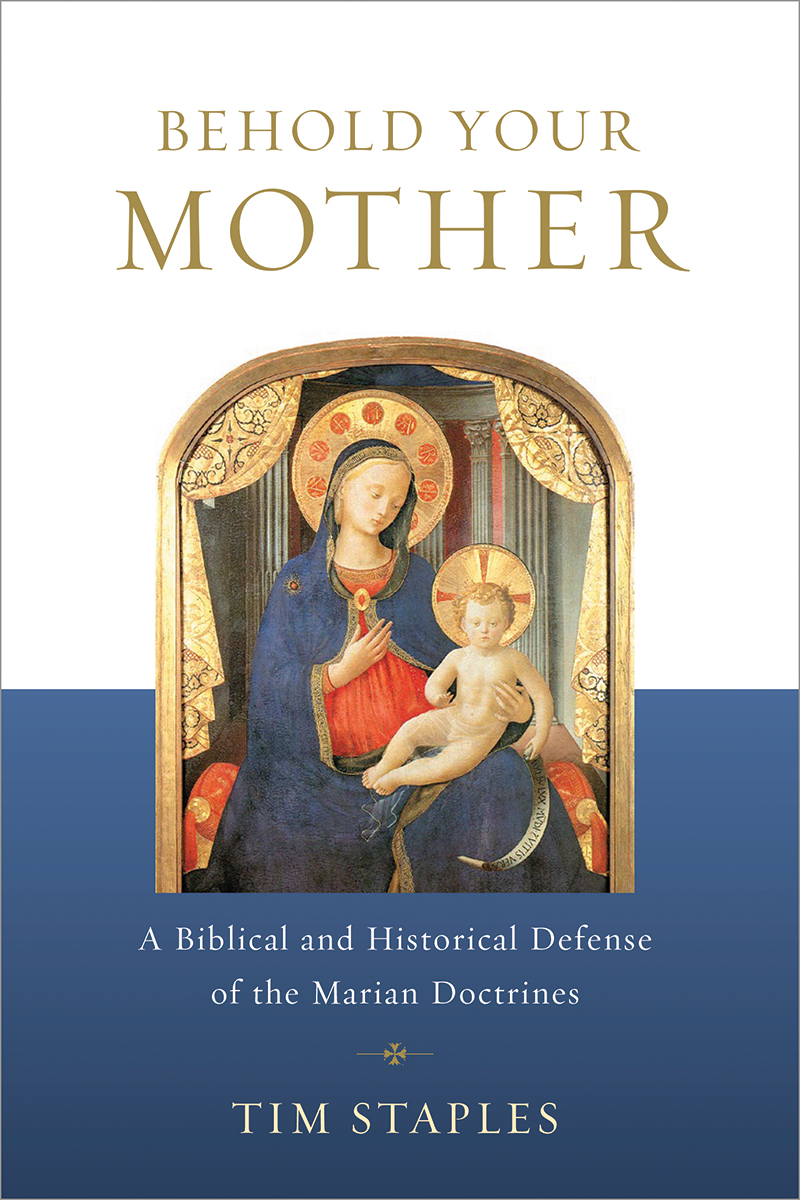
    Tim Staples is Director of Apologetics and Evangelization at Catholic Answers. He is also an author and speaker. Tim converted to Catholicism in 1988. I’ve gotten to know Tim through communication at TimStaples.com. We’ve had enough back and forth that good or bad ( GRIN ) Tim knows who David Williams is. This Part 1 and Part 2 of “Is There a Queen in the Kingdom of Heaven?” is being used by permission of Tim Staples. He is the one that provided the text to me. Tim Staples is one of several ( Scott Hahn, Stephen Ray, Jimmy Akin, Trent Horn, Deacon Harold, Father Mike Schmitz, Father Larry Richards, Father Mitch Pacwa, Dr. David Anders, Patrick Madrid, Marcus Grodi ( Through The Journey Home ), Karlo Broussard, John Martignoni and more ) that caught my attention through my study of Catholicism. However, Tim has been key to communication since early December 2017 before entering the Church at the March 31st, 2018 Easter Vigil. At the end of this article, you’ll see the cover and Tim’s book: Behold Your Mother: A Biblical and Historical Defense of the Marian Doctrines.” Be sure to listen to Tim on Catholic Answers Live and visit TimStaples.com.
    ____________________________________________________________________________________________________________________
    Article Length: Just over 3,000 words.

    Pope Pius XII effectively summarized the core reasons Christians ought to honor Mary with the title of Queen of Heaven and Earth:

    “According to ancient tradition and the sacred liturgy the main principle on which the royal dignity of Mary rests is without doubt her divine motherhood. In holy writ, concerning the son whom Mary will conceive, we read this sentence: ‘He shall be called the son of the most high, and the Lord God shall give unto him the throne of David his father, and he shall reign in the house of Jacob forever, and of his kingdom there will be no end,’ and in addition Mary is called ‘Mother of the Lord,’ from this it is easily concluded that she is a queen, since she bore a son who, at the very moment of his conception, because of the hypostatic union of the human nature with the Word, was also as man, king and lord of all things. So with complete justice St. John Damascene could write: ‘When she became mother of the creator, she truly became queen of every creature.’ Likewise, it can be said that the heavenly voice of the Archangel Gabriel was the first to proclaim Mary’s royal office” (Ad Caeli Reginam, 34).

    This is simple enough. But many Protestants I speak to won’t hear a word of this because they cannot get past one biblical text from the Old Testament that casts a shadow over this topic like none other. In Roman Catholics and Evangelicals—Agreements and Differences, Norman Geisler and Ralph MacKenzie present that text along with their commentary that represents the misguided faith of millions. And that text is Jeremiah 7:18:

    “Do you not see what they are doing in the streets of Judah and in the streets of Jerusalem? The children gather wood, the fathers kindle fire, and the women knead dough, to make cakes for the queen of heaven; and they pour out drink offerings to other gods, to provoke me to anger.”

    Geisler and MacKenzie comment:

    “To call Mary ‘Queen of Heaven,’ knowing that this very phrase comes from an old pagan idolatrous cult condemned in the Bible (cf. Jer. 7:18), only invites the charge of Mariolatry. And Mariolatry is idolatry” (p. 322).

    I can certainly sympathize with their thinking here. I once thought the same. But the truth is: this text has absolutely nothing to do with the Blessed Mother as Queen of Heaven for at least three reasons:

    Jeremiah here condemns the adoration of the Mesopotamian goddess Astarte (see Raymond Brown, S.S., Joseph Fitzmeyer, S.J., Roland E. Murphy, editors, The Jerome Biblical Commentary, Prentice-Hall, Inc., Englewood Cliffs, New Jersey, 1968, p. 310). She is in no way related to Mary. In fact, “she” did not and does not exist in reality. Mary, on the other hand, was a real historical person who was—and is—a queen by virtue of the fact that her son was—and is—”the King of kings and Lord of lords” (Rev. 19:16).

    Jeremiah condemned offering sacrifice to “the queen of heaven.” In Scripture, we have many examples of the proper way we should honor great members of the kingdom of God. We give “double honor” to “elders who rule well” in the Church (1 Tim. 5:17). St. Paul tells us we should “esteem very highly” those who are “over [us] in the Lord” (1 Thess. 5:12-13). We sing praises to great members of the family of God who have gone before us (Psalm 45:17). We bow down to them with reverence (1 Kings 2:19). We carry out the work of the Lord in their names (Matt. 10:40-42, DRV), and more. But there is one thing we ought never to do: offer sacrifice to them. Offering sacrifice is tantamount to the adoration that is due God alone. And this is precisely what Jeremiah was condemning. The Catholic Church does not teach—and has never taught—that we should adore Mary (see CCC 2110-2114; Lumen Gentium 66-67; CCC 971). Catholics offer sacrifice exclusively to God.

    To the Evangelical and Fundamentalist, the mere fact that worshiping someone called “the queen of heaven” is condemned in Jeremiah 7 eliminates the possibility of Mary being the true Queen of Heaven and Earth. This simply does not follow. The existence of a counterfeit queen does not mean there can’t be an authentic one. This reasoning followed to its logical end would lead to abandoning the entire Christian Faith! We could not have a Bible because Hinduism, Islam, and many other false religions have “holy books.” We could not call Jesus Son of God because Zeus and Hera had Apollo, Isis and Osiris had Horus, etc. The fact that there was a false “queen of heaven” worshiped in ancient Mesopotamia does not negate the reality of the true queen who is honored as such in the kingdom of God.

    Another text of Scripture that very plainly demonstrates Mary’s queenship is Revelation 12:

    “And a great sign appeared in heaven, a woman clothed with the sun, with the moon under her feet, and on her head a crown of twelve stars; she was with child… she brought forth a male child, one who is to rule all the nations with a rod of iron, but her child was caught up to God and to his throne… Then the dragon was angry with the woman, and went off to make war on the rest of her offspring, on those who keep the commandments of God and bear testimony to Jesus” (Rev. 12:1-2; 5; 17).

    Here Mary is clearly depicted as a cosmic queen giving birth to both Christ and all Christians, all the while wearing her royal crown. She rules and reigns with her divine son at the center of the perennial battle between the kingdom of God and the kingdoms of this world in union with “the serpent” of old. These texts alone demonstrate Mary to be queen of the kingdom of Christ.

    But here’s the problem. Although Pope Pius XII says “it is easily concluded that [Mary] is a queen,” it is not so easy for millions outside of the Catholic Church to conclude. For the skeptic, then, I am now going to show how a fuller understanding of Old Testament typology can be the key to illuminating the truth of Mary’s queenship.

    Hidden in the Old and Revealed in the New

    The “kingdom of David”—which Christ came to (in a sense) re-constitute, in accord with prophecy—is the most prominent type of “the kingdom of Christ” in the New Covenant, and it also reveals Mary’s role as queen of that New Covenant kingdom.

    “I will raise up your [King David’s] offspring after you, who shall come forth from your body, and I will establish his kingdom. He shall build a house for my name, and I will establish the throne of his kingdom forever. I will be his father, and he shall be my son” (II Samuel 7:12-14).

    For to us a child is born, to us a son is given; and the government will be upon his shoulder, and his name will be called “Wonderful Counselor, Mighty God, Everlasting Father, Prince of Peace. Of the increase of his government and of peace there will be no end, upon the throne of David, and over his kingdom, to establish it, and to uphold it with justice and with righteousness from this time forth and for evermore. The zeal of the Lord of hosts will do this (Isa. 9:6-7).

    From the very first verse of the New Testament through the book of Revelation, we find Jesus referred to as this prophetic “son of David,” or “the holy one, the true one, who has the key of David.” There can be no doubt that Christ is revealed as the king. But what is revealed to us about a queen?

    Scott Hahn provides the answer in the remarkable ancient office and Old Testament type of the gebirah (Heb.: great lady):

    In the ancient Near East, most nations were monarchies ruled by a king. In addition, most cultures practiced polygamy; so a given king often had several wives. This posed problems. First, whom should the people honor as queen? But more important, whose son should receive the right of succession to the throne? In most Near Eastern cultures, these twin problems were resolved by a single custom. The woman ordinarily honored as queen was not the wife of the king, but the mother of the king (Scott Hahn, Hail, Holy Queen).

    It can be difficult for us in the modern Western world to understand ancient monarchical concepts. But first-century Jews understood the notion of the kingdom that Jesus preached because they lived it. They knew that a kingdom meant that there was a king. And, in ancient Israel as in many nearby cultures, if there was a king there was a queen mother.

    2 Kings 11:1-4:

    “Now when Athaliah the mother of Ahaziah saw that her son was dead, she arose and destroyed all the royal family. But Jehosheba, the daughter of King Joram, sister of Ahaziah, took Joash the son of Ahaziah, and stole him away from among the king’s sons who were about to be slain, and she put him and his nurse in a bedchamber. Thus she hid him from Athaliah, so that he was not slain; and he remained with her six years, hid in the house of the Lord, while Athaliah reigned over the land.”

    Queen Athaliah ruled in Israel for six years after her son, King Ahaziah died. She was a wicked woman and so may not seem to be the greatest type of the Blessed Mother. But then there were many wicked kings in ancient Israel, too, who were nonetheless types of Christ. (Even the great King David himself is quite well-known for his moral failings.) Leaving aside Athaliah’s wickedness, we see in this text a scriptural example of the importance and the authority of the queen mother.

    2 Chronicles 15:16:

    “Even Maacah, his mother, King Asa removed from being queen mother because she had made an abominable image for Asherah. Asa cut down her image, crushed it, and burned it at the brook Kidron.”

    Queen Mother Maacah was not exactly a picture of holiness, either. But her office was a powerful one in ancient Israel. Maacha held royal authority and was only deposed from it because she made an idol.

    Jeremiah 13:18:

    “Say to the king and the queen mother: ‘Take a lowly seat, for your beautiful crown has come down from your head.’

    Both the king and the queen mother wore royal crowns, just as Mary is depicted wearing in Revelation 12:1.

    Perhaps the best example of the power and authority of the queen mother in the Old Testament is found personified in Bathsheba in 1 Kings.

    1 Kings 1:11-16, 22:

    “Then Nathan said to Bathsheba the mother of Solomon, ‘Have you not heard that Adonijah the son of Haggith has become king and David our lord does not know it? Now therefore come, let me give you counsel, that you may save your own life and the life of your son Solomon. Go in at once to King David, and say to him, “Did you not, my lord the king, swear to your maidservant, saying, ‘Solomon your son shall reign after me, and he shall sit upon my throne’? Why then is Adonijah king?” Then while you are still speaking with the king, I will come in after you and confirm your words. So Bathsheba went to the king in to his chamber (now the king was very old, and Abishag the Shunamite was ministering to the king). Bathsheba bowed and did obeisance to the king, and the king said, ‘What do you desire?’… While she was still speaking with the king, Nathan the prophet came in.”

    While King David was still alive, Bathsheba was merely one among many of his wives. As such, she had to bow before her husband the king when making a request of him. In this case, in order to ensure that her request would be granted by the king, she also needed the aid of Nathan the prophet. However, after David’s death, Bathsheba received a crown and a drastic change in authority. Bathsheba became the queen mother.

    1 Kings 2:13-23:

    “Then Adonijah the son of Haggith came to Bathsheba the mother of Solomon. And she said, ‘Do you come peaceably?’ He said, ‘Peaceably.’ Then he said, ‘I have something to say to you.’ She said, ‘Say on.’ He said, ‘You know that the kingdom was mine, and that all Israel fully expected me to reign; however the kingdom has turned about and become my brother’s, for it was his from the Lord. And now I have one request to make of you; do not refuse me.’ She said to him, ‘Say on.’ And he said, ‘Pray ask King Solomon—he will not refuse you—to give me Abishag the Shunammite as my wife.’ Bathsheba said, ‘Very well; I will speak for you to the king.’

    So Bathsheba went to King Solomon, to speak to him on behalf of Adonijah. And the king rose to meet her, and bowed down to her; then he sat on his throne and had a seat brought for the king’s mother; and she sat on his right. Then she said, ‘I have one small request to make of you; do not refuse me.’ And the king said to her, ‘Make your request, my mother; for I will not refuse you.’ She said, ‘Let Abishag the Shunammite be given to Adonijah your brother as his wife.’ King Solomon answered his mother, ‘And why do you ask Abishag the Shunammite for Adonijah? Ask for him the kingdom also; for he is my elder brother, and on his side are Abiathar the priest and Joab the son of Zeruiah.’ Then King Solomon swore by the Lord, saying, ‘God do so to me and more also if this word does not cost Adonijah his life!’

    What a change! Once, Bathsheba bowed to the king. Now the new king—Solomon—bowed to her. (At that time the king of Israel bowed to no one except God… and evidently the queen mother.) As wife of the king, Bathsheba had to beg her husband David for a favor with the assistance of Nathan. As queen mother, Bathsheba needed no assistance and would be refused nothing.

    The high degree of power and authority wielded by the queen mother in the kingdom of Israel gives us a context to appreciate in a deeper way the intercessory power of Mary as exemplified, for example, at the wedding feast of Cana in John 2. Are we saying that whatever Mary asks will be brought to pass by her divine son? Yes, we are! If it was so for the Old Covenant type, how could it be anything less for the New Covenant fulfillment? We should always keep in mind, however, that Mary will never ask her Son to do anything that is contrary to his will. Her perfectly obedient will is only to do his will.

    Queen and Mother Prophesied

    Psalm 45:1-9a prophesy in some detail about Christ the king:

    “My heart overflows with a goodly theme; I address my verses to the king… In your majesty ride forth victoriously for the cause of truth and to defend the right… Your divine throne endures forever and ever. Your royal scepter is a scepter of equity; you love righteousness and hate wickedness. Therefore God, your God, has anointed you with the oil of gladness above your fellows; your robes are all fragrant… From ivory palaces stringed instruments make you glad; daughters of kings are among your ladies of honor.”

    In the New Testament, the inspired author of Hebrews 1:8-9 quotes verses 6-7 of this very text as referring to Christ, his divinity, and his kingship. But immediately following those verses is another, lesser-known, prophecy that speaks of Mary:

    ” … at your right hand stands the queen in gold of Ophir. Hear, O daughter, consider, and incline your ear; forget your people and your father’s house; and the king will desire your beauty. Since he is your lord, bow to him; the people of Tyre will sue your favor with gifts, the richest of the people with all kinds of wealth. The daughter of the king is decked in her chamber with gold-woven robes; in many-colored robes she is led to the king, with her virgin companions, her escort, in her train. With joy and gladness they are led along as they enter the palace of the king. Instead of your fathers shall be your sons; you will make them princes in all the earth. I will cause your name to be celebrated in all generations; therefore the peoples will praise you forever and ever” (9b-17).

    Set in the context of a royal wedding, on the literal level this psalm referred to the king of Israel, likely Solomon, receiving a new bride, with his mother standing at his right to symbolize her power and authority. But on the spiritual level it refers to Christ and Mary. In “A Catholic Commentary on Sacred Scripture, published in 1953 by Thomas Nelson and Sons, T.E. Bird says of this text:

    “But although the poem may have been written in honor of a royal wedding (probably Solomon’s), the inspired writer’s thoughts reach beyond the actual event; he sees a king fairer than an ordinary man (3), one whom he addresses as ‘God’ (7,8), one whose throne is to remain forever (7), whose rule is to extend over the world… It is not surprising, therefore, that Jews and Christians have seen here the espousals between the Messiah and his people. The Targum treats the Psalm as strictly Messianic; St. John Chrysostom could say that on this point Jews and Christians were agreed (PG 55, 183); St. Thomas Aquinas gives the Catholic interpretation: ‘The subject-matter of this psalm is the espousals between Christ and the Church.’ On feasts of the Blessed Virgin, the Psalm is recited as Matins; (10-16) are applied to her as the Spouse of the Holy Ghost and the Queen of Heaven.”

    Who is this woman of whom the Lord said, “I will cause your name to be celebrated in all generations; therefore the peoples will praise you forever and ever”? Not one of Solomon’s wives fit the prophetic description.

    Most every Christian—indeed most of the world beyond Christendom—knows the name of the Mother of God—Mary—who in fulfillment of this prophetic text said, “All generations shall call me blessed” (Luke 1:48).

    Check out Tim’s book: “Behold Your Mother: A Biblical and Historical Defense of the Marian Doctrines”

  • Confession: And What Joy Feels My Soul, Just To Know, Just To Know

    I have some advice, in Christian love, before you read this: GET YOURSELF OUT OF THE WAY. There is always another side to what one believes. I’ve been on the Protestant side of Christianity ( until age 50ish ) and the Catholic side ( entering the Catholic Church at age 51 ). If you are not willing to get “SELF” out of YOUR way, bookmark this article, pray sincerely about it and come back to it later.

    As I continue to prepare to become Catholic ( Easter Vigil 2018 ) in less than 2 weeks and reflect on my first confession that was just over 48 hours ago,  I had an old hymn come to mind from the 1970’s which is where the words in the title come from.

    The hymn is “His Grace Is Sufficient.” The chorus goes like this “O, His grace is sufficient for me. And His love is abundant and free. And what joy fills my soul, Just to know, just to know, That His grace is sufficient for me.”

    I come from a Protestant tradition. I grew up Pentecostal and became Baptist as a married adult. Although confession of sins was always taught as being direct to God, it was not uncommon to seek the council of the pastor or pastoral staff when going through struggles ( sin included ) in life.

    I’m not going to get into all the history and theology of confession in this article. However, I have provided references ( Catholic.com ) at the end of this article for deeper insight for those who don’t understand why Catholicism and Protestantism are different when it comes to confession ( repentance ).

    As a Baptized Protestant Christian entering the Catholic Church, the sacrament of reconciliation ( confession ) is part of coming into full communion with the Catholic Church. I was never really adamantly opposed to confession to a priest from the start which I think came partly from multiple meetings with Protestant pastors over the years because I felt there were some similarities. I was also open to understanding confession from a Catholic perspective. Why did Catholics approach repentance different than Protestants?

    As I mentioned earlier, it’s not uncommon to meet with a Protestant pastor or a member of the pastoral staff, share some struggles ( sin, etc. ), the pastor offer advice, the pastor might ask have you asked God’s forgiveness, the pastor pray with you to close out the meeting and say as you leave “I’ll be praying for you.” It’s NOT the same as a Catholic Confession, but it’s a key reason that my initial acceptance of confession was fairly easy.

    Before I dive in, I know the classic Protestant objections to Catholic Confession: 1) I don’t need to confess my sins to a priest. 2) I can go straight to God with my sins. 3) Only God can forgive sins. I’m not getting into all that in this article.

    I initially had one key hang up about 14 months ago: As a Protestant, I prayed direct to God and asked His forgiveness for a sin ( or sins ) that I had committed. So I got stuck on the confession to a priest thing and what about praying to God? But, once a faithful Catholic man, who has become a great friend, told me about “An Act of Contrition” which is a prayer to God ( included further down in this article ) that is said in the confessional, I overcame the only known barrier ( at the time ) for me concerning confession. However, another objection raised it’s ugly head as I began to learn more about Catholicism. But it came from me letting “SELF” get in the way.

    The Catholic Church says that I have to confess “ALL” my sins ( mortal ) since my Baptism before entering the Church at the Easter Vigil. “What? You mean that I have to think back “ALL” those years and confess all my sins ( mortal ) to a priest that have occurred since my Baptism. You got to me kidding me. That’s crazy.” That was something along the lines of my thinking.

    I was letting “ME” get in the way. I was letting “SELF” run the show. FYI, until “YOU” get “YOU” out of the way, I guarantee “YOU” that “YOU” will NEVER, EVER, NEVER truly give it “ALL” to God. Remember, it’s easier to sing the song “I SURRENDER ALL,” than to actually live it out: “I surrender all, I surrender all, All to Thee my blessed Savior, I surrender all.”

    I have fought my “self-righteous, protestant believing self” many times in this Catholic Transformation: I this, I that, I don’t, I do, I, I, I. Guess what? I am actually more open minded to accepting things that are contrary to what “I” have believed much of my life than many others are.

    You see, as a Protestant, I knew God had forgiven me of the sins because I had already prayed asking for His forgiveness. Mentally, I knew it because I was faithful to God’s word as I knew it from a Protestant perspective. However, Spiritually, I didn’t feel God’s mercy ( grace ) in my life over many of the sins since my Baptism. Trust me, I understand it’s not all about feelings because there has been more than one time that I have felt like just giving up on becoming Catholic.

    As I continued my Catholic journey, I accepted what the Catholic Church taught about confession and decided to get “ME” out of the way. I knew that I had to go to Confession before entering the Church at the Easter Vigil. What I didn’t know is how much joy, peace, forgiveness, healing, grace and God’s mercy I would feel after confession. I went to confession out of obedience not because I “felt” like I really needed to go to confession ( Protestant mentality from childhood to 50+ ). I’m glad that “I DIED TO SELF” and accepted going confession out of obedience.

    If I’m going to be a cherry picking, cafeteria Catholic, I might as well remain Protestant. It’s all in for me. It’s truly let go and let God. I do “SURRENDER ALL.”

    Now I’ll transition into my preparation for and my experience of my first confession.

    To prepare for confession, one is to do an examination of conscience which is truly a blessing. This is a reflection of sin in ones life and for me, it was since my Baptism. That’s a lot of years and a lot of sin. But I was up for it. I have accepted what the Catholic Church teaches and I’m doing it out of obedience. I didn’t want “SELF” getting in my way. For me, I didn’t want to miss anything, so I did make a list ( not required ) of the BIG things that I didn’t want to forget: “There was NO HOLDING BACK. If I’m going to do this, it’s all or nothing.” FYI, you are not supposed to intentionally skip confessing a sin that you are aware of. In other words, I know that “I’m a habitual liar ( not really ),” but I decide that I’m not confessing this one sin.

    I also decided to do a HOLY HOUR. For those who don’t know what that is, the simplified version is an hour of prayer and meditation in an adoration Chapel. I did this on the morning of my confession and started the Holy Hour about 3 hours before confession. FYI, this was not my first Holy Hour.

    As I entered the confessional, I sat and talked with Father Edward. Again, it kind of reminds me of talking with a pastor in my Protestant days, but this became FAR MORE POWERFUL by the time the confession ended.

    We began with doing the sign of the cross together. Although it’s not necessary to have a list, I literally began to read off my sins. Father Edward added advice throughout. We had a conversation.

    OK, I read my SIN list. Nothing powerful had happened. Nothing life changing had hit me. I was wrapping up my first ever confession with no emotion: YET!

    As I began to close, I like the recommendation of saying something like this “forgive me of these sins and any that I may not be aware of or may have forgotten.” I wasn’t holding ANY known sin back. I wanted a clear conscience and a clean slate.

    Father Edward asked me “Is there anyone that you are NOT willing to forgive?” I said NO.

    From this point on, it went something like this.

    Father Edward has a beautiful crucifix that I’ve seen him hold in his Homilies. It was likely the one that he was holding around 14 months before when I heard his first homily on January 2017. He handed me his crucifix and said “make and act of contrition.”

    I held the crucifix in my left hand and the act of contrition words in my right hand. This is the act of contrition that I read.

    “My God, I am sorry for my sins with all my heart. In choosing to do wrong and failing to do good, I have sinned against you whom I should love above all things. I firmly intend, with your help, to do penance, to sin no more, and to avoid whatever leads me to sin. Our Savior Jesus Christ suffered and died for us. In his name, my God, have mercy.

    As I began to read the words in bold above and looking at MY SAVIOR ON THE CROSS, the one who died for my sins, the one who shed His blood on calvary that I might call upon His name for eternal life tears began to come into my eyes ( and they are in my eyes as I type this now ), I felt the presence of God as much as I ever have in my life. Remember, I come from a speaking in tongues Pentecostal background ( later Baptist ). However, that was ONLY THE BEGINNING.

    Father Edward prayed the prayer of absolution and I’m guessing it’s the one that I found online because there was such a moving of God in my life while all this was happening that I don’t remember all the words.

    “God the Father of mercies, through the death and resurrection of your son, you have reconciled the world to yourself and sent the Holy Spirit among us for the forgiveness of sins. Through the ministry of the Church, may God grant you pardon and peace. And I absolve you of your sins, in the name of the Father, and of the Son and of the Holy Spirit. Amen.”

    As Father Edward was saying the words above, the presence of God hit me even stronger and the tears came down my cheeks. Father Edward had told me 3 things earlier that happen in confession: Forgiveness, Healing, Grace ( or God’s Mercy ). I felt forgiveness. I felt healing. I felt God’s Mercy. I felt God’s Amazing Grace. I felt God’s Sweet Presence.

    “O, His grace is sufficient for me. And His love is abundant and free. And what joy fills my soul, Just to know, just to know, That His grace is sufficient for me.”

    Father Edward gave me some final words of comfort and a simple penance to help me get my eyes back on the Cross at Calvary. For me, the closing words of comfort and penance can be similar to a closing meeting in a Protestant pastors office when the pastor offers some closing words of comfort and maybe recommend that one go home, read the 23rd Psalms ( hypothetical example ) and continue to pray for God’s mercy. The difference in my experience of confession is FAR GREATER than a meeting in a pastors office. I met JESUS AT THE FOOT OF THE CROSS IN CONFESSION. He filled me with His love, His forgiveness, His healing, His grace, His mercy.

    I DO NOT RECALL another time in my life of God’s presence being so strong when I confessed my sins as in His presence in the confessional. I now better understand “In Persona Christi” which is a Latin phrase meaning “In The Person Of Christ”,

    This Bible Camp song from the 1970’s comes to mind as I close this out. I’m willing to get “SELF” out of the way.

    I have decided to follow Jesus;
    I have decided to follow Jesus;
    I have decided to follow Jesus;
    No turning back, no turning back.

    The world behind me, the cross before me;
    The world behind me, the cross before me;
    The world behind me, the cross before me;
    No turning back, no turning back.

    Though none go with me, still I will follow;
    Though none go with me, still I will follow;
    Though none go with me, still I will follow;
    No turning back, no turning back.

    My cross I’ll carry, till I see Jesus;
    My cross I’ll carry, till I see Jesus;
    My cross I’ll carry, till I see Jesus;
    No turning back, no turning back.

    Will you decide now to follow Jesus?
    Will you decide now to follow Jesus?
    Will you decide now to follow Jesus?
    No turning back, no turning back.

    If you are a Catholic, GO TO CONFESSION. If you are a fallen away Catholic, come home and GO TO CONFESSION. If confession is a barrier for you ( Catholic or not ), please pray, get “SELF” out of the way and be obedient. If you are a Protestant reading this who has an issue with confessing to a priest, you are getting “YOU” in the way: Sorry, but I’ve now experienced both sides. If you are not a Christian, contact your local Catholic Parish to begin your journey. Also, don’t hesitate to contact us here at Catholic Transformation.

    Resources to look up on Catholic Answers ( Catholic.com )

    Confession

    Is Confession in Scripture?

    How to Defend the Sacrament of Confession

    Note: I didn’t get into mortal and venial sin in this article. I recommend the articles above to learn more about confession.

  • Guest Article ( A Must Read ): A Journey To The Catholic Church

    This is a guest article from a lady that Brenda and I know from RCIA. Each person has their own story and I’m thankful that she was willing to share hers here with us on Catholic Transformation.

    __________________________________________________________________________________________________________________
    Almost 7,000 Words – Well worth reading.

    This Lent, as I prepare for baptism and entry into the Catholic Church, I have looked back upon my journey and wondered with amazement: How did I come to be here? How did someone like me from a Hindu background arrive at this point of becoming Catholic? Today this sense of awe struck me afresh during one of the rites at our cathedral, when I stood among the other elect at the front of the church to receive the blessing of the priest. I gazed upon Christ on the cross before me and my soul was moved. I spoke in my heart, “How is it that You will receive me, after all the years I never knew You? Will I really become one of Yours?” And quietly but clearly, I heard a whisper-like reply: I have been with you from the beginning.

    So it is for each of us. These journeys which each of us are taking are not the work of our own hands, but reflect the artistry of God, ever at work in our lives. As I reflect upon my own journey, I marvel that God has drawn me thus far into the faith, out of a background so seemingly disparate with Christianity.

    I was raised in a nominally Hindu family. Perhaps it is more accurate to describe my Hindu upbringing as a cultural one, rather than a religious one, for we never spoke of God at home. Being Hindu was just what we were and had nothing to do with what anyone really believed; after all, my father called himself Hindu by birth, atheist by belief. Once or twice a year we would take a three-hour drive to the nearest temple in Chicago, and I remember the loathing I felt for those trips. I would follow my parents into the temple with dread and discontent, waiting each time for the ordeal to be done with. I always felt a deep aversion to the idols of the gods set there in the temple. I found myself incredulous at the devotions of everyone else there. I saw people prostrating themselves before the idols, and two thoughts came strongly to mind: one, that is not God; and two, why do I feel nothing, compared to everyone else here? I wanted to feel something. Even at that age, I felt a desire for God which I could not express.

    That wordless hunger to know God is wired into each of our hearts. How, then, does that seed blossom into faith? My path has been complex, yet as I peruse the design, I see that God has woven two main threads in my life to bring me here: beauty and suffering. The experience of beauty opened my mind to the faith; suffering opened my heart.
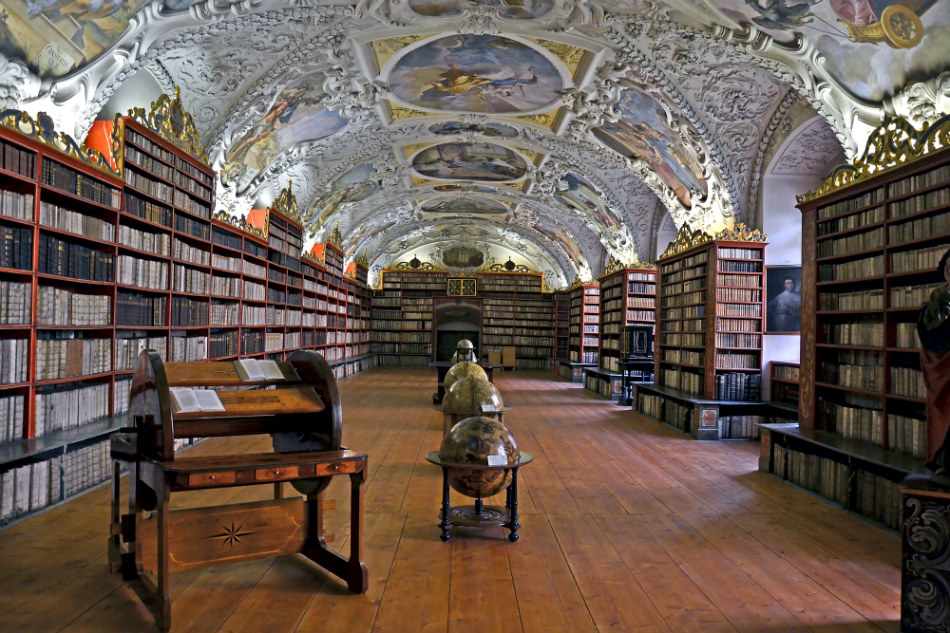

    Beauty
    Though I had no place of true religious worship while growing up, I knew one place which became for me my temple, my church, and my sanctuary: the public library. It was through the abundance of the library, inexhaustible in its treasure of the written word, where I came to know the large ideas of life which my heart was searching for. It was not yet God; but it was the hint of God, through the transcendental values of life which coalesced in my mind as one principle, Beauty.

    In high school, prompted by a friend’s recommendation, I began to read the classics. I took up a novel called Tess of the D’Urbervilles, which, though it was not religious in any sense, nonetheless opened to view a whole vista of ideas and truths I had never encountered before. It was unlike any other book I had ever read, for it transcended plot in order to reveal universal questions and ideas about life; and these questions struck a powerful chord in me. I was hungry for more. Over the next ten years I made it my mission to read as many classics as possible; and so I read with zeal, exploring many of the gems of Western literature, and in the process, discovering more and more of my desire for truth, goodness, and beauty.

    I do not know if I was more attuned to these ideas than anyone else; I believe everyone has a built-in capacity to appreciate beauty, and to discern the forms of truth. Nonetheless I often felt like a solo wanderer. While everyone around me in high school was looking forward to college, I felt profoundly aware of the passing of time, and I spent my last summer of high school wrestling with this reality of the transience of life. How could no one else see it? I wondered. Life was passing, passing even as we spoke; somehow I had to figure out the meaning of it all.

    Inevitably, my travels through literature brought me into increasing acquaintance with Christian ideas. Acquaintance became interest, which led to understanding, and finally an attraction and desire I had to hide even from myself. I clothed that desire with the name of intellectual interest, and under that name, I allowed myself free rein into the world of Christian ideas and art.

    Dostoevsky was a revelation. In his novels I discovered living breathing souls who were grappling with the existence of God and the nature of free will. I had never known people who seemed so startlingly real, so full of the contradictions of the human heart. Strangely, at that age, I was not bewildered or confused by those contradictions, but filled with respect for Dosteovsky’s insight into the psyche, into the heart.

    In college I took up Dante’s Divine Comedy. I started with the Inferno, and though I read it with a certain detachment at the outset, as I accompanied Dante on his journey into Hell, his world became more and more real to me. By the end I felt so subsumed by the darkness of the Inferno, with its vivid exploration of human sin, that I found myself thirsting for escape into Purgatory. The day I finished reading Inferno, I ran all the way to my campus library, up three flights of stairs, to the shelf where I found Purgatario. And when I sat down to open up the book, I expressed thanks silently, then looked up and at that very moment saw a bird flying along the ceiling of the library. I have never forgotten that moment, which seemed like a touch of God’s grace into my life.

    So profound is my love for the library, that I believe anyone left long enough in the library is bound to become Catholic. It is only a matter of time.
    At length, I found my way to the New Testament. I would not have taken it up as a religious work, since my mission was still purely literary and aesthetic. I was a follower of beauty and of truth, not of religion. Yet while wandering the shelves one day at my library, I discovered a prose translation of The New Testament by a well-known translator of Greek, Richmond Lattimore. He had written beautiful translations of Homer’s Odyssey and Iliad, so I had great respect for him. Well, I asked myself, why not? With both curiosity and uncertainty, I took the book home and made it my companion over the next couple months.

    The story of Christ had long fascinated me from afar. Yet I had never encountered him up close. Till then I had known only the mainstream, hand-me-down picture of Jesus as a teacher of peace, and little else. Even then, I had felt that picture to be strangely dissonant with the image of the cross. How could the nice, simple Jesus I saw depicted around me be the same as one who died that horrific death on the cross? Were they the same? So, at last, I started to read the Gospels for myself.

    Here, I discovered Christ to be startlingly different than the one I’d imagined up till then. Put simply, this Christ was compelling, real, and historical. There was a piercing truth in his words; and his words conveyed a presence, an authority, more powerful than anything I’d known before. Was this truly the Son of God? a small voice in me wondered. Was this the one who had risen from death, as he had said he would? I could not yet let myself answer these questions with certainty, yet I knew I was in the midst of something—rather, Someone—powerful enough to change the world. Rather than offering mere teachings, Jesus offers himself, his very person, in the Gospels, testifying again and again to his sonship with God the Father. What other religion, what other philosophy dared give something so radical? So almost unimaginable?

    More and more as I delved into the Gospels, I realized I was discovering a presence, a person, which felt eternal and historical at the same time. One verse seared my heart to the point of making me teeter upon faith: I am the truth, the way, and the life. Who could fail to be transfixed by those words?

    When I finished reading the New Testament, the landscape of my thoughts was irreversibly changed. I had glimpsed a reality and a person beyond nature, beyond time. I could not yet utter the words of belief, yet I sensed them on the cusp of expression, waiting to be spoken. At the very least, I said to myself, This is the faith I want to believe in. I acknowledged that desire, held it to view, then wrapped it up like a treasure box in the innermost room of my heart.

    The search for beauty had led me this far, to the precipice of faith. I could not make it my own, however; as someone from the outside, I could not yet surrender myself to belief. So it was that I locked up that secret room, hoping no one would ever find it, and I returned to the outside world and continued on with my life, believing I would never need to open it up to view. I would only come back many years later, when the darkness around me forced me to call upon the light of faith.

    Suffering
    After finishing medical school, I began to focus my energy on searching for a life partner. I found someone who seemed to have the same simple, thoughtful sensibility as I did, and I felt an immediate connection with him. After a few years of courtship, we married; and I began what I thought was the deep and beautiful adventure of married life.

    It certainly seemed that way in the beginning. I was convinced we were the example of a truly happy marriage, the kind of marriage other people longed to have.

    After the birth of our first son, however, the dream evaporated. My husband’s mask fell off, and what I saw was a person utterly unlike the husband I knew: cold, callous, terrifying, completely void of feeling or remorse. For the next year and a half, I lived through nightmarish abuse on an almost daily basis. It seemed too bizarre to be real, yet it was. I could make no sense of it. Why would someone who loved me turn into such a monster? Rather than facing the uncomfortable truth, I tried to bend the truth to my wishes. Surely he didn’t know what he was doing; surely he couldn’t see that he was hurting me. For I didn’t know the alternative. I could not reconcile myself to the possibility that my real husband was indeed the abuser, and that the one I had fallen in love with was the mask.

    That year and a half was the darkest time of my life. I had never known I could experience such intense pain day after day, month after month, without reprieve; I had not known such desolation in my soul before, such intense loneliness. There was no witness to this nightmare. There was only me and him, and he could continue to hurt without restraint; indeed, when I asked him, he replied that he wanted to hurt me, and didn’t want to stop. Each day when I would try to pick myself back up and rebuild a semblance of peace, he would dash it back down with a burst of anger or contempt.

    I remember many times stepping outside and sobbing quietly on the front porch, since I was not allowed to cry in front of him. And on Sunday mornings, in the midst of my tears, I would see our neighbors across the street heading out to church. They were an elderly couple we had befriended when we moved there. Each Sunday I watched the wife take time to wheel her husband out to the car, helping him out of his wheelchair into the car, then folding up the chair into the trunk. They did this every Sunday without fail; and through my tears I marveled at their quiet, steady faith, and I longed for the nourishment they must be receiving at church. I felt like a prisoner looking out through the bars of my window to the sunlit world outside. How nice it would be to have faith like theirs, I thought to myself wistfully.

    When we moved to Virginia and when I started working, the abuse started to subside. I tried to push it under the rug, since we could never seem to agree on what had actually happened. I simply said that we would resolve it all another time, when we were more stable as a couple; and so for awhile, we reached a level of seeming peace at home. Of course, even then I didn’t realize I was still working hard to avoid any anger from him and making sure never to show any sadness or frustration to him, for fear of the consequences.

    We had a second son, and life continued in this state of apparent equilibrium. Yet soon the abuse re-emerged in full force. My husband’s anger and contempt once again became the climate of our home. Every discussion with him became a distorted reality, an attempt to speak with someone who insisted upon blatant untruths. I struggled to figure out how I could communicate with someone who operated in a reality of his own making, in which the sky was red, and two plus two was five. And again, such was my devotion to our marriage that rather than firmly defending the truth, or challenging his lies, I tried to wrap my head around the possibility that his distorted reality might somehow coexist with the reality I knew to be true. I did not know that such existential gymnastics are not part of a normal relationship.

    Soon, though, even my mind was stretched beyond capacity, and I could no longer stomach the flagrant unreality. One day, for example, my husband mouthed curse words at me, and when I asked him if he had said what I thought he said, he denied it outright, almost smiling as he lied to me. It was at such times I glimpsed with horror the world of lies my husband was living in. Where was the truth? Did truth even mean anything anymore? I felt as if reality were slipping away.

    One exchange stayed in my mind, making me wonder seriously about truth. My husband had spent a whole discussion trying to convince me to repeat back to him that I spoke things which were false—essentially asking me to state that I tell lies; and I struggled and struggled but told him I just couldn’t say something like that. My refusal left him angry and silent, while I felt completely bewildered. I called up a friend of ours, sharing the exchange, and her reply struck a discordant note I could not shake off. She said simply, “It is all perception. He has his perception, you have your perception.”

    As I mulled over her words, I became indignant. No, it had to stop here. What he was doing was utterly and absolutely wrong, and it could not be washed away with the excuse of “perception.” When had the concept of right and wrong dissolved away into the meaningless haze of mere “perception”? To ignore this kind of evil by calling it merely “perception” was like ignoring a cancer in one’s body.

    Thus I began to experience a pull back toward the primacy of truth, away from the lies I had been living with while at the mercy of my husband. Truth began to whisper in my heart. I began to realize I could no longer negotiate between the world of his lies, and the real world of truth which was out there and in my heart. I had to choose, for it was now impossible to keep one foot in both.

    Finally, one night, after being on the receiving end of another barrage of abuse, I went to my room and knelt on the floor by my bed, overtaken with tears. I sobbed for a long time that night, mourning the sheer wreckage of my marriage, feeling utterly desolate and utterly alone. I thought of all the countless nights in the past few years I had cried myself to sleep, wondering when the abuse would end, and here I still was, still bearing the lashes of his anger. And the worst part of it was, only I knew of the abuse. It was only between me and him. There was no one else to see it or stop it. I was completely alone, without anyone to help.

    Then, all of a sudden, there came to me a flash of truth which was like a voice in the night: I am not alone. God is with me. In that moment, for the first time in my life, I sensed a presence other than myself in my solitude. I felt the presence of a Person, an Other far greater than myself and yet closer to me than I was to my own thoughts.

    In that moment, the darkness lifted. I realized, almost with a start through my soul, that I was not alone. I never had been alone. God is here with you…God is with you, a voice echoed in my heart. The knowledge of that mysterious and intimate “with-ness”—that divine Person who had never left me, and never would leave me—was like water to my thirsty soul. None of my suffering had been alone; not one tear had escaped unnoticed, but in fact all of those tears, from all those lonely nights, had been caught lovingly in the hand of God. God had been present with me on each and every one of those dark nights.

    As this settled upon me, another refrain proclaimed itself in my mind: God knows the truth of what happened. God knew it even more deeply than I did. The realization was liberating. Up till then I had felt resigned to the fact that there was no actual truth of what had happened between my husband and me. After all, no one else had witnessed the abuse. Yet now I could trust once again in the truth, for God knew. I was no longer a slave to my husband’s lies and his distorted reality. I was free to call upon truth through God.

    That night was the decisive moment of my journey into faith. God’s presence had broken in upon the darkness of abuse, and I, like a prisoner who sees a light from afar, knew that my only way out of the prison rested entirely in following that light. For the past few years I had struggled to find someone, anyone who could help me out of the darkness. I had reached out to my husband’s parents, his brother, his friends, hoping that someone might offer a helping hand, or at least a word of sympathy; yet I had found none. I had felt like someone trapped in a burning building, calling for help, yet receiving only the indifferent stares of people who passed by. None had cared.

    Yet now, at last, I was rescued from the burning building. Was this, then, what people meant when they spoke of being saved by God? I did not know for sure, but I was certain that God’s presence that night had shown me the way out of my prison, when all hope and all truth had seemed lost. So it was that I began to take my first steps toward faith.
    Beginning the Journey
    It was on Christmas Eve that I first ventured to step inside a church. That morning I had had a massage, prompted by my mother’s urging; and during the session, the masseuse spoke to me of her Christian faith, slowly at first, then as I shared my wonderings, she suddenly just offered, “Go tomorrow.” The offer was like opening a door before me, and I paused in disbelief, amazed that it could be so simple. Could I really just step inside a church, just like that? Yes, I could, she replied. I mulled over this. Wouldn’t they see I didn’t belong? I asked. She urged me again that all I needed to do was go inside, that I would be welcome in any church.

    That evening itself, armed with the keys of her invitation, I drove to a nearby church and walked inside. At that point I didn’t even think of choosing any denomination or type of church; I simply found one near my parents’ home and walked inside. It happened to a be a non-denominational church called The Vineyard. When I stepped inside I saw each person held a candle, and as each person lit his neighbor’s candle, the room became aglow with warmth and light. I was touched by the fellowship I saw here, so different than the cold indifference I had endured these past few years; how I had longed for that warmth of spirit! One other point captured my attention: the pastor’s wife spoke to the congregation and mentioned her love of Shakespeare. When I heard the name of Shakespeare I was won over. I thought to myself, Surely God is speaking to me now. If these people knew Shakespeare, and if love of Shakespeare could coexist with faith, then I was in.

    That church did not become my church, but it was the doorway in my search for a true and living faith. I knew I wanted to be Christian; but what exactly did that mean? In the back of my mind, locked away in the secret room of my heart, I remembered I had once loved all the art and literature of the Catholic tradition. I remembered that I had used to feel very Catholic in my sensibility, understanding the sacramental quality of life. Yet I did not let such thoughts come to the surface. I tried a couple other churches at first, believing I ought to be fair in my selection, rather than following the deep intuition of my heart. In a way, because I had so long known and admired the Catholic faith from afar, I regarded it as something too good, too beautiful for me.

    Yet those churches failed to satisfy the longing of my heart. Where was the sense of reverence and mystery? Where was the power of beauty? Where was that glimpse of the transcendent, drawing one into the presence of God? I discerned none of it there.

    At length, I gave in to the quiet desire of my heart. I remembered St. Michael’s in Cary: in months past when driving out of Bond Park, I had seen the church standing there like a great punctuation mark touching the sky; and I had felt wistful even then, loving the sight of that beautiful building. Finally, one Friday after work, I decided to go there. I didn’t even know if it would be open, or what I would do when I got there; but I sensed that I should just go and see for myself.

    When I arrived, I found the door was locked; I peered through the window for a moment, then, finding no one, walked away, feeling disappointed. Yet then I heard a voice calling behind me, and the door was opened. Apparently there had been some workers inside, one of whom had seen me at the door. I offered my thanks and walked inside.

    When I stepped inside, I almost had to catch my breath: I had not expected such beauty, such hospitable beauty, in this house of God. I knew immediately that I had found my spiritual home. It was as if the deep chord my heart had been longing for finally found completion here. I will not belabor the details here, for every Catholic church is sprung from beauty, and offers that beauty to all who come. Yet I found special and significant touches of beauty at each turn in St. Michael’s that effectively convinced me this was, beyond doubt, my destination.

    There were many beautiful pieces of art in the gathering space; the one which spoke most powerfully to me was a tapestry of The Holy Trinity, by the Russian iconographer Andrei Rublev. Why did it win me over? This was more than mere beauty; this was God announcing His presence to me. I had watched a movie on Andrei Rublev many years ago in high school, long before I knew anything about God. I had picked it out by chance, and had found it a strange, even bizarre movie, yet what had stuck in my mind was the last scene showing long, sustained still shots of Rublev’s paintings, featuring this very icon of the Holy Trinity.

    I realized then, as I have realized countless times since, the fact that God wastes nothing. Every piece of our life finds echoes and connections with other pieces, all weaving together to draw us ever closer to God.


    God is a master artist. Once we begin the journey of faith, we can look back upon our life and find dozens upon dozens of various moments which at the time may have seemed insignificant, yet which suddenly reveal their meaning in the light of burgeoning faith. I certainly have. One of the gifts of this exercise is that we begin to hear God speak to us, as we discern His providence, His craftsmanship, in the various moments of our life. I now understand, for example, that all the moments of my youth in which I had an intense, memorable experience of beauty, were actually intimations of God.

    It is astonishing to realize now that God has been seeking me all this time, long before I even cared to know Him. He has spoken countless times to me through the vehicle of beauty. I remember, for example, that when I was living in Virginia I would often have an hour or two to myself on Saturday mornings, while the boys would be outside with my husband. For that time I would sit by myself in the living room, drinking my tea, savoring the quiet; and slowly the room would be filled with intense mid-day sunlight, almost overpoweringly so, till the whole room became like a vessel of light. I was moved deeply by those moments, sensing—and knowing—that something much greater than mere sunlight was at work. I did not yet know that God was sharing His presence with me through that beauty.

    Sometimes God can speak very clearly. One such experience last year proved to me that when we ask for guidance, especially when we are most earnest, God always answers. Last summer, months after separating from my husband, I went to attend the wedding of one of my cousins. It ended up being an emotionally grueling experience. That night during the wedding reception activities, I found myself at a very low point. All day I had been faced with reminders of my own wedding years ago. The absence of my husband felt more painful than ever, in the midst of this wedding event. On top of that, I had to endure the indifference of my cousin, judgmental remarks from another, and the unruly behavior of my two little boys. Finally, feeling almost ready to burst with grief, I walked outside in search of escape.

    The night was strangely peaceful outside. I walked and walked through the parking lot, not knowing where I was headed. At length I reached the edge of the lot; I leaned against the gate and bowed my head low for quite some time, just reaching out in fervent prayer to God for some comfort, some strength. After a moment, I looked up. I saw directly in front of me two street signs next to each other, one saying, “One way,” pointing to the right, and the other, “Do not enter.” Slightly up along the road was another sign, saying, “No U-Turn.” The message was too obvious to ignore, and it spoke clearly in my heart. What did “One Way” mean except the Way? And the Way, of course, was Christ. The arrow on the sign pointed to a bridge leading across the river, and here too the meaning was clear: Christ was the Way, the bridge and the path to a new life.

    I knew, also, what God meant by “Do not enter,” and ‘No U-Turn.” I was not to enter into the temptation of going back to my husband; I could not turn back. There was only one way, the Way, to take, which meant following Christ. It was almost with a sigh in my heart that I received the message. God knew the struggle in my heart and had marked out my path clearly. The way forward meant turning away from darkness; and that meant rejecting all temptations of evil, even to the point of sacrificing my attachment to my husband. Yet heavy as the message was, I could not help being struck with awe by God’s clarity. I had asked, and He had answered. In that answer was the grace of His love.
    Why Catholic?
    Choosing the Catholic Church, versus the myriads of other Christian denominations, was never a real question for me. In fact the question was rather, Why not the Catholic faith? Why not choose the original church planted by Christ’s apostles, sustained throughout the centuries, versus choosing a particular offshoot?

    In truth, my mind had been Catholic for a long time already, through my love of the arts, of philosophy and knowledge. For years I had explored and savored the Catholic tradition; I had come right up to the cathedral, in a sense, appreciating its beauty, yet not letting myself open the door. When I was finally ready to offer up my will to Christ, to become a follower of Christ, it was only natural that I enter the Catholic faith which I had long loved from a distance. Through that supreme artistry of God, head and heart were reconciled in perfect harmony, like a lost key fitting at last into its lock. By choosing to become Catholic, I was becoming more fully the person I was always meant to be.

    The Catholic faith is nothing less than an abundant treasure-house, into which we are each invited. To me it is the ultimate library, and indeed invokes the very spirit of the library. As a child—and even now as an adult—I have felt unspeakable joy simply in entering the library and knowing I could partake of any book I wished. All the knowledge and creativity of human history was there for me to peruse, to sit with, to take home and absorb deeply into myself. What had I done to deserve such a gift? I wondered at times. How much greater, then, is the joy of entering the Catholic faith, which is the house of God’s love for each of us. Here we may bring all our intellect, our imagination, our love of science and truth, our love of literature and beauty, and all finds its consummation in the great ark of the Catholic Church.

    Because Catholicism traces back to a robust intellectual tradition, it vigorously invites reason and discussion, rather than discouraging it. I was delighted to discover, for example, that my love of space and astronomy was entirely consonant with the Catholic faith. I didn’t have to leave behind the theory of the Big Bang or scientific evidence for the vastness of an expanding universe; all of it cohered within the Catholic understanding of God.

    To be Catholic, in fact, is to be raised up through reason, through intellect, to the realm of faith. All that is best in our human nature—both individually and generally, across all of civilization—finds its fullest expression once we accept God’s grace. As St. Irenaeus tells us, “The glory of God is a man fully alive.”

    Deciding to become Christian was a radical choice for me. It seemed like leaving behind the culture and background I had come from, leaving behind the ties of my family in a sense, in order to unite myself to a new family—the body of Christ, through His Church. Yet I found great solace in knowing I had chosen to become Catholic: for the very word Catholic means “universal.” Therefore I was not losing anything by becoming Catholic; rather, I was joining something as universal and all-encompassing as the sky and stars above. This is of vital importance for anyone coming into the faith from a non-Christian background. Because Catholicism has roots throughout the world in hundreds of different countries, it embraces everyone. One need not abandon one’s ethnicity or culture, in order to become Catholic; and I find this abundant hospitality to be one of the most beautiful parts of the Church. Like a ray of light which encompasses countless different shades of color, so too the Church reaches out to all cultures, to all times, and to every human heart.
    Final Thoughts
    As one who enters the Church from outside the fold, so to speak, I cannot help rejoicing in the sheer gift of this Catholic faith. It seems at times like an uncontainable joy, ready to burst. Over the past year of my journey I have discovered, almost to my surprise, that all the truths of life find their full expression in the framework of the Catholic faith.

    What defines the human person? Quite simply, it is our relationship to God. We exist purely because God has loved us into being. Our journey into or out of that relationship is the defining nature of our existence.

    Here I say to all of you, as one who used to live outside the fold: What a gift we have been given! No other faith offers this treasure of relationship. Other religions like Hinduism offer a God that is impersonal, diffused throughout every creature and object of the universe, rather than a Person we may engage with, converse with, and ultimately, love with our whole mind and heart. Or there is Eastern philosophy, which casts off God altogether and encourages a total emptying of the mind in order to attain peace.

    Yet somehow these ideas never satisfied me. The soul longs to relate to a reality outside of itself; in a sense, to eat the bread of real truth, rather than ruminate on its own self-referential thoughts. Quite simply, the soul hungers to know God, in Whom is all truth, all goodness, and all beauty. We do not wish simply to know of God, but to know Him deeply, intimately, and honestly, as we would know a beloved. To enter into right relationship with God naturally aligns our heart with all that is good, all that is true, indeed with the very life of God which is love. One might say that the real value of a person emerges only to the extent that he relates fully to God. And this is the extraordinary gift which Christ has won for us through his death on the cross: a reconciliation between man and God. In accepting the enormous gift of Christ’s sacrifice, we are restored back to friendship with God, in a way we could never have achieved on our own. The Christian life could be expressed simply as our continual free response to God’s continual grace, and the love which flows from that relationship.

    In the past year, as I have immersed myself in the Christian faith, I have been able to forgive my husband fully for what he has done, and in fact to love him with compassion. Yet at the same time, I often found myself wondering: If I forgive him, can I not simply allow him back in my life? If I love and forgive him, why do I close the door on him?

    Here, I recall the tale of the prodigal son. In that story, Christ tells us of how the younger son willfully abandoned his father, wasted away his inheritance, and gave himself over to a sinful life. Yet everything changes once he decides to turn home. That act of repentance is the key, for once he turns back home in humility, his father receives him with joy. Indeed, the father has been waiting all along. He could not seek out the son himself, because the relationship would not have been restored without his son’s free choice. The father was waiting with abundant mercy, yet he could not offer it until his son had repented of his sins and decided, out of love for the father, to turn home.

    In this light I understood that forgiving my husband for what he had done was not enough to reconcile the relationship. True reconciliation demands the repentance of the one who has turned away from the relationship to begin with; there must be that turn back home, however seemingly small that step may be, for without it, the gift of mercy cannot be given. Put simply, a gift cannot be given if one is not there to receive it.

    This also sheds light on the meaning of the cross. I often found myself wondering why Christ had to suffer so terribly, in order to effect reconciliation between mankind and God. Could not have God easily erased the debt of original sin, and restored mankind in an instant to its original state of harmony with God? Indeed, God could have done so quite easily, yet it would not have truly restored the essential relationship, once broken by original sin. Man’s heart had to be made completely new, in order to obtain union with God; and for his heart to be changed, he had to freely say yes in response to God’s grace. To freely say yes, though, means one has the freedom to say no as well. This is the great crux of being human. God well knew what was at stake when He created us with the ability to reject Him, yet He allowed it all the same, knowing that love ceases to be love when it is forced, and that love is real only when it is freely given.

    In the aftermath of leaving my husband, I have many times wondered how I might bring him back to truth. If he just knew that I had already forgiven him, might he not receive the love I was offering him? Might he not learn to love genuinely and fully for the first time? I realized that the first move had to come from him, not from me. He had to choose freely on his own, to choose truth over lies, in order for love to work on his heart.

    Though I cannot change him, I have learned from this the beautiful gift-and-response dynamic of our relationship with God. In response to our infinite sin, He has given us the infinite gift of mercy through Christ’s death on the cross; yet even here God has not forced our hand. He offers the gift, desiring our love as any parent does for his child, and we may receive or reject it. Yet what an extraordinary journey unfolds, once we make that first movement toward God. That lifelong dialogue, in which we respond to God’s grace, to which God gives again and again, continually and abundantly, is the essence of the Christian life. We are blessed to know this gift in its fullest form through the Catholic faith; may we share that gift through our lives to all those around us.

    In closing
    , if there is only one point my story may leave you with, let it be this: Be always aware of the power of each of your encounters with everyone you meet, especially people outside the faith. I have learned from my journey that each of our interactions with others is a seed. Some seeds bear fruit right away, but many of them do not bear fruit for years to come. Yet they will. Now as I look back on my life, I see countless small encounters which were actually small seeds of the faith I now receive in my heart. When you live out your faith sincerely, when you share the love of Christ through your example and your life, you are planting seeds in the hearts of the people you meet. It is the people who seem most different from you, most devoid of God and Christ, who bear a heart most desiring the gift of faith. We do not know where the seeds will fall, but we may trust in God’s grace to work through us and to bring about new life in each heart.
  • Saved: A look at the evangelical simple plan of salvation

    This article was sparked by some text that I found online earlier that I have included in this article.

    I’ll admit that my journey to Catholicism as it relates to salvation was a struggle at times. It wasn’t because I thought Catholics were not Christians. It was mainly because I thought Catholicism made the message of salvation too complicated. That was primarily because of the simple plan of salvation that I had been use to as a protestant. However, I have never thought that just the simple prayer protestants use was all there was to being SAVED.

    One thing that I already had in common with the Catholic view of salvation is the words of Jesus in Matthew 24:13 “But he who endures to the end will be saved.” In other words, salvation can be lost because of sin ( mortal sin in Catholicism ). Just like one can repent and turn to God for salvation that same individual can choose to live a life of sin, turn from God and be unrepentant.

    I have lost count of how many services I’ve been in with altar calls or everyone standing up at their seats with the preacher saying with “every head bowed and every eye closed” with the intention of leading those who don’t know Jesus as their personal Lord and Savior to accept Jesus into their hearts to become SAVED. For protestants, this is a moment in time that happens in ones life to be SAVED or BORN AGAIN.

    Justification is the same for Protestants and Catholics on the surface level, but Catholicism goes far deeper than one moment in time. Both sides view salvation as a FREE GIFT OF GOD’S GRACE.

    Although someone professes to be a Christian because they have been SAVED by confessing Jesus as Lord, repenting and turning to God, we are all subject to fall into sin.

    1 Corinthians 6:9-10 says “Do you not know that the unrighteous will not inherit the kingdom of God? Do not be deceived; neither the immoral, nor idolaters, nor adulterers, nor sexual perverts, nor thieves, nor the greedy, nor drunkards, nor revilers, nor robbers will inherit the kingdom of God.”

    So is a professing Christian that is living in sin who remains unrepentant of their sin going to heaven? Are they saved? God is the judge in the end.

    In between the lines below is some text that I found online to give you an idea of what the simple Evangelical plan of salvation can look like. I’ll make a few comments, but I’ll continue on with more at the end of the text below the second line:

    ______________________________________________________________________________________________________

    WHAT DO YOU THINK?

    We have all sinned and deserve God’s judgment. God, the Father, sent His only Son to satisfy that judgment for those who believe in Him. Jesus, the creator and eternal Son of God, who lived a sinless life, loves us so much that He died for our sins, taking the punishment that we deserve, was buried, and rose from the dead according to the Bible. If you truly believe and trust this in your heart, receiving Jesus alone as your Savior, declaring, “Jesus is Lord,” you will be saved from judgment and spend eternity with God in heaven.

    MY NOTE: Yes, one might be able to use scripture out of context and preach “once saved always saved.” But I stand on words of Jesus previously mentioned in Matthew 24:13. However, I think there are plenty of scriptures that show we have to obey (Mt 6:1-21, 1 Cor 3:8, 13-15, Mt 25:34-40, Rom 2:6-7, Gal 6:6-10, Jas 1:12, Rom 5:5, Phil 2:13) to be saved. I also believe that there are plenty of scriptures that support baptism is not just symbolic like John 3:5 “Truly, truly, I say to you, unless one is born of water and the Spirit, he cannot enter the kingdom of God.” The Catholic Church also teaches the Baptism of desire ( one plans to be baptized but may have died before baptism happened ) and Baptism by blood ( giving ones life for the Christian faith before water baptism ). ALL my context stands on the Catholic Church teachings not the “Gospel according to ME!”

    After the paragraph, there is a question. When clicking on the first response, it leads to what is known as the sinners prayer.

    What is your response?

    Yes, today I am deciding to follow Jesus

    Here is a suggested prayer. This is not a ritual based on specific words, but rather a prayerful guideline for your sincere step of faith.

    “Father, I know that I have broken Your laws and my sins have separated me from You. I am truly sorry, and now I want to turn away from my past sinful life toward You. Please forgive me, and help me turn away from sin. I believe that Your Son, Jesus Christ died for my sins, was resurrected from the dead, is alive, and hears my prayer. I invite Jesus to become the Lord of my life, to rule and reign in my heart from this day forward. Thank You for sending Your Holy Spirit to help me obey You, and to do Your will for the rest of my life. In Jesus’ name I pray. Amen.”

    Congratulations! Welcome to the family of God!

    Please tell us your story, ask us a question, or send us your feedback using the “comment” field below. Also, for telling us about yourself, we will send you a Free Dual CD Set of the Bible on MP3 audio. Be sure and give us your correct street address if you want this gift. Your privacy is protected. We will never sell your information to any third party.

    MY NOTE: I hope this organization is doing more than sending out the Bible on CD. Yes, the Bible is important, but one of my key issues with the simple plan of salvation is “Say this prayer, here’s a Bible and find a good Bible believing church.” How is a lifelong atheist who just converted to Christianity going to “endure to the end” with such a plan? What if they don’t read the Bible, don’t obey the teachings in the New Testament and don’t find a good “Bible” believing church? Will this prayer save them if they said it at age 30 and live to age 80?

    ( Source AllAboutHistory.org )

    ______________________________________________________________________________________________________

    I would still use a similar prayer like this TODAY with someone, but it can be dangerous to give someone hope that they are set for life with this simple prayer. I would never intentionally give someone a false sense of hope. It takes far more to live a Christian life than accepting Jesus at ONE MOMENT in time. The first step is BELIEVING. But believe is a verb and steps must be taken toward Christ.

    Philippians 2:12 “…work out your own salvation with fear and trembling;”

    Yes, I do believe that God’s Grace and God’s Mercy is far greater than human comprehension. God knows the heart. If a person said this prayer with sincerity and then died instantly, I believe that God would save them. However, under ordinary circumstances, when the individual lives another 10, 15 or 50+ years, one has to live the life of a Christian by being obedient and not just profess they are a Christian in word only.

    ARE YOU SAVED?

    A lot of Christians will say they are SAVED ( common Protestant terminology ) because of believing in Jesus, repenting and turning to Jesus.

    Some Protestants believe in “once saved always saved” which means they believe that no matter what they do that their eternal salvation is secured forever and they use scripture to back up this VERY dangerous claim.

    Other Protestants will say they are SAVED but believe one can lose their salvation. So are they really SAVED? They likely believe that if they dropped dead at that moment in time that they would go to heaven. But inside, they know that if they do NOT endure to the end that they will not be SAVED.

    I like the Catholic response to this question.

    1) I have been SAVED. (By Grace through Faith, Baptism, repentance, believing, etc. )

    2) I am being SAVED. ( Philippians 2:12 “…work out your own salvation with fear and trembling;” )

    3) I hope to be SAVED. ( Matthew 24:13 “But he who endures to the end will be saved.” )

    I have come to understand the Catholic way of Salvation which includes more than I have provided in this article but can be summed up as “I have been SAVED, I am being SAVED and I hope to be SAVED” which is the proper way of actual Biblical salvation as taught for 2,000 years.

  • Draw near to God and he will draw near to you – James 4:8

    The images above have relevance to any Christian whether Catholic or Non-Catholic. The Rosary above represents prayer. The Chalice above represents many things, but I will use it as communion for now. The Bible represents God’s written word.The image of Jesus is a reminder of what he did for us on the cross. : In other words, Prayer, Communion, the Bible and Jesus are all areas that if we focus on regularly, not just on Sunday, will help us draw near to God.

    Daily Prayer…

    Do you have a daily prayer life? Prayer is the core of any solid Christian walk. It’s not just saying the Lord’s Prayer at Mass on Sunday as a Catholic. It’s not just saying “now I lay me down to sleep” with your children or grandchildren.

    1 Thessalonians 5:16-18 says “Rejoice always, pray constantly, give thanks in all circumstances; for this is the will of God in Christ Jesus for you.”

    It’s typically easy to pray when we need something for ourselves from God, but we should be praying for others not just ourselves. We should be praying to God even when life is great: “Rejoice always…give thanks in all circumstances.”

    It’s NOT required that Catholics pray the rosary. It’s just one of many things in the Catholic faith to help one focus on Christ and serving God. The rosary can be used to pray the Chaplet of Divine Mercy which I love praying for multiple reasons. I love these words “For the sake of His sorrowful Passion, have mercy on us and on the whole world.” Focusing on the Cross and God’s mercy are powerful.

    If you do not have a strong daily prayer life, make a commitment today to change that. The world we live in needs Christians who pray daily.

    Communion…

    A Google search for the definition of Communion returns 1.the sharing or exchanging of intimate thoughts and feelings, especially when the exchange is on a mental
    or spiritual level. 2. the service of Christian worship at which bread and wine are consecrated and shared.

    The chalice with the host in it and the bread and grapes could be a full book alone focused on the Mass and Catholic teaching on the Eucharist. But for the purpose of making a point in this article, I’ll keep it much shorter.

    Hebrews 10:23-25 says “Let us hold fast the confession of our hope without wavering, for he who promised is faithful; and let us consider how to stir up one another to love and good works, not neglecting to meet together, as is the habit of some, but encouraging one another, and all the more as you see the Day drawing near.” It’s apparent in the Bible that Christians should come together for worship. God designed us to be a community not just the church of me and my recliner.

    For Catholics, participating in Holy Communion during Mass has numerous meanings. One of those is showing Communion with the Catholic Church. Receiving the host near the end of each Mass is the pinnacle of Catholic worship.

    Holy Communion cannot be done on the golf course, on a boat at the lake, sitting at home watching sports, etc. In other words, attending Mass is important. Anyone in good health that is capable of attending Mass should be in Church…PERIOD!!!

    FYI, it’s NOT about You. It’s above serving God and serving others.

    Reading The Bible…

    Yes, Catholics read the Bible. The ones who do not read the Bible should be reading it. That goes for any professing Christian.

    Psalm 119:11 “Thy word have I hid in mine heart, that I might not sin against thee.”

    It’s important to read the Bible, study the Bible and even memorize verses. But Catholics should look to the Magisterium ( teaching authority ) of the Church as a guide because private interpretation is what has created the mess known as Protestantism. I was a Protestant until my 50’s, so I know what I’m talking about. I’ve seen how private interpretation creates confusion.

    John 6 and the Bread of Life discourse is a great example of Catholic teaching of the “REAL PRESENCE” vs. the “Symbolic” version so popular in the Protestant world. So read the Bible and learn more about your Catholic faith along the way by looking into how verses are properly interpreted in context.

    Protestants often use commentaries for deeper Bible study, but there are so many differing denominational views that it’s likely to be all over the place in interpretation.

    Catholics have the Catechism, Catholic commentaries and other Catholic resources: Catholic.com is a great online resource to utilize for topics like the Eucharist and the Real Presence and much more to get a solid Catholic view on particular areas of the Bible including scripture references.

    Try to make it a habit to read / study the Sunday scriptures in advance. Many parishes will have their bulletin online in advance of the weekend Mass. I have a paid membership to Catholic Productions and try to be consistent about listening to Dr. Pitre going deeper into the readings. He typically spends about 25 to 30 minutes going into each Sunday reading.

    Jesus…

    If we PRAY daily, attend MASS like we should, read the BIBLE and keep our eyes on Jesus by constantly focusing on Him, it will be easier to get through life than letting self get in the way.

    Galatians 2:20 “I have been crucified with Christ; it is no longer I who live, but Christ who lives in me; and the life I now live in the flesh I live by faith in the Son of God, who loved me and gave himself for me.”

    Luke 9:23 “… “If any man would come after me, let him deny himself and take up his cross daily and follow me.”

    Life can be challenging enough doing everything that I’ve mentioned in this article, but without Jesus, life is nothing. It’s all about JESUS.

  • Men will render account for every careless word they utter

    “I tell you, on the day of judgment men will render account for every careless word they utter;” Matthew 12:36

    There may be some that read what I write and think that I’m a former, bitter, anti-Protestant. I truly hope that is not the case because I THANK GOD for my Protestant roots which taught me to LOVE Jesus and LOVE the Bible. I said that to make my intention clear not only in this article but for CatholicTransformation.com in general. I love what Protestantism taught me about loving Jesus and the Word of God, but I am thankful that I found Catholicism which I believe to be the fullness of the Christian faith.

    It really bothers me to hear of ex-Catholics and especially ex-Catholic Priests ( see here ) that leave the Catholic Church and attack the Church with words that they will likely be accountable to God for on judgment day. There are likely Protestants who convert to Catholicism and become a staunch anti-Protestant which is no better than a staunch anti-Catholic. We all need to be careful about what we say.

    It’s interesting that without even searching hard that it’s fairly easy to come across former ex-Catholics ( including Priests ) who attack the Church and seem to want to bring Catholics to JESUS through Protestantism: FYI, faithful Catholics know JESUS and I’m sorry that ex-Catholics somehow never found JESUS in Catholicism even as a priest. That is truly a tragedy. But ex-Catholics should come back home to the Catholic Church and thankfully many do after 5, 10 or even 20+ years away.

    There are a lot of protestants going through the motions as well which is sad on either side of Christianity that anyone would go through the motions and not know Jesus. Although it may seem like it, the grass is not greener on the Protestant side.

    In Luke 9:23 – Jesus said “…If any man would come after me, let him deny himself and take up his cross daily and follow me.” Coming from a Protestant tradition, I think it was harder deny self and it’s easier now to deny self through teachings of the Catholic Church. Yes, self still gets in the way, but Catholic teachings have totally changed my relationship with Christ. And I considered myself a solid Christian before my Catholic journey. I wasn’t weak in my faith.

    I regret that I didn’t find Catholicism many years ago. Brenda and I have admitted to each other that having more children would be one thing different in our lives if we had of become Catholic years ago. I could be bitter about that and bash Protestant teachings on contraception. I’ll likely write an article about that at some point, but I hope that I can do it in love.

    There is already enough misunderstanding and anti-Catholicism around without bitter ex-Catholics spreading anti-Catholic rhetoric at every opportunity they have. Is this really showing the LOVE of neighbor that Christ wants when both Protestants and Catholics LOVE the same Jesus?

    If I went into all the reasons why I think Catholics leave the Church, this would be a really long article. So I will focus a few more words on Matthew 12:36 and that sometimes it is better to not saying anything.

    Protestants, in general, who talk disrespectfully about Mary should be careful. It’s something that I never did as a Protestant. Although, as a Protestant, I didn’t take the full Catholic view of Mary, Mary did give birth to Jesus.

    No matter what your position on Mary, she deserves more honor than “Mary was just a vessel and nothing more.” Is that how you see your own mother? What about Luke 1:48? “…all generations will call me blessed;” Hmmm… I wonder if Jesus will hold people accountable on judgement day for the downright terrible things they said about Mary in this life while saying how much they LOVE Jesus in the same conversation.

    Ex-Catholics who leave the Catholic Church and reject the Eucharist ( Real Presence ) and replace it with a symbolic representation of a once per quarter ( some cases ) version of Holy Communion must not truly grasp Catholic teachings. Leaving the Catholic Church and not keeping their mouth closed by being DISRESPECTFUL about Mary, the Eucharist, other Catholic teachings and even the Pope to the point of being bitter, hateful or just making jokes is a path that I wouldn’t want to go down and answer for on judgement day.

    It is better sometimes to say nothing at all if you have nothing nice to say. I’m thankful for my Protestant roots. But I’m even more thankful for Catholicism. I’m not going out trying to get Protestants SAVED because I see them as poor lost souls like many Protestants see poor old Catholics. I hope to share my Catholic faith and compare beliefs to Protestant beliefs but hopefully do it all in love with respect: That’s something that I have to work on.

    If you have never been a Catholic Christian, you owe it to yourself to look into the Catholic Church. If you are an ex-Catholic, it’s not too late to come back home: Contact a local parish.

    “I tell you, on the day of judgment men will render account for every careless word they utter;” Matthew 12:36

  • “What If” Questions That I Never Thought Much About As A Protestant

    What if your Christian beliefs have been heavily influenced by protestant traditions and not the actual TRUTH?

    What if there is a form of Christian worship that has been in existence since the first century that is still in existence today?

    What if your rejection of proper worship is causing you to be blinded by entertainment style worship that makes you feel good?

    What if an altar should be the center of attention and not the pulpit?

    What if the reformers got it wrong?

    What if the reformers were just men who decided to rebel against the Church that Christ established?

    What if Christ established one Church that is visible?

    What if the great apostasy never happened?

    What if Jesus laid hands on the apostle’s who laid hands on their successors and apostolic succession never ended?

    What if there has always been a Church fighting against heretical teachings since the time of Christ?

    What if you are choosing to reject and even criticize the Church that Christ established?

    What if the Romans road to salvation is not correct?

    What if your own private interpretation of scripture is wrong?

    What if faith alone was actually something the reformers started?

    What if there is Church authority that’s greater than your personal authority?

    What if Mary deserves more honor than you are giving her?

    What if purgatory is real?

    What if communion ( The Eucharist ) is the Real Presence of Christ and not just symbolic?

    What if confession to a priest is the way Jesus set it up?

    What if attending Church really matters?

    What if Jesus really meant it when he said “you shall love your neighbor as yourself” and we actually have to do something about it?

    What if what you have been looking for is right in front of you and self has been preventing you from seeing it?

    What if you get self out of the way, stop worrying about what others might think and seek TRUTH no matter where it leads you?

    What if you should get self out of the way and become Catholic?

    WHAT IF?

    It’s not about YOU. It’s about JESUS. What’s your next move?

    “Whatever be historical Christianity, it is not Protestantism.
    If ever there were a safe truth, it is this.” – John Henry Newman ( Converted to Catholicism in 1845 )

  • Priests ( Pastors ) Need Our Prayers

    Fr Edward Wolanski ( of Holy Name of Jesus Raleigh ) gave a homily a few weeks ago and reminded everyone that priests need our prayers. He needs our prayers.

    Just a couple of weeks or so ago, as Brenda and I were leaving Mass, Fr Edward said “pray for me” as I shook his hand on the way out. That’s twice in a fairly short period that I was reminded that priests need our prayers.

    Just yesterday on Instagram, I saw a post about a prayer for priests. Is God telling me something? I do believe it’s a reminder that priests need our prayers.

    Maybe you have already made it part of your daily prayer life to not only pray for your local Parish priest(s), but I’ll admit that it’s a weak point for me. I think that it can be easy to forget that faithful men of God truly need our prayers. It’s something that I plan to change in my life. I’m hoping that anyone reading this is also reminded that priests need our prayers. If you are already praying regularly for your Parish priest(s), don’t forget the priests and Bishops around the world including The Pope.

    One of the many things that I love about Catholicism is the prayers that can be found for so many different things. In this case, it’s a prayer for priests.

    Prayer by Pope Benedict XVI

    Lord Jesus Christ, eternal High Priest,
    you offered yourself to the Father on the altar of the cross
    and through the outpouring of the Holy Spirit
    gave your priestly people a share in your redeeming sacrifice.
    Hear our prayer for the sanctification of our priests.
    Grant that all who are ordained to the ministerial priesthood
    may be ever more conformed to you, the Divine Master.
    May they preach the Gospel with pure heart and clear conscience.
    Let them be shepherds according to your own heart,
    single-minded in service to you and to the Church,
    and shining examples of a holy, simple, and joyful life.
    Through the prayers of the Blessed Virgin Mary, your Mother and ours,
    draw all priests and the flocks entrusted to their care
    to the fullness of eternal life where you live and reign
    with the Father and the Holy Spirit, one God, for ever and ever.

    Amen.


  • Defending The Catholic Faith Against The Matt Slick’s Of The World

    I was a Protestant Christian from childhood well until 40+ years later. I get the Protestant position on many areas of Christianity.

    Anti-Catholicism – It Exists – Matt Slick is only one of many examples:

    Matt Slick is one of the key individual names that I came across as I began to research Catholicism. It didn’t take me long to figure out that he had a lot of things wrong and that he cherry picks to attempt to make a point. His interpretations, in many instances, are just that: His interpretations. He is very anti-Catholic in my opinion. His tone is not as bad about Catholics as some I’ve seen. But he definitely is not a fan of Catholicism and sheds an inaccurate, negative light on Catholicism.

    Matt Slick has written plenty about Catholicism as you can see here on his website. It’s content like this that causes me to want to know more about Catholicism and to understand the REAL Catholic teachings/position. I want to DEFEND the Catholic faith from people like Matt Slick because it sickens me to see misuse of scripture and personal interpretation that is FALSE. FYI, I don’t care if he has a radio show. That doesn’t make him a guru of Catholicism.

    Catholic Apologetics – It must exist because Catholics cannot just sit back:

    John Martignoni is a Catholic Apologist that I have great respect for. The thing that I like about Catholic Apologists is that the foundation is on the position of the Catholic Church and not just a free for all, cherry picking a few scriptures to attempt to prove a point. It has been refreshing to see the depth that a Catholic Apologist like John, Dr. David Anders, Tim Staples, Steve Ray, Jimmy Akin, Trent Horn and others go to in order to establish a solid Catholic position. Over and over and over, I have found the Catholic position to be far better than the Matt Slick’s of the anti-Catholic world.

    I posted this a few weeks ago JOHN MARTIGNONI – APOLOGETICS FOR THE MASSES #319 – MATT SLICK’S FALSE TEACHINGS that you can reference to see my point. John has some new material out going head to head with Matt Slick again.

    Deciding What To Believe:

    Yes, all this can get confusing. You can take a position of “Who Cares?” – “Why bother?” I’ll just believe that I believe and leave it at that. I can understand that position, but is it really the best position?

    What if the apostle’s and early Church fathers took that position? What if they didn’t stand up for the faith and just let heresies be? No worries, why bother, that’s fine if that group doesn’t believe in the deity of Christ. What about Gnosticism, Montanism, Sabellianism, Arianism, Pelagianism, Nestorianism, Monophysitism and more that were popping up in the early centuries of Christianity? No worries, just let them be. We believe what we believe and there is no need to defend our faith? Really? Is that the best position to take?

    One things for sure, NOT calling out the Matt Slick’s of the world will not help Matt Slick potentially see the TRUTH ( all things are possible ) or those that are reading his incorrect Catholic position to further help create more anti-Catholics. It doesn’t matter if Matt Slick uses the Bible, the Catechism of the Catholic Church, Catholic documents, etc. etc. to prove his point because anyone can cherry pick almost anything to try and show a position that’s not accurate.

    Hey, Did you know that Catholicism is NOT Christian according to Matt Slick?

    It’s easy to just grab one line from anything ( religious or not ) that is out of context and not shown through the full light that it is meant to be shown. It’s easy to create confusion that way which is how I have seen anti-Catholic after anti-Catholic attempt to make Catholicism look bad like the example below:

    Are Roman Catholicism and Christianity the same thing? FIRST TWO SENTENCES: No, Roman Catholicism and Christianity are not the same thing. Christianity is properly defined by certain doctrines that are revealed in the Bible. …… LAST PARAGRAPH: So, even though Roman Catholicism claims to be Christian and that it is the one true church, it violates the essentials of the Christian faith. It goes beyond what is written in God’s word (1 Cor. 4:6). It denies the sole and true sovereignty of the living God by promoting prayer to and the worship of Mary. Also, it denies justification by faith alone in Christ alone. It is not a Christian church.

    I am not going to go into an exegesis of 1 Corinthians 4:6 that Matt Slick uses, but it’s not proving his point. It only further proves to me that the Matt Slick’s of the world can cherry pick their way to almost anything. At the end of the day, Matt Slick may say, “THE BIBLE IS MY FOUNDATION.” However, it’s Matt Slick’s cherry picking, personal interpretation of the Bible that does not hold water with me. I don’t care who your are. Cherry picking scripture using your own private interpretation of scripture is of no value to me.

    As long as GARBAGE like the content from Matt Slick exists, I will continue to defend the Catholic faith as long as I can. It’s positions like this and many other non-Catholics that continue to cause issues in Christianity. It’s people like Matt Slick that cause me to want to understand the Catholic position even more and I have yet to ( after hundreds of hours ) seen a Catholic position that causes me to want to take the stance of the Matt Slick’s of the world.

    Sadly, some Catholics who are weak in their faith may fall for the false writings of Matt Slick. Sadly, many protestants read what Matt Slick writes and take it as the Gospel truth because of all his cherry picking scripture quoting which they cannot see properly through their protestant lenses. Sadly, many who are already anti-Catholic probably use Matt Slick’s false writings to argue with Catholics or talk about the Catholic faith in a negative way.

    Sorry, Matt, Catholics are Christians and the Catholic Church is a Christian Church. Catholics believe in the EXACT same Jesus Christ as you do. 100% the same Jesus without exception. Catholics repent and turn to Christ. Catholics worship only Jesus and any that worship Mary are going CONTRARY to Catholic teaching. Yes, there will likely be Catholics that don’t make it to heaven just like some of the pew warmers in Protestant churches. But faithful Catholics are just as Christian as you are. 

    Who are you to say who is Christian and who is not? Oh, I get it. It’s because of your cherry picking, fallible, private interpretation of scripture that leads you down that path. Sorry, that doesn’t work with me. You’re just a man with an opinion. My faith and hope is in Jesus Christ.

    Matt, you are a Christian correct? Because I could be judgmental and say that writing lies goes against the teaching of the Bible about lying. However, I’ll leave you accountable to God for your false writings because it’s not place to judge.

    These are two articles that I found of Catholics defending the Catholic faith: Refuting Matt Slick’s “Did the Roman Catholic Church Give Us the Bible?” ( Dave Manthei ) and “My PalTalk Runaround w Anti-Catholic Matt Slick (CARM)” ( Dave Armstrong – More Articles )

    How Should Catholics Combat The Matt Slick’s Of The World?

    PRAY for starters. However, learning the Catholic faith better would be very helpful:

    1) Get a copy of the Catechism of The Catholic Church ( use in conjunction with Bible )

    2) Download the EWTN app for free and listen to AUDIO ON DEMAND ( Called to Communion with Dr. David Anders )

    3) Spend time on Catholic.com – It’s probably the single most helpful website for Catholics.

    Hey, here’s an idea: Start a Bible study group that dives into the anti-Catholic rhetoric of people like Matt Slick. In other words, break it down to see the real Catholic position and how the anti-Catholics twist what they say to make it work.

    You DO NOT have to be a Catholic apologist. However, knowing your Catholic faith better is a good thing because someone may challenge you. If you don’t know the answer, tell them you’ll have to get back to them and do get back to them.

    If you want to keep a conversation super simple, you can say, “I’m a Catholic Christian and I love and worship the same Jesus you do. Is it OK if we just leave it at that because I’m no theologian?” FYI, you may want to invite them to MASS.

  • RCIA Faith Formation or Find A Good “Bible” Believing Church?

    Confusion…

    I grew up in a Pentecostal church that used the KJV Bible. It was a challenge to understand scripture and to read in Old English. However, I did attend church regularly which helped, but the older I got the more confused I became about scripture interpretation even when I started to read other versions in more modern English.

    Why can’t the Pentecostal church I grew up in agree with the Baptist church on speaking in tongues, divorce and remarriage, the use of tobacco, drinking alcohol and much more? Why does the Church of Christ that my wife grew up in not have music in services, practice weekly communion and teach that water baptism is far more important than the Pentecostal and Baptist churches? It was all so confusing that I fell into the Protestant trap of “As long as we agree on Christ on the Cross, the rest really doesn’t matter.” But does the rest really matter? Did Jesus establish a Church and a way to worship him?

    NOTE: I’m not anti-Bible ( by any means – read it before I could drive ). I’m not anti-Protestant ( was one from Childhood to Middle Age ). But it’s frustrating to see how so many Protestant Christians misuse scripture and have so many things backwards. Like me, many of them cannot ( my case could not ) see the forest for the trees as the saying goes. Yes, Protestants are fellow brothers and sisters in Christ and love Jesus. But unity is missing.

    My Personal Observation:

    Becoming Catholic – RCIA Structured Faith Formation… 

    RCIA or the Rite of Christian Initiation for Adults is a faith formation process in the Catholic Church for those wanting to enter the Catholic Church at the Easter Vigil. There is typically one meeting a week for several months that is usually an hour long. In the Catholic Church, it’s not as simple as walking up to the front of the Church on a Sunday morning and shaking the Pastor’s hand to make it known that XYZ Community Church is where you want to call your new Church home.

    The RCIA journey also includes a sponsor. That’s someone that is there along the way that is already a Catholic and can help with questions and faith formation outside of RCIA. This is a nice added benefit beyond the RCIA class.

    To become Catholic, the Church wants individuals to learn about the Catholic faith through RCIA, but many people in RCIA also spend time learning the Catholic faith outside of class. This helps an adult become a more well formed Catholic when entering the Church rather than just saying the sinners prayer one Sunday and joining XYZ Community Church the next.

    There are exceptions to RCIA for those that really know Catholic Church teachings through self study ( for example ) or other ways, but one thing that RCIA helps with is building community among those that are seeking a common goal of entering the Catholic Church. It’s a great way to get to know people especially in a large Church like the Cathedral that we attend.

    In our RCIA class, it wasn’t all former Protestants looking to convert to Catholicism. There was a variety of backgrounds. There was at least one former Atheist and a former Hindu which makes it even more important that there be a faith formation process in place. You should not just say the sinners prayer with an atheist at a coffee shop, hand them a KJV Bible ( Bible Alone ) and say “Go find a good “Bible” believing Church.

    For me, although I did pick up a few things, RCIA was more beneficial in getting to know others, learning from comments of others and being there for Brenda ( wife ) who was not nearly as far long as I was. RCIA didn’t go as deep as the 200+ hours that I had into the Catholic faith when RCIA started or the 400+ total hours that I had in several months later. That’s just me and how I function. However, RCIA does provide a good sound foundation and I’m glad the Catholic Church has it in place. Brenda went from starting the journey in RCIA not knowing if she would enter the Catholic Church at the Easter Vigil to several months into RCIA deciding that Catholicism was the right place for her. Brenda and I both have NEVER been at home more in any other Church.

    Let me clarify that RCIA is not a pushy class. No one twisted arms to force any class member to be Catholic or shoved Catholic teachings down anyone’s throat. I don’t recall EVER hearing the Catholic faith is right and everyone else is wrong. My experience has been if you decide to be Catholic great. If Catholicism doesn’t work for you, then we are not going to force it on you.

    Protestant Faith Formation…

    Yes, it’s true that some Protestant churches have faith formation classes. I remember being interested in joining a Baptist church and going through a single class ( Yes, just one. ) that was pretty basic. Then, I remember getting together with the group at the Pastors home for a gathering with food. That’s all I remember of it. However, I realize some Protestant churches may go much deeper than this with a solid faith formation class. I’m simply sharing my experience.

    In Protestant churches, faith formation seems to come through small groups ( Sunday School ), weekly Bible study and more. Protestant churches typically really encourage Bible reading ( nothing wrong with that – Catholics read the Bible as well. ). But based on my experience, there is no lengthy study like RCIA to join the church. Someone can typically join a local church based on professing Christ as their Savior and maybe agreeing to a statement of faith, then get plugged in to the local church after becoming a member and being formed over time with some of the other ways previously mentioned. In other words, the individual doesn’t necessarily have to be well formed to actually join the local body of believers.

    Yes, one can grow in the faith over time and we should all be growing in our faith even if we have been Christians as long as we can remember. I’m simply sharing some of my formal Catholic formation experience vs. my Protestant experience.

    Not At The Same Place…

    For those of us that have been Christians as long as we can remember that were brought up either Protestant or Catholic, it can be easy to forget that not everyone has that kind of foundation. Not everyone is a lifelong Christian since childhood.

    In the Protestant world, you should not just witness to someone who has been an atheist all their life ( well into their 30’s for example ), lead them in the sinners prayer, hand them a KJV Bible and say, “Just read this book. It’s called the Bible. The spirit of God will guide you into interpreting it because scripture is easy to understand and scripture interprets scripture.” What kind of sense does this make?

    My point is that without faith formation, the Bible alone has a key flaw in that it’s missing oral tradition: Teaching and Guidance. Yes, the Bible is important, but a free for all, coming up with individual interpretation is not how it’s supposed to work. If it really were that easy, couldn’t a new atheist convert just read the Bible and figure it all out? This is one key reason that the BIBLE ALONE doesn’t completely work. It’s a Martin Luther, reformation, invention that’s not in the Bible.

    Yes, the Bible should be used in our Christian faith. However, there is a fallacy in a popular Protestant saying that goes something like this, “GO FIND A GOOD BIBLE BELIEVING CHURCH.”

    Help me out here. How is an atheist and recent convert going to know what a good Bible believing church is? For that matter, how is someone weak in their Christian faith going to know what a good Bible believing church is? Does the Bible say that we should go find a good Bible believing church? And for those strong in their faith, SELF can get in the way through private interpretation of scripture. Many will claim to be led by the Holy Spirit to the right church. Often, it’s likely more SELF leading than spirit leading.

    Is a “Good Bible Believing Church” the church that feels right? Teaches right? Worships right? As long as it feels good, just do it. Really?

    Finding A Good Bible Believing Church – Who Is Right?

    Is a Jehovah’s Witness Kingdom Hall a good Bible believing church? Why? Why Not? Is The Church of Jesus Christ of Latter-day Saints a good Bible believing church? Why? Why Not? What about Baptist, Presbyterian, Lutheran, Pentecostal, Methodist, Church of Christ or the large non-denominational congregation on main street USA? Ah, these last few sound more Christian mainstream, so any of them should be a good Bible believing church. Well, they all disagree with each other on something, so which one is right? Which one is teaching the TRUTH OF THE BIBLE? Why? Why Not? How does one know? On whose authority is TRUTH based? It cannot be solely on the authority of the Bible as led by the Holy Spirit if there is so much disagreement? Hmmm…gets kind of confusing doesn’t it?

    The reason it gets confusing is because Christ didn’t set up a free for all, willy nilly, I believe this and you believe that. Ah, no worries, it’s OK to be confused. It’s OK to argue with our Christian brothers and sisters. If you study the New Testament ( take off your Protestant glasses ), you should see that Christ set up something different. Christ established a visible Church not an invisible one. If you study the Early Church Fathers, you will see that they continued to strive for unity and stood up against heresy.

    Jesus and the Apostles were one ( except when Judas betrayed Christ ). It wasn’t Jesus and  the 12 denominations of the Apostles: The Church of Matthew, The Church of Mark, The Church of Luke, The Church of John and so on. Have you ever thought about it like that? What kind of sense does that make? Jesus would have never tolerated the Apostles teaching 12 different ways as long as they all agreed he was the Messiah. You know the essentials. Nope, Jesus would have and did straighten them out many times. Jesus preached one Gospel and it involved things like if you love me keep my commandments meaning that Jesus taught some other things were important.

    WWJD – You likely remember “What Would Jesus Do?” Well, how about WDJD? What DID Jesus do?

    Jesus called 12 Apostles. Jesus instructed them orally in the faith. Jesus didn’t write anything down. Jesus didn’t command the Apostle’s to write anything down. Jesus didn’t hand them a book and say read this and you’ll be a well formed Christian that will agree with your other brothers and sisters in Christ.

    We can clearly see through the Bible which is the word of God, but not the only way to know the truth of the faith, that the apostle’s also taught orally and yes, many ( not all ) did write books of the New Testament. However, much of what they did to form others in the faith was through oral teaching and guidance in conjunction with the written word working hand in hand.

    Why would oral teaching and guidance stop? It makes no logical sense because the Bible alone, left up to each individuals interpretation, creates confusion without leadership in place ( apostolic succession ).

    What’s My Point?

    The point is that we all need faith formation through oral teaching and guidance. We should not just hand a new convert a KJV Bible and say go find a good Bible believing church. There is more to it than that. Even for those rooted in their faith, Christ didn’t set it up for all of us to be fighting over scripture.

    Christ set up one Church that teaches and guides using sacred scripture and sacred tradition working together to protect the faith and help form others in the faith.

    I’m still working on getting SELF out of the way to see what God’s will is for me. However, I’m glad that the Catholic Church has a long faith formation process ( RCIA ) in place to help those who want to convert to Catholicism better understand the faith. It’s not simply welcome aboard, here’s a KJV Bible and hold on for the ride.

  • Small “c” Catholics & Big “C” Catholics – No Cafeteria Plan For Me

    I had lunch recently with a cradle ( lifelong ) Catholic friend. At lunch, he mentioned looking into a Christian school for one or several of his children ( he has 7 – not sure how recent of a search ). One of the things that the school wanted my friend to agree to was sola scriptura ( scripture alone). My friend said that he was Catholic and could not agree to that. The man at the school said there were other “catholics” in the school but that my friend must be a BIG “C” Catholic. The man at the school and my friend both respected each others position.

    Although I have only been around Catholics for just over a year, I have been around some awesome Big “C” Catholics who take their faith seriously. Big “C” Catholics are Catholics that are not on the cafeteria plan like small “c” Catholics also known as cafeteria Catholics. Small “c” Catholics pick and choose what they want to accept, practice, believe, etc.

    For me, embracing Catholicism was about experiencing the fullness of the Christian faith and not being on a cafeteria plan just picking what I wanted to accept or reject. It has not been an easy path to be on because there are some differences compared to Protestant beliefs. It came down to either the Catholic Church has authority and is truth or it’s not. If the Church does not have authority or teach truth, I might as well shop churches like many Protestants and there is no reason to become a small “c” Catholic. It’s all or nothing.

    In Protestantism, many people pick a church because it lines up with their own interpretation of scripture. So if one believes in “once saved always saved,” then most ( if not all ) Pentecostal churches are out as a potential option. If someone believes in gay marriage, then they can shop around for a church that accepts gay marriage. There can only be ONE TRUTH, but self gets in the way when seeking truth.

    In my case with Catholicism, I wasn’t shopping for a church that lined up with my own interpretation of scripture. I was seeking the truth. It was not easy putting self and many lifelong beliefs that were not accurate behind me and being open to something new.

    I hope that small “c” Catholics will not leave the Catholic Church because something comes along that sounds good that fits more in line with their interpretation of teachings. I hope that small “c” Catholics will become Big “C” Catholics and help unify the Church. I also hope that others outside the Catholic Church will put SELF behind them and God’s will for their life before them.

    I have found that embracing Catholicism has drawn me closer to Christ and strengthened my faith. It’s likely difficult for some people to see especially those living on the cafeteria plan of Catholicism or those outside Catholicism.

    Now that I have pushed aside self and discovered the Catholic Church, I want to follow Jesus even more than ever before. It brings a childhood song to memory:

    I Have Decided To Follow Jesus

    I have decided to follow Jesus;
    I have decided to follow Jesus;
    I have decided to follow Jesus;
    no turning back, no turning back.

    Though none go with me, I still will follow;
    though none go with me, I still will follow;
    though none go with me, I still will follow;
    no turning back, no turning back.

    The world behind me, the cross before me;
    the world behind me, the cross before me;
    the world behind me, the cross before me;
    no turning back, no turning back.

    Are you willing to do as this song says?

    This verse “Though none go with me, I still will follow;” resonates with me because I came to the conclusion that I would join the Catholic Church with or without my wife. Fortunately, Brenda is entering the Church with me at the Easter Vigil.

    Challenge…

    If you are Catholic, please be a BIG “C” Catholic.

    If you are not Catholic, please look at the Catholic Church with an open mind and ask God to lead you on your journey. Don’t let self hold you back.

  • Bringing Others To Jesus: Sharing, Inviting, Loving, Praying

    Perspective…

    I’m in my 50’s now but for many years, until my mid-teens, I thought God was more out to get me than love me. 1970’s style, fire-and-brimstone, pentecostal preaching is not the most loving style of preaching around: Accept Jesus or Go to Hell. Yes, there is some truth to that, but we can win more people over with love than preaching Hell. 1 Corinthians 13 about love is one of my favorite full chapters of the Bible and there is much that we can all take away from that chapter.

    Like many 17 to 21 year olds, I didn’t pay much attention to the things of God. I was more wrapped up in self and sin during that period of my life. It was not until my early to mid twenties that I began to realize that God is a loving God as I began to attend the Baptist church more and the Church of Christ that my wife was brought up in. I remember clearly being baptized by a Church of Christ minister at age 24 which was a key turning point in my adult life.

    I said all that before transitioning into sharing, inviting, loving and praying to give you some brief history about me to help put some things into perspective.

    Sharing…

    The Great Commission: Jesus said in Matthew 28:19-20 “Go therefore and make disciples of all nations, baptizing them in the name of the Father and of the Son and of the Holy Spirit, teaching them to observe all that I have commanded you; …”

    As Christians, we are called by Jesus to share the good news of the Gospel. But being a Bible thumper, scripture quoting, shove the Gospel down someone’s throat Christian is not what we are called to do. Jesus didn’t command us to share the Gospel this way.

    Jesus commanded us in Luke 6:31 “And as you wish that men would do to you, do so to them.” In other words, do unto others as you’d have them do unto you. Treat others the way you want to be treated. Force feeding the Gospel is not the way to bring others to a loving relationship with Jesus.

    There are numerous ways to share the Gospel with others, but I’ll keep it short:

    1) Actions do speak louder than words, so living by example is one of the most basic ways. However, so many people just want this to be their one and only way of sharing the Gospel by simply living a good Christian life that can be seen by others. Although it’s important to “let our light so shine” and to be “salt and light,” there is more that we can all do beyond leading by example.

    2) We don’t have to stand on the street corner with a mega phone; however, we can all share by casually mentioning to others what Christ has done for us through answered prayer, through a service we attended, by sharing stories from others, etc.

    3) With the Internet, there are numerous ways to share like having your own website or blog or writing articles. If you get caught up in forums, Facebook and commenting online, it may get into a heated debate quickly. That’s why looking for other ways to share online like a website, a blog or somewhere to publish an article may be a better way to share.

    4) Tracts are a great way to share. Tracts can be handed to someone, left behind where other literature may be, put in an envelope along with a bill payment and utilized in many ways. Tracts are usually affordable as well.

    5) Start your own bible study group. If you are not part of a small group, you can start one. It may initially be just you and one other person. The nice thing about having a group is that you can also invite someone to visit your group.

    Inviting…

    When is the last time you invited someone to Church? That’s one of the easiest ways to get things started. If someone attends a service with you, it opens up an opportunity for conversation afterwards. If they don’t want to attend with you, it may open up a conversation as well. There are a lots of people who don’t attend church regularly. I’ve been on both sides. What’s interesting is when I wasn’t attending regularly, I very rarely EVER got invited to Church or any other Church related function.

    You can invite someone to coffee or lunch with another friend from Church, but I’d suggest being upfront and saying, “I’m having coffee with a friend of mine from Church, would you like to join us?”

    You don’t have to over invite, but until you are told by the person “stop inviting me,” I would consider the door still being open.

    Loving…

    Jesus said in Mark 12:30-31 “you shall love the Lord your God with all your heart, and with all your soul, and with all your mind, and with all your strength.’ The second is this, ‘You shall love your neighbor as yourself.’ There is no other commandment greater than these.” It’s very clear here that Jesus commanded us to LOVE.

    I Corinthian 13: 4-7 “Love is patient and kind; love is not jealous or boastful; it is not arrogant or rude. Love does not insist on its own way; it is not irritable or resentful; it does not rejoice at wrong, but rejoices in the right. Love bears all things, believes all things, hopes all things, endures all things.”

    Loving others is not always easy. However, it’s something that we should all strive for.

    Is putting someone down about their beliefs being loving? Is trying to prove someone wrong loving? Is making someone feel bad by antagonizing them loving? I think we all need to be careful and conscience about loving especially when Jesus says, “You shall love your neighbor as yourself.”

    Drawing closer to Jesus in our own lives can help us become more loving to others. I think that loving Jesus more and focusing on his command “You shall love your neighbor as yourself” can make a difference in our lives.

    Father Larry Richards has a saying “I am third.” God First. Others Second. Me Third. If we all truly lived that everyday, imagine how different the world we live in would be.

    If we love others, we will want to share the Gospel and we will want to invite them to Church. If we love others as we love ourselves, we will not argue as much because we will treat others as we want to be treated.

    I Corinthians 13 closes with verse 13 “So faith, hope, love abide, these three; but the greatest of these is love.” Love is greater than faith and greater than hope.

    Praying…

    When all else fails, praying is always something that we can do. We can pray for ourselves and for others.

    I want to share more, invite more and love more. But I also need to pray more and I need to pray that I can share, invite and love more.

    1 Thessalonians 5:16-18 “Rejoice always, pray constantly, give thanks in all circumstances; for this is the will of God in Christ Jesus for you.”

    Think about that verse. It says that “this is the will of God in Christ Jesus for you.” It’s God’s will that we rejoice always, pray constantly and give thanks in all circumstances.

    It’s not easy to do these things all the time. However, if we pray more and seek to have a closer relationship with the Father, the Son and the Holy Spirit it will be far easier than staying caught up in self.

    To bring others to Christ, we have to share, we have to invite, we have to love and we have to pray. St. Augustine’s mother, Monica, prayed for him for many years ( some say 30 – I’ve seen 17 ) and he became a great man of God. In other words, never stop praying even if it takes years.

    Have you noticed that sharing, inviting, loving and praying all require ACTION? In other words, it’s all faith in action. 

  • The Biblical Roots For Ash Wednesday – Dr. Brian Pitre

    From YouTube: In this video, Dr. Pitre gives insight into the Biblical foundation for Ash Wednesday, as well as the rationale and purpose of the season of Lent. He addresses questions such as:

    • Why do you we use ashes?
    • Why are we asked of the Church to increase our fasting, prayer, and almsgiving during Lent?
    • Is Lent just about abstaining from a favorite food, or is there something more to it?

  • I Finished Reading “Why We’re Catholic” By Trent Horn

    Why We’re Catholic by Trent Horn was released in 2017 and it’s just over 200 pages. Trent Horn is in his early 30’s, a Catholic convert and is  part of the Catholic Answers Team ( an amazing website Catholic.com ).

    The book is divided into 5 parts.

    Part 1: Truth and God – 1)  Why we believe in the truth. 2) Why we believe in Science. 3) Why we believe in a Creator. 4) Why we believe in God. 5) Why we believe God conquers evil.

    Part 2: Jesus and the Bible – 6) Why we believe in Jesus. 7) Why we believe in the Resurrection. 8) Why we believe in the Trinity. 9) Why we believe in the Bible. 10) We we aren’t Bible-Only Christians.

    Part 3: The Church and the Sacraments – 11) Why we belong to the Catholic Church. 12) Why we have a Pope. 13) Why we have Priests 14) Why we go to Mass. 15) Why we Baptize babies.

    Part 4: Saints and Sinners – 16) Why we believe in spite of scandal. 17) Why we believe that faith works through love. 18) Why we believe in Purgatory. 19) Why we pray to the Saints. 20) Why we honor Mary.

    Part 5: Morality and Destiny – 21) Why we protect Life. 22) Why we cherish our Sexuality. 23) Why we defend Marriage. 24) Why we believe there’s a Hell. 25) We we hope for Heaven.

    The book closes with: How to become Catholic, How to go to Confession, Common Catholic Prayers and Endnotes.

    My thoughts: It truly is a great book and an easy read. It will not answer every question one might have about Catholicism, but it’s also only just over 200 pages. I do recommend Why We’re Catholic to anyone wanting to learn some basics of Catholicism including Catholics like recent converts or Catholics that may not know much about many of the topics that I listed that the book covers. If you have a family member or friend that converted to Catholicism, you may want to read this book to gain some basic understanding of Catholicism especially if you are struggling with their decision.

    Trent Horn does have several other books like “The Case for Catholicism: Answers to Classic and Contemporary Protestant Objections” which is 342 page and “Hard Sayings: A Catholic Approach to Answering Bible Difficulties” which is 435 pages. Although I own both of these books, I have not read either of them.  However, knowing Trent’s style, they are both great books.

  • “Out of Context” – “That Ain’t Bible” – On Whose Authority Is That ?

    Quick Note: If you ever talk with me or write me, just be aware that it could become an article on this website. 

    1 Peter 3:15 says “…Always be prepared to make a defense to any one who calls you to account for the hope that is in you, yet do it with gentleness and reverence;”

    I have to work hard on gentleness and reverence when someone attacks my beliefs because they are also attacking the Catholic Church as far as I’m concerned: This article was inspired by a Protestant Christian who said some of my content was “out of context” and even used “that ain’t Bible” when sharing what scripture does and doesn’t say according to this individuals interpretation of scripture.

    But what makes my interpretation different? I no longer take a Protestant approach to private interpretation of scripture. I can tell you from experience that it became very confusing at times trying to figure out what I thought vs. other interpretations. Now, I want to know what the Catholic Church says about how a particular verse or verses should be interpreted. ( FYI, read the full article to understand this better. )

    A Fun Fact That You Might Not Know: The Catholic Church is actually silent on many verses. For example, Creation and Genesis, was it literally 6 days that lasted 24 hours each? “Catholics are at liberty to believe that creation took a few days or a much longer period, according to how they see the evidence, and subject to any future judgment of the Church (Pius XII’s 1950 encyclical Humani Generis 36–37 – source ).” At the end of the day ( pun intended ), does this example really matter what one chooses to believe? It is indeed true that some verses are more important than others.

    More On The Protestant View: “Out of Context” – “That ain’t Bible”

    1) If a protestant looks at the Catholic interpretation through protestant lenses, it’s going to likely yield an out of context remark.

    The problem with this is ON WHOSE AUTHORITY is the correct interpretation based? I work hard to make sure that I have the accurate Catholic Church ( authority – read the whole article ) position when necessary as it relates to scripture.

    2) If a protestant believes ( most do ) in the BIBLE ALONE ( scripture alone – sola scriptura ), then it’s likely to yield a “that ain’t Bible” or the most popular one “where is that in the Bible?”

    The problem with this is that the BIBLE ALONE “ain’t Bible.” No where in the whole Bible does the Bible say that everything has to be in the Bible. The classic verse protestants like to bring up is that “All scripture is inspired by God…” in 2 Timothy 3:16. I believe that, but it doesn’t say that ONLY scripture is inspired by God nor does the Bible tell us what books belong in the Bible. The Bible didn’t drop out of the sky with a table of contents. In other words, the BIBLE ALONE is a made up doctrine of the reformers in the 1500’s that is NOT supported by the BIBLE.

    The reformers started doing their own private interpretation of scripture which quickly lead to them disagreeing with each other and the protestant free for all dance began. The reformers rejected the authority of the Catholic Church, so they ended up starting their own Churches based on their own individual ( Luther, Calvin, Zwingli and more ) interpretation of scripture. And so rampant private interpretation has been alive and well for 500 years now and it’s a key reason why there are so many protestant churches.

    What the attitude of “that ain’t Bible” leads to is keeping professing Christians fighting amongst themselves when all Christians should be doing what Christ commanded in Matthew 28:19-10Go therefore and make disciples of all nations, baptizing them in the name of the Father and of the Son and of the Holy Spirit, teaching them to observe all that I have commanded you;…..” That’s direct from JESUS CHRIST himself not a man. Interesting, Jesus didn’t say, “Go give them this book I’m leaving you and tell them to read it deciding for themselves what to believe.” Ever thought about that one? Chew on it for a bit. It may taste bitter depending on your view.

    Whose Authority?

    Who decides what’s “out of context” and what “ain’t Bible?” By whose authority is context and what is and is not proper Bible interpretation to be determined? For many protestants, it’s their own personal authority as they feel led by the spirit. But wait, here comes the roller coaster ride: If I don’t agree with you and you don’t agree with me and the other two people in the room don’t agree with each other or the two us who don’t agree and we are all being led by the same spirit, what’s missing? The answer is AUTHORITY that was passed on from Jesus to the apostle’s to their successors. The same spirit is not going to lead everyone different ways. That’s ludicrous.

    Most people have no issue with the authority of Jesus and the apostle’s. As a matter of fact, many people often talk more about what Paul taught than what Jesus himself said. We all know Jesus has the supreme authority. However, Paul was a great man of God and we can see clearly in the New Testament that the great men of God appointed other men of God to lead and GO PREACH. When did Jesus ever command GO WRITE?

    The early Church was growing so much that there was far too much to be done for the 11 original apostle’s, Matthias who replaced Judas and Paul who was called by Christ on the road to Damascus. There are many names mentioned in the New Testament of men that were ordained by the apostle’s. This is why I believe apostolic succession is far more logical and acceptable than the protestant free for all: “It’s out of context. That ain’t Bible.” In case you don’t know it, the Catholic Church teaches scripture and tradition.

    Sorry, I don’t buy into the authority of ME. Been there, done that, and authority is one of the critical areas for me when it comes to the Catholic Church. Either the Catholic Church has authority or it doesn’t. That doesn’t mean that I worship the Church. Christ is still my Savior, but something greater than ME has to have authority on this earth.

    You may not like it, but Christ didn’t set up a free for all mess like we have today that is primarily caused by private interpretation of scripture that is most often started by one man ( sometimes a woman ) that founded a denomination, non-denomination or whatever kind of church one wants to call it that leads to endless, senseless bickering among professing Christian’s. Remember, The Great Commission is GO TELL not GO YELL amongst your fellow brothers and sisters in Christ.

    A Biblical Example Of Someone Ordained By The Apostle’s Interpreting Scripture…

    Would you agree that someone directly ordained by the apostle’s with the laying on of hands has some authority? Let me here an AMEN! That’s an example of apostolic succession whether you agree with it or not.

    Philip is one of 7 deacons mentioned in Acts 6:5. In Acts 6:6, Philip is part of the needs of the growing Church “Whom they set before the apostles: and when they had prayed, they laid their hands on them.” Did the apostle’s have authority? YES – Did the apostle’s pass on that authority to other men of God? YES – Were they all one Church during this time of the growing Church in Acts without division of a different denomination on every corner of the block because of private interpretation over doctrinal differences? YES – If not, the apostle’s would have straightened it our or cast them out.

    Why is it so “freakin” hard for people not to grasp that the authority has been never ending since the time of Jesus and the apostle’s? It is because of MANMADE doctrine on private interpretation of scripture and rejecting the authority of the Catholic Church. Again, that’s what happened with the reformation. Sadly, much of Catholic Church history is based on a lot of lies of things like the church going into apostasy and other misconceptions.

    I’ve done my homework and it’s not that hard to discover the TRUTH if you let the barriers of SELF get out of the way. You cannot see the TRUTH if you don’t want to see it especially when it might not match up with what you have believed all your life.

    In Acts 8:29-31 “And the Spirit said to Philip, “Go up and join this chariot.” So Philip ran to him, and heard him reading Isaiah the prophet, and asked, “Do you understand what you are reading?” And he said, “How can I, unless some one guides me?” And he invited Philip to come up and sit with him.” The text goes on with Philip sharing the good news of Jesus and Baptizing the eunuch. Then Philip was caught up by the spirit but found in Azo’tus and “preached the gospel to all the towns till he came to Caesare′a.”

    Remember, Philip was not just some random man that walked up to this chariot. Philip was ordained by the laying on of hands by the apostle’s which has never ended since the time of Christ.

    “Apostolic Tradition is the transmission of the message of Christ, brought about from the very beginnings of Christianity by means of preaching, bearing witness, institutions, worship, and inspired writings. The apostles transmitted all they received from Christ and learned from the Holy Spirit to their successors, the bishops, and through them to all generations until the end of the world.” ref. CCC 75-79, 83, 96, 98 – Catechism of the Catholic Church

    As a protestant, I struggled with many interpretations of scripture. That’s because of my own private interpretation or those of other men who could NOT agree with each other which made it even more confusing.

    Think about it: Who has more authority? the local congregation Pastor at the Southern Baptist church preaching once saved always saved or the televangelist ( Joel Osteen, Jimmy Swaggart, etc.) or Billy Graham or Martin Luther from the 1500’s ? That’s the problem. There is no authority in this scenario except the individual. Yeah David, but they are all led by the Holy Spirit. We’ll why don’t they all agree? Rest assured, if Jesus and the apostle’s were here on earth ( physically ) in modern times, it would likely be a house cleaning to beat all house cleanings and there would be only ONE Church teaching the same things which by the way is how it started out in the time of Christ. Stop and think, did Jesus want us all to be one? Does he still want us all to be one?

    Galatians 2:20 “I have been crucified with Christ; it is no longer I who live, but Christ who lives in me; and the life I now live in the flesh I live by faith in the Son of God, who loved me and gave himself for me.”

    When all is said and done, all Christians likely have a lot of agreement on the verse above. Why don’t we spend more time living like it? Me included. Sadly, if I personally get attacked or I see others attacking the Catholic faith, I will likely continue to write content like this. However, I want to endure to the end and one day spend eternity in the presence of our Lord and Savior Jesus Christ.

    I’ll close with several things from the Catechism of the Catholic Church. However, if you deny the authority of the Catholic Church and lean on your own private interpretation then what is mentioned below will likely fall on deaf ears. All I can do is share it. It’s not my job to force feed anyone.

    1 Corinthians 2:9 “But, as it is written, “What no eye has seen, nor ear heard, nor the heart of man conceived, what God has prepared for those who love him,” God may have more in store for you than you know, but are you open to discovering what that is? Don’t let self get in the way of discovering the TRUTH.
    ________________________________________________________________________________________________________________

    III. The Holy Spirit, Interpreter of Scripture

    109 In Sacred Scripture, God speaks to man in a human way. To interpret Scripture correctly, the reader must be attentive to what the human authors truly wanted to affirm, and to what God wanted to reveal to us by their words.

    110 In order to discover the sacred authors’ intention, the reader must take into account the conditions of their time and culture, the literary genres in use at that time, and the modes of feeling, speaking and narrating then current. “For the fact is that truth is differently presented and expressed in the various types of historical writing, in prophetical and poetical texts, and in other forms of literary expression.”

    111 But since Sacred Scripture is inspired, there is another and no less important principle of correct interpretation, without which Scripture would remain a dead letter. “Sacred Scripture must be read and interpreted in the light of the same Spirit by whom it was written.”

    The Second Vatican Council indicates three criteria for interpreting Scripture in accordance with the Spirit who inspired it.

    112 1. Be especially attentive “to the content and unity of the whole Scripture”. Different as the books which compose it may be, Scripture is a unity by reason of the unity of God’s plan, of which Christ Jesus is the center and heart, open since his Passover.

    The phrase “heart of Christ” can refer to Sacred Scripture, which makes known his heart, closed before the Passion, as the Scripture was obscure. But the Scripture has been opened since the Passion; since those who from then on have understood it, consider and discern in what way the prophecies must be interpreted.

    113 2. Read the Scripture within “the living Tradition of the whole Church”. According to a saying of the Fathers, Sacred Scripture is written principally in the Church’s heart rather than in documents and records, for the Church carries in her Tradition the living memorial of God’s Word, and it is the Holy Spirit who gives her the spiritual interpretation of the Scripture (“. . . according to the spiritual meaning which the Spirit grants to the Church”).

    114 3. Be attentive to the analogy of faith. By “analogy of faith” we mean the coherence of the truths of faith among themselves and within the whole plan of Revelation.

    The senses of Scripture

    115 According to an ancient tradition, one can distinguish between two senses of Scripture: the literal and the spiritual, the latter being subdivided into the allegorical, moral and anagogical senses. the profound concordance of the four senses guarantees all its richness to the living reading of Scripture in the Church.

    116 The literal sense is the meaning conveyed by the words of Scripture and discovered by exegesis, following the rules of sound interpretation: “All other senses of Sacred Scripture are based on the literal.”83

    117 The spiritual sense. Thanks to the unity of God’s plan, not only the text of Scripture but also the realities and events about which it speaks can be signs.

    1. the allegorical sense. We can acquire a more profound understanding of events by recognizing their significance in Christ; thus the crossing of the Red Sea is a sign or type of Christ’s victory and also of Christian Baptism.

    2. the moral sense. the events reported in Scripture ought to lead us to act justly. As St. Paul says, they were written “for our instruction”.

    3. the anagogical sense (Greek: anagoge, “leading”). We can view realities and events in terms of their eternal significance, leading us toward our true homeland: thus the Church on earth is a sign of the heavenly Jerusalem.

    118 A medieval couplet summarizes the significance of the four senses:

    The Letter speaks of deeds; Allegory to faith;
    The Moral how to act; Anagogy our destiny.

    119 “It is the task of exegetes to work, according to these rules, towards a better understanding and explanation of the meaning of Sacred Scripture in order that their research may help the Church to form a firmer judgement. For, of course, all that has been said about the manner of interpreting Scripture is ultimately subject to the judgement of the Church which exercises the divinely conferred commission and ministry of watching over and interpreting the Word of God.”

    But I would not believe in the Gospel, had not the authority of the Catholic Church already moved me.

    IN BRIEF

    134 All Sacred Scripture is but one book, and this one book is Christ, “because all divine Scripture speaks of Christ, and all divine Scripture is fulfilled in Christ” (Hugh of St. Victor, De arca Noe 2,8:PL 176,642: cf. ibid. 2,9:PL 176,642-643).

    135 “The Sacred Scriptures contain the Word of God and, because they are inspired, they are truly the Word of God” (DV 24).

    136 God is the author of Sacred Scripture because he inspired its human authors; he acts in them and by means of them. He thus gives assurance that their writings teach without error his saving truth (cf. DV 11).

    137 Interpretation of the inspired Scripture must be attentive above all to what God wants to reveal through the sacred authors for our salvation. What comes from the Spirit is not fully “understood except by the Spirit’s action’ (cf. Origen, Hom. in Ex. 4, 5: PG 12, 320).

    138 The Church accepts and venerates as inspired the 46 books of the Old Testament and the 27 books of the New.

    139 The four Gospels occupy a central place because Christ Jesus is their center.

    140 The unity of the two Testaments proceeds from the unity of God’s plan and his Revelation. The Old Testament prepares for the New and the New Testament fulfills the Old; the two shed light on each other; both are true Word of God.

    141 “The Church has always venerated the divine Scriptures as she venerated the Body of the Lord” (DV 21): both nourish and govern the whole Christian life. “Your word is a lamp to my feet and a light to my path” (Ps 119:105; cf. Is 50:4).

  • The Chaplet Of Divine Mercy, Prayer And Moving Of The Holy Spirit

    Do you believe in the power of prayer?

    You’ve likely heard “Prayer Changes Things” and “The Family That Prays Together Stays Together.” But prayer takes discipline and commitment. Prayer doesn’t always come easy, but prayer is a crucial part of the Christian life.

    I love the kneelers attached to the pews in Catholic Churches. I love seeing so many people kneeling before and during Mass. It brings me peace when kneeling and praying at Church. However, kneeling and prayer should be done outside of Church as well. I’m pretty good about praying outside of Church, but I need to get better at kneeling outside of Church.

    I also like praying the Chaplet of Divine Mercy. One key point, among many, that I have picked up from Father Larry Richards is to insert someone’s name in the place of us like this “For the sake of His sorrowful Passion, have mercy on us ( insert name ) and on the whole world.” I’ve used this method multiple ways like “on my parents and on the whole world” or “on our business and on the whole world.” I find it helpful to either insert a name or like I’ve listed here with “on my parents” or “on our business.”

    Whether you are non-Catholic, beginning your Catholic journey, a new Catholic or a long time Catholic, don’t hesitate to embrace the Rosary which is also used to pray the Chaplet of Divine Mercy. FYI, praying the Rosary is NOT a requirement of Catholicism. However, it is just one of many ways to pray. Whether prayer is structured or not, God knows the heart and the intention.

    People need to stop with “It’s not in the Bible” or  the “Vain repetition of prayer.” That gets really old and shows they haven’t done their homework.

    God doesn’t always answer our prayers how we want him to or when we want him to. However, if you have ever had prayers answered, you have experienced the power of prayer. You have also likely experienced God answering prayers in his way and in his time.
    Moving of the Holy Spirit…

    I believe the Holy Spirit can and does work in our lives apart from specific prayers. However, I also believe our prayers can cause the Holy Spirit to move in our own lives and the lives of others. That’s exactly what I believe happened in Brenda’s ( wife ) life through my prayers and her own prayers during our Catholic journey.

    In late January 2018, just over 8 weeks from the Easter Vigil, Brenda shared things with me, with a writer who is doing a featured article on us for NC Catholics Magazine and her parents, that proved to me that she has the Holy Spirit moving in her life and that she gets Catholicism more than I thought she did.

    It’s important to note that Brenda is different than I am. Brenda is less vocal and a far better listener. It’s also important to note that our Catholic journey has not all been a holding hands, singing Kumbaya experience. There have been challenges even as recent as during the writing of this article. For most of the journey, we were not at the same place at the same time. But just weeks before the Easter Vigil, it all started to come together which I believe is a moving of the Holy Spirit because of prayer and what God wants from us.

    I prayed multiple ways during our Catholic journey concerning our unity and decision. Obviously, I was hoping that we’d be one as husband and wife and enter the Church together. I prayed the Rosary, The Chaplet of Divine Mercy, on my knees at Church, during special visits to Church and other ways. It’s amazing how the Holy Spirit moved just weeks before the Easter Vigil.

    Brenda came to the same conclusion that I have: We are both at home in the Catholic Church. Brenda has never felt God’s presence and the feeling of belonging like she does in the Catholic Church. That includes all other churches that we have attended regularly during our marriage ( Pentecostal, Free Will Baptist, Southern Baptist – Some Church of Christ ) and it includes all her years in the Church of Christ from childhood into her teens. I firmly believe for both of us that it’s because something was missing in our lives that we couldn’t put a finger on: The Catholic Church.

    Although I wasn’t around when Brenda spoke with her parents just days ago as of this article going live, Brenda shared how the conversation went. Both Brenda’s parents and my parents have no issue with us attending a Catholic Church. Neither of us were raised to believe that Catholics are not Christians. That is far more important than some may realize since some Protestant Christians believe Catholics are not Christians and need to be evangelized.

    Brenda and I are adults with adult daughters of our own and with parents in their 70’s; however, it’s still important to know that our parents are supportive. When Brenda told me how she was able to share several areas of Catholicism with her parents, I knew that her listening skills, her love for Christ and a moving of the Holy Spirit were all working into her conversation.

    1 Thessalonians 5:16-18 “Rejoice always, pray constantly, give thanks in all circumstances; for this is the will of God in Christ Jesus for you.”

    I’m thankful that the Father, Son and Holy Spirit has been at work in our lives and the lives of our parents. It has not been an easy journey, but it would have been far more difficult without prayer.

    This article may make it sound like it just all happened overnight and all fell into place, but it was about 1 year difference in Brenda getting to the place that I felt like I was headed a year before. I also got to a point several months into our Catholic journey that I was ready to give up. So, NO, it was not at all an easy journey and even as I write this article, I know that it will not be easy. However, through prayer and the moving of the Holy Spirit, I have confidence in our future.

    I’m not sure where you are in your faith journey, but I would encourage you to pray often. Don’t give up: Saint Monica prayed for her son Saint Augustine for 17 years. I’ve even heard some say 30 years. Either way, it was a long time of praying. Saint Monica’s prayers did pay off in the end.

    “O Holy Spirit, descend plentifully into my heart. Enlighten the dark corners of this neglected dwelling and scatter there Thy cheerful beams.” Saint Augustine

  • History + Authority + Truth = Catholic

    Early Church / Christian History…

    It’s disappointing that in the Christian community there are two versions of Church / Christian history which means one is the truth and the other is not. That means that the one that is not true is a lie. Yep, I said it. There is a truth believed by Christians and there is a lie believed by Christians because both versions cannot be TRUE.

    My old view may have been a lie, but I really didn’t share my view all that often that I can recall. It was just something that I thought but didn’t debate anyone on. Honestly, I guess that I really didn’t see it as all that important. But that was my mistake to not realize how important early Church / Christian history really is.

    That’s probably how a lot of Christians are. They are just happy where they are and don’t really care about diving in to see if what they believe about the early Church was true or not.

    My Old Version…

    There was a time back in 2016 before I started my Catholic journey that I really didn’t think much about the early church or early Christian history.

    It basically went something like this: Jesus and the apostle’s spread the Gospel. However, after Jesus ascended to heaven and the apostle’s died, the early Church / Christians just kind of got by. But at some point the church went into apostasy and what’s known as the dark ages with true Christians somehow keeping the truth alive. ( Note: I actually never investigated it all too deep for myself. ) Then, there came a great renewal, but I really didn’t know much about the reformation or Martin Luther other than some basics. Fast forward to 1903 when the Pentecostal church I was raised in started. I knew that story pretty well back in the 1970’s and 80’s. Although I identified more as Baptist as an adult, I don’t recall ever looking much into Baptist history. If I did, it never really clicked with me.

    A Popular Version…

    My journey has taught me that one of several similar views of Church History goes something like this: After Christ ascended to heaven and the apostle’s died, that early Christians were “not” Catholic, that the Catholic Church was founded by Constantine in the 300’s, the Catholic Church took Christian beliefs so far off track ( apostasy ) that the true Christians operated separately from the Catholic Church and not as one unified visible Church, then in the 1500’s the reformers really opened up the door with the 5 solas: The Bible Alone, Faith Alone, Christ Alone, Glory To God Alone and Grace Alone. This set the foundation for the last 500 years. As long as it’s Christ centered with the ALONE doctrine of the reformers and Christians agree on the essentials, it’s all good or is it?

    The True Version…

    Wow! It’s amazing discovering something that you never knew before and then realizing that it’s the truth: Either the Catholic version is TRUE and I need to be a part of it “or” It’s a lie and I don’t need anything to do with it. I’ve decided to live the TRUTH and not a LIE.

    Jesus founded a visible Church. Jesus wanted unity. Jesus gave the apostle’s authority. Jesus gave Peter the keys to the kingdom. Jesus chose Peter to be his first successor. Peter and the apostle’s operated as ONE after the resurrection of Christ. It was ONE Christian Church, One Christian Faith, One Message of Christ. If anytime anything else popped up, the apostle’s stood up against it ( heresy ) with the authority given to them by Christ. The apostle’s began to install other men of God in positions of authority as seen in the New Testament. However, beyond the New Testament, there is proof the succession and leadership continued as mentioned in the writings of the early Church Fathers. There is proof that the early Church operated a certain way in the early 1st, 2nd and  3rd centuries and beyond. There is proof the word Catholic was used for the first time just after the year 100. There is proof that there was a succession of leaders ( Popes ) after Peter as listed in the early 2nd century. The writings of the early Church Fathers show that they, like the apostle’s, stood against heresy. There have been many great men of God stand firm in the Catholic Christian faith with never ending succession that started with Jesus and the apostle’s.

    The above is a very short version of what can be proven through more in depth study. It was so apparent the more I dove in. It all made more sense than the Protestant view of it all.

    In the end, do I want to be a part of  “THE” Church ( Visible ) that Christ founded or “A” church that a man founded because that man didn’t see eye to eye with another church or in Luther’s case he didn’t agree with the Catholic Church on all points but Luther did on some.
    ___________________________________________________________________________________________________________________

    Authority Makes Sense…

    So I established some basis for authority above under history. No Christian would deny the authority of Christ. And I would hope that most ( if not all ) Christian’s would agree that Jesus gave the apostle’s authority which is quite apparent in scripture. But what gets me is the thinking that the authority would somehow stop after the apostle’s.

    It makes 100% logical sense that someone would succeed Peter. That person was Linus (67-76) then Anacletus (Cletus) (76-88) then Clement I (88-97) then Evaristus (97-105) and through the centuries until today with Francis and there will be successors after Francis until Christ returns.

    In addition to the successors of the Bishop of Rome ( Pope ), Paul passed on authority to Timothy and we know Timothy ordained men based on Paul’s instructions. The apostle John had a disciple named Polycarp. Yes, there are names, like Polycarp, not mentioned in the Bible that can be found through early history of men, like Polycarp, who actually knew the apostle John. Polycarp was the Bishop of Smyrna which means he had authority. It makes logical sense that Polycarp would ordain other men of God in his lifetime especially as a Bishop.

    The other piece of all of this that makes sense is the teaching authority of the church ( The Magisterium ). Again, no Christian would deny what can clearly be seen in the New Testament with the apostle’s speaking with authority and settling issues. It would only make logical sense that Jesus who founded ONE Church would still have a teaching authority in place.

    To me, the Church as an authority is far better than every man for himself and so many different churches using private interpretation of scripture.
    ___________________________________________________________________________________________________________________

    Truth Is Truth – Once Discovered – Truth Cannot Be Ignored…

    If someone doesn’t know the truth, should he or she be held accountable?

    If someone discovers the truth and chooses to reject it, should he or she be held accountable?

    The truth can be hard to accept when believing something else all of your life. My Catholic journey has “not” been easy. I have questioned a lot of things. I have hit road blocks. I have almost given up. However, I came to the conclusion that what I have discovered in the Catholic Church is TRUTH or it is isn’t. If it’s TRUE, I cannot ignore it. If it’s a lie, then I cannot be a part of it.

    Either Jesus founded the Catholic Church or he didn’t.

    Either Peter was the first Pope or he wasn’t.

    Either the Church is the protector of “Sacred Scripture” and “Sacred Tradition” or it isn’t.

    Either the Church has authority or it doesn’t.

    Either Church history as presented by the Catholic Church is true or it isn’t.

    Either the Church is ONE or it isn’t.

    Either the Church is HOLY or it isn’t.

    Either the Church is CATHOLIC or it isn’t.

    Either the Church is APOSTOLIC or it isn’t.

    I’m glad that I discovered the TRUTH of the Catholic Church. I still serve the same Jesus Christ. Jesus is still my Savior. To be honest, my love for Jesus, my love for others and my Christian faith have grown STRONGER through my Catholic journey.

    History = Catholic
    Authority = Catholic
    Truth = Catholic
    ___________________________________________________________________________________________________________________
    Anyone who leaves the Catholic Church has either never known the full truth of the Catholic Church or they are choosing to reject the truth or likely letting self get in the way. Anyone who is not a part of the Catholic Church either doesn’t see the truth or sees it and rejects it due to stigma, family, friends, etc. There may be other reasons in both cases, but truth is truth no matter what.

    I don’t know where you are in your Christian walk. If you have read this far, you must be serious about your faith. I encourage you to seek the truth and be careful with all the anti-Catholicism. Don’t be fooled by people who claim to know the Catholic faith even if they are an ex-Catholic.

    I have spent hundreds of hours on my Catholic journey. I have not accepted things by blind faith nor have I bought into all the anti-Catholic views. I wanted to find the answers for myself and that cannot be done by reading nothing but anti-Catholic views. It’s important to see the Catholic response, research it and validate it. It’s also important to pray along the way.

    Please join me in a prayer for unity:

    Lord Jesus Christ,
    At your Last Supper you prayed to the Father that all should be one.
    Send your Holy Spirit upon all who bear your name and seek to serve you.
    Strengthen our faith in you, and lead us to love one another in humility.
    May we who have been reborn in one baptism be united in one faith under one Shepherd.
    Amen.

    Please use the SHARE BUTTONS below to SHARE THIS…

  • John 3:16 ..God So Loved The World..his only Son..whoever believes..

    John 3:16 “For God so loved the world that he gave his only Son, that whoever believes in him should not perish but have eternal life.” If all Christians believe that, why is there so many arguments among Christians? So much finger pointing? So much judgment toward fellow believers? Before I dive in, watch the video below in under 7 minutes and see how something so simple can have such an impact. Grant it, most people reading this do not have this level of reach, but so what? What if we could all just reach those around us in a similar way?

    I love the way Tim Tebow just talks so sincerely in this video and shares an awesome story. He doesn’t get into Protestant vs. Catholic or this church vs. that church. Tim simply shares an amazing story of a verse that every professing Christian should know.

    Sadly, Christian unity is often not that simple. We should all be praying for unity among Christians because we are all on the same team, serving the same Jesus ( see “SON” below ) and going to the same heaven if we endure to the end as scripture says.

    I am 100% for all Christians promoting John 3:16. Get the bumper sticker, wear the t-shirt and share John 3:16 anywhere and everywhere. However, as soon as you look at just two words deeper there will be disconnect among professing Christians which can make it hard to witness to those who don’t know Jesus when they see Christians not in unity. But unity is going to take prayer among Christians, patience and a moving of God because humans let humanity get in the way.

    Let’s look at “SON” and “BELIEVES” and see how two words can create disconnect:

    SON…
    How “SON” ( Jesus ) is defined outside the verse is an important first look into unity among Christians: Jesus was not just a prophet. Jesus was not “a” god ( little g – one of many ). Jesus was not created. So knowing who the “SON” ( Jesus ) is makes a huge difference.

    Knowing that the “SON” ( Jesus meaning Savior and Christ meaning Anointed ) is truly God and is the second person of the Trinity ( Father, Son, Holy Spirit ) who was born of a virgin, became man but was also divine, shed his blood on the cross for our sins, rose on the third day, ascended to heaven and is seated at the right hand of the Father are all critical points of the Christian faith.

    Most Protestants and Catholics agree on who the “SON” is. However, there is still a lot of disconnect between both sides on several other things. In addition, I would assume that some Protestants must not realize Catholics actually know who the “SON” is since some Protestants think Catholics are not Christians.

    Typically, mainstream Christianity does not view Mormon’s and Jehovah’s Witness as truly Christian because of how both groups define the “SON” ( Jesus ). That’s why it’s crucial to dig deeper when talking with anyone who says Jesus this and Jesus that but really defines Jesus completely different than who Jesus really is. Jesus was not just a great prophet that lived a good life. Jesus is divine, is the Savior of the world through the cross and is God.

    BELIEVES…
    It’s definitely far easier for Protestants and Catholics to agree on the “SON” in unity than it is on the word “BELIEVES” in John 3:16. Believe is a verb. That means it’s an action word.

    I think it’s very clear in the New Testament that believe is not meant to be as loosely used as some people in modern times think it is. It seems pretty simple “whoever believes in him should not perish but have eternal life.” But do you really, truly, deep down inside think that all you have to do is “BELIEVE” and that believing requires no action? If you just “BELIEVE” you will spend eternity in heaven? Remember, believe is a verb.

    Context of the whole New Testament and not just one verse is crucial to the Christian faith. If it’s truly so simple as “BELIEVE,” we’d only need John 3:16 and nothing else in the Bible. Hmmm…. that’s an interesting way to think of those who push “BELIEVE.”

    In John 14:15, Jesus said “If you love me, you will keep my commandments.” Jesus also said “do unto others,” “love your neighbor” and “feed my sheep.” In Matthew 16:24, Jesus said “If anyone would come after me, let him deny himself and take up his cross and follow me.” I don’t think “take up his cross and follow me” is defined as being out on the golf course all weekend saying “I believe” so I’m all set to do whatever I want whenever I want because it’s about me and not about Jesus.

    Even at the most basic level of those who say they are “SAVED” likely say that salvation includes “accepting” the free gift of salvation from God by “believing” on Jesus and “confessing” sins. Please pay close attention and note that accepting, believing and confessing all require action. So even at the most basic level, salvation requires action. However, I don’t want to put my eternal hope in just the most basic level. I want my BELIEVING to translate into doing. I want to LIVE OUT MY FAITH.

    No, we shouldn’t complicate things. But we also shouldn’t water down the Gospel so much so that it becomes cheap grace. Whether it’s John 3:16 or other verses of the Bible, it’s not all going to be holding hands singing Kumbaya anytime soon. However, Christians need to pray for unity.

    Will you join me in prayer?

    A prayer for unity…

    Eternal Father,
    we praise you for sending your Son
    to be one of us and to save us.
    Look upon your people with mercy,
    for we are divided in so many ways,
    and give us the Spirit of Jesus to make us one in love.
    We ask this gift, loving Father,
    through Jesus Christ our Lord.

    Amen.

  • The Church – Visible Not Invisible: One, Holy, Catholic and Apostolic

    There is no one single reason that I decided to become Catholic. However, there are several reasons in this post that made a huge difference for me like “One, Holy, Catholic and Apostolic” which are the four marks of the Catholic Church.

    Catholic means universal. According to Catholic Answers, “The Greek roots of the term “Catholic” mean “according to (kata-) the whole (holos),” or more colloquially, “universal.” At the beginning of the second century, we find in the letters of Ignatius the first surviving use of the term “Catholic” in reference to the Church. At that time, or shortly thereafter, it was used to refer to a single, visible communion, separate from others.”

    I believe, as the Catholic Church teaches, that an individual doesn’t have to become Catholic to make it to heaven ( Salvation Outside The Church ). However, I also believe that there is more accountability to those who know the truth and reject it.

    I know that those who endure to the end are saved by God’s Grace through faith by believing in Jesus Christ whether Catholic or non-Catholic can one day spend eternity in Heaven. However, I have never believed, even when I was a Southern Baptist ( Pentecostal upbringing ), in “once saved always saved.”

    I also believe that once an individual ( me ) discovers what he believes to be the fullness of truth and the visible Church that Jesus Christ founded that he is then responsible to God for what he decides to do with that knowledge. I think we are all held accountable to God for what we know is truth and what we do or do “NOT” do with that knowledge. God knows the heart. None of us can fool God.
    ______________________________________________________________________________________________________________________
    Did Christ want us all to be one?

    Jesus prayed to the Father in John 17:20-23 “I do not pray for these only, but also for those who believe in me through their word, that they may all be one; even as thou, Father, art in me, and I in thee, that they also may be in us, so that the world may believe that thou hast sent me. The glory which thou hast given me I have given to them, that they may be one even as we are one, I in them and thou in me, that they may become perfectly one, so that the world may know that thou hast sent me and hast loved them even as thou hast loved me.”

    I have believed for most of my adult life that Protestantism often created confusion not true oneness, but I could never put my finger on it: “once saved always saved vs. losing your salvation” – “speaking in tongues as only a gift to the early church vs. speaking in tongues is relevant to today” – “alcohol in moderation is OK vs. alcohol will send you to hell” – “baptism is symbolic vs. necessary for salvation” – and what about the “Mormons” who believe that Joseph Smith ( around 1820 ), at the age of 14, had a vision: “God the Father and His Son, Jesus Christ, appeared to Joseph and told him the true Church of Jesus Christ was not on the earth and They had chosen Joseph to restore it.” ( Source LDS Website ) or what about “Jehovah’s Witness” that started when a group of Bible students “compared the doctrines taught by the churches with what the Bible really teaches. They began publishing what they learned in books, newspapers, and the journal that is now called The Watchtower—Announcing Jehovah’s Kingdom.” ( Source JW Website)

    You may think that there is no way the “Mormons” or the “Jehovah’s Witness” can be right. I mean really: It’s common among most Christians that “Mormons” and “Jehovah’s Witness” are “not” true Christians. But who decides? Many would answer that it can be proven from the “Word of God.” All a Christian needs is the Bible Alone ( Sola Scriptura ) and to be led by the spirit. However, both “Mormons” and “Jehovah’s Witness” use scripture to back up their claims. They are using the “Word of God” to prove they are right ( or at least in their minds ).

    As long as John 3:16 is at the center of it all “For God so loved the world that he gave his only Son, that whoever believes in him should not perish but have eternal life.” Then, true Christians can spend a lifetime arguing everything else because the non-essentials don’t matter. Really?
    I have wondered about why there are so many denominations ( including non-denominations ), why so many churches split and why Christians cannot agree? But, like many Bible Christians, I came to the conclusion that the Church is invisible and it’s simply made up of all true Christians. You know, those Christians who believe in the essentials. The non-essentials don’t really matter.

    Many Christians that believe the essentials are what true Christians must agree on typically don’t believe that “Mormons” and “Jehovah’s Witness” are really true Christians especially in main stream denominationalism nor do I believe they are because they distort Christ for one thing ( all too intense to cover here ). But there are some of these same Christians who believe in the essentials that say the Catholic Church is “The Whore of Babylon,” that Catholicism is “NOT” Christian, Catholicism is the largest cult and that Catholics need to leave the Church. Who decides who is right? Is it up to each individual with the Bible alone being led by the Spirit? Private Interpretation of Sacred Scripture? 

    Would the God of the universe that created all things visible and invisible really create an invisible church ( that almost seems almost laughable – sorry if that offends you ) that has led to thousands of denominations ( a lot to do with private interpretation ) with millions of Christian people in disagreement but primarily over those non-essentials not the really the core important essentials? So what are the essentials? Who decides?

    Is it possible that Christ established a visible Church during his earthly ministry and the there was leadership ( apostles’ ) in His Church that is still in existence today through apostolic succession? Is it possible this all came through training, “Sacred Tradition” and the laying on of hands? Were the 3,000 souls in Acts 2:41-42 added to the invisible Church? “So those who received his word were baptized, and there were added that day about three thousand souls. And they devoted themselves to the apostles’ teaching and fellowship, to the breaking of bread and the prayers.” I not only believe that the Church is visible, but I believe it to be true through scripture and history. I also believe that the visible Church is still in existence today: “The Catholic Church.”

    Let’s take a look at what makes far more logical sense ( with Biblical support ) than the countless divisions in Protestantism and the never ending splitting that is usually over what is considered the non-essentials. But still essential enough to split up a congregation.

    1) In the Gospels, it is well known that Jesus started His ministry with 12 apostles’. One hung himself ( Judas ). But Judas was replaced by Matthias in Acts. Although Jesus was obviously over the apostles,’  Jesus didn’t do everything. Jesus gave authority to His apostles’ which most Christians will not deny especially since it’s crystal clear in Mark 3:14-15 “And he appointed twelve, to be with him, and to be sent out to preach 15 and have authority to cast out demons:”

    Have you ever thought about how many of the 12 apostles’ actually wrote books of the Bible ( Peter, James, John, Andrew, Bartholomew also called Nathanael, James ( the Lesser or Younger ), Judas, Jude also called Thaddeus or Lebbeus, Matthew also called Levi, Philip, Simon the Zealot and Thomas ) vs. 100% of them being commanded by Jesus in Matthew 28:19-20 “Go therefore and make disciples of all nations, baptizing them in the name of the Father and of the Son and of the Holy Spirit, teaching them to observe all that I have commanded you; and lo, I am with you always, to the close of the age.” But would you agree that 100% of them spread the good news of the Gospel orally whether they ever wrote a book of the New Testament or not?

    Have you ever really thought about “Sacred Tradition” being passed down orally? Jesus never actually wrote anything in the Bible. He taught orally. Jesus said far more than is written down: John 21:25 “But there are also many other things which Jesus did; were every one of them to be written, I suppose that the world itself could not contain the books that would be written.”

    Were there things Jesus taught to his apostles’ orally that the apostles’ orally communicated to others through “Sacred Tradition?” YES! 2 Thessalonians 2:15 “So then, brethren, stand firm and hold to the traditions which you were taught by us, either by word of mouth or by letter.” Could there have been and still be a Magisterium ( teaching authority of the Church ) in place then and now? What was Paul doing in his letters? Did authority stop with the apostles’ or was there a plan in place to appoint others to continue on generation after generation? Keep reading…

    2) Jesus said to Peter in Matthew 16:18 “And I tell you, you are Peter, and on this rock I will build my church, and the gates of hell shall not prevail against it.” (NIV) Yeah, yeah, I know the counter argument of Greek “Petros” and “Petras” as words for rock. I also know that Jesus spoke Aramaic and that rock is Kepha ( not masculine or feminine ). And Yes, I know that Jesus is the cornerstone as mentioned in Ephesians 2:20 “built upon the foundation of the apostles and prophets, Christ Jesus himself being the cornerstone.” I do believe that Jesus is the head of His Church which is what the Catholic Church teaches, but I also believe Jesus still has a visible leader hear on earth for His Church: “The Pope.” This is far to deep to go into here. However, Steve Ray wrote “Upon This Rock: St. Peter and the Primacy of Rome in Scripture and the Early Church” or to get the faster highights check this out on YouTube from Steve Ray. ( Baptist Convert To Catholicism )

    3) Most Christians will agree that the apostles’ continued the ministry Jesus started. Most Christians will agree that the Church grew based on the book of Acts. However, many Christians do not agree that Jesus left Peter in charge as the head of the apostles’ and the head of His visible Church.

    But what really gets me is the belief that when the apostles’ died that the Church Jesus Christ established went into apostasy. That the God of the universe didn’t have a plan. That Jesus Christ ( Savior of the World – King of Kings – Lord of Lords ) would let His Church “go to Hell in a handbasket” when He clearly said the “gates of Hell will NOT prevail against it.”

    Yet, miraculously Christianity came out of the dark ages of apostasy with Martin Luther and other reformers ( Revolters is more like it. Study it with an open mind. ) to fix it all beginning in 1517. Oh what a guy. Martin Luther the savior of true Christianity as know it today. Really? Have you really studied both sides of Martin Luther?

    In the end, the 1500’s really opened up the flood gates for churches starting and splitting. There has never been a time like the last 500 years of churches founded by men that split and split and split. If you study the first 1,500 years from the death of Christ vs. the last 500 years since the reformation ( revolution ), it’s hard to ignore the overwhelming evidence of what private interpretation of scripture has led to: I am ONLY referring to the churches that most mainstream Christians would consider Christian churches. Even in the 1st, 2nd, 3rd and 4th centuries through today, there have been heretics.

    Here’s a list of a few denominations and their founders: Lutheranism ( Martin Luther 1517 ), Swiss Reformed Church ( Zwingli 1523 ) Calvinism ( John Calvin 1536 ), Presbyterianism ( John Knox 1560 ), Baptist Churches ( John Smyth 1605 ) Methodism ( John Wesley 1739 ) and Pentecostalism ( Charles Parham 1900 ). This is a very small list.

    It is clear that the apostles’ ( including Paul ) entrusted others who are named in the New Testament like Timothy and Titus as two quick examples. Most solid Bible believing Christians would not deny that Paul entrusted Timothy and Titus with important matters.

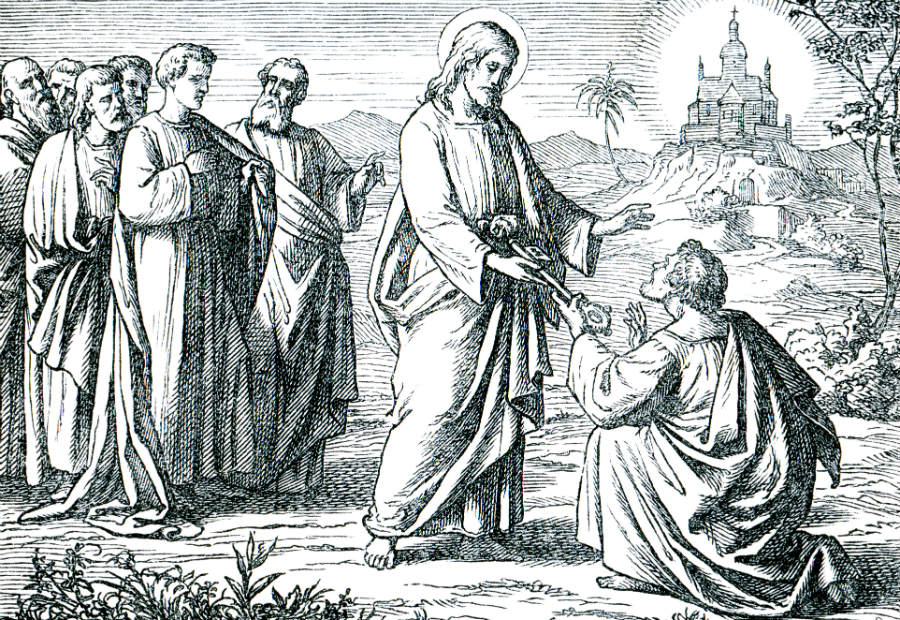
    Let’s look at Timothy first: Is it possible that Paul was grooming Timothy and giving Timothy advice to not only know and abide by the Christian faith in Paul’s lifetime but to continue it after Paul’s death?

    In 1 Timothy 3:14,15 Paul writes to Timothy: “I hope to come to you soon, but I am writing these instructions to you so that, if I am delayed, you may know how one ought to behave in the household of God, which is the church of the living God, the pillar and bulwark of the truth. Was Paul talking about an invisible Church? Really?

    In 1 Timothy 4:12-14 Paul writes to Timothy: “Let no one despise your youth, but set the believers an example in speech and conduct, in love, in faith, in purity. Till I come, attend to the public reading of scripture, to preaching, to teaching. Do not neglect the gift you have, which was given you by prophetic utterance when the council of elders laid their hands upon you.”

    Timothy wasn’t the only one Paul directed advice to by name. In Titus 1:5, Paul writes: “This is why I left you in Crete, that you might amend what was defective, and appoint elders in every town as I directed you,” It is very apparent that there were others through succession that were doing the work of the Lord through the direction of others like Paul. So Paul gave advice to Titus and Titus appointed elders ( presbyters – priests ).

    Have you every thought about the laying on of hands and appointing of Bishops, Elder ( presbyters – priests ) and Deacons being never ending and not just stopping with Paul at his death around 67 AD? Do you think it’s possible that those who Timothy and Titus appointed through the direction of Paul may have appointed others for generation after generation?

    4) Early Church History – The Early Church Fathers – Sadly, I never knew much ( if anything at all ) about them prior to my Catholic journey.

    Early church history and the writings of the early church fathers is what got me thinking beyond what can be found in the Bible. But for the Bible only ( sola scriptura ) Christians, it can be seen clearly in scripture as already demonstrated with Timothy and Titus.

    Is there succession? Is that succession leadership based ( Bishops – Elders ( Presbyters – Priest ) – Deacons ) as seen in the New Testament? Why would it have all stopped with the death of the apostles’ and not continued in never ending succession until our modern times? Is it not only possible but probable that generation after generation would train and ordain successors? It is more than probable because that is what has actually happened in the Catholic Church from Jesus to Peter and the apostles’ through today.

    Let’s take a look: Jesus left Peter in charge with “the keys to the kingdom” (Matthew 16:19) along with other leadership that Jesus established ( the other apostles’ ). Mark 3:14 “And he appointed twelve, to be with him, and to be sent out to preach.”

    Clearly in the New Testament, beyond the apostles,’ others were placed in positions of authority and entrusted as already pointed out with Timothy and Titus. But is it not logical that someone would succeed Peter as leader and that there would still be Bishops, Elders ( Presbyters – Priest ) and Deacons in place? There is proof in the writings of The Early Church Fathers and history that this was not only logical but actually happened.

    One of many examples is that of Polycarp ( an early church father and Bishop of Smyrna who lived from 69 to 155 AD ). Polycarp was a disciple of the Apostle John. Saint Jerome wrote that John ordained Polycarp as Bishop. But it doesn’t stop there because Irenaeus ( Bishop of Lugdunum and author of Against Heresies who lived from 130 to 202 – dates often disputed ) was said to be from Polycarp’s hometown and to have heard the preaching of Polycarp. Irenaeus is one of the first to use the idea of apostolic succession to refute his opponents ( source ).

    The Early Church Fathers were not only shown to be leaders of the Church after the apostles’ but also fought against heretics ( those holding an opinion at odds with what is generally accepted ). They continued on with both the written word and “Sacred Traditions” as handed down by the apostles.’

    The Bishop of Rome ( “The Pope” ) has continued with a never ending list starting with Peter. What other church can claim this apostolic succession and also still have the visible leadership that started with Peter and continues today?

    Have you ever stopped to think that the early Church leaders were “not” walking around caring a New Testament quoting verses left and right to attempt to prove a point like modern Christians often do? Have you ever stopped to think that it is well documented that the New Testament writings didn’t begin for at least two decades after the death of Christ with the writings of Paul in the 50’s, that the first Gospel was written near the year 70 with the rest of the Gospels written into the 80’s and 90’s and the Gospel of John being the last one written sometime in the 90’s to early 100’s? Although dates are debatable, they are close enough even in a heated debate to prove that “Sacred Tradition” passed along orally must have been key to early Christianity and is still key today through The Magisterium or Teaching Authority of the Church.

    If all we need is the BIBLE ALONE ( Sola Scriptura ), what did the first Christians use as their rule of faith since the New Testament was not completed for 60 to 70 or so years after the death of Christ, was not fully and officially agreed upon as the 27 books we know today until around the year 400 and was also hand copied ( extremely expensive ) until the 1400’s when the invention of the printing press changed things? Could there have been so few Bibles at one time in history that the Catholic Church chained them down to avoid having them stolen because they were so expensive and had to be copied by hand? Could it be that early Christians heard the word of God read more than they actually read the Bible themselves because there was not a family Bible in every home? Could it have been a visible Church? Could it have been The Teaching Authority of the Church? Could it have been The Bishop of Rome ( The Pope ) along with other Bishops, Elders ( Presbyters – Priest ) and Deacons?

    Some Christians take the “led by the Holy Spirit” belief to extremes. If we are all being “led by the Holy Spirit,” why is there so much confusion? Why is there so much Jesus and Me and I don’t need a church or organized religion telling me what to do? ( I’ve been there. ) Why is there so much church hopping ( been there – done that ), church splitting, church arguing? Could it be that many Christians are not being truly “led by the Holy Spirit” but maybe some are being led by the “spirit of me and my private interpretation of the Bible?” Although you may think “Mormons” and “Jehovah’s Witness” are over the top, how did they get started?

    If you are a practicing Catholic, please learn your faith and not just go through the motions. If you are nominal Catholic or thinking about leaving the Catholic Church, please learn your faith, pray and get involved in living your Catholic faith. It really is beautiful and Christ centered. Finally, if you are non-Catholic, I hope that you will open your heart and open your mind to what the Father, Son and Holy Spirit have in store for you.

    I believe there is a visible, hierarchal Church, founded by Jesus Christ, with a teaching authority in place that has protected “Sacred Tradition” and Biblical interpretation for the last 2000 years and has conducted 21 Ecumenical Councils over a period of 1700 years as of this writing to cover church matters: I’m glad that I have found a home in the Catholic Church that Christ established.

    Psalm 19:14 “Let the words of my mouth and the meditation of my heart be acceptable in thy sight, O Lord, my rock and my redeemer.”

    ______________________________________________________________________________________________________________________

    Here’s a list from the Santa Fe Arch Diocese of Churches in communion with Rome and those that call themselves Catholic but are not in communion with Rome. There are 1.2 billion ( roughly ) Roman Catholics in the world not counting those in communion with Rome. You can also see “What is the difference between the Roman Catholic and the Catholic religion?” At the end of the day, it’s the Roman Catholic Church with the never ending succession of Popes ( from Peter through today ) that I believe is the Church Jesus Christ founded.

  • “Where Is That In The Bible?” – The Protestants “Sola” Predicament

    Be sure to also read: CLYDE URGED ME TO READ 2 TIMOTHY 3:16 & STOP GROPING IN THE DARK

    Let me set the stage for this post before getting more deeply into  “Where is that in the Bible?

    Whether you are Catholic, Protestant or have other beliefs, you will most likely form an initial opinion based on your current beliefs. I ask that you keep an open mind and see both sides of this: Catholic View vs. Protestant View.

    As far back as I can remember into my childhood until the age of 50, my time was spent in a Pentecostal or Baptist church with some attendance in the Church of Christ ( wife brought up in ) and like many Protestants, I have had periods of stay at home Christianity.

    In my opinion, stay at home Christianity is one of the problems with the “Alone” or “Sola Doctrine” that Martin Luther came up with and how it has developed over 500 years: Just me and Jesus at home with my Bible because I have faith ( Sola Scriptura “Scripture alone” | Sola Fide “faith alone” | Solus Christus “Christ alone” ) when I’m perfectly capable of attending church and doing way more for God. FYI, we are clearly commanded “to do” and “to not do” and it’s hard to do much on the couch ( if able to do more ).
    ____________________________________________________________________________________________________________________

    I never attended a regular Catholic Mass until I was 50 years old. The only times that I had ever been in a Catholic church were two Catholic weddings that come to mind that I barely remember from when I was in my 20’s.

    I never gave Catholicism much thought either way until mid-to-late 2016 and have NEVER been anti-Catholic. For example, some anti-Catholics say that Catholics are not Christians or that the Catholic Church is the “Whore of Babylon” mentioned in the Bible.

    I have approached Catholicism with an open mind and eager to understand the Church teachings. No one has shoved Catholicism down my throat. As of this post, I have yet to meet a pushy Catholic or hear a pushy Catholic on Catholic radio.

    One of my discoveries has been that Protestants seem to like asking “Where is that in the Bible?” which is often directed towards Catholics as a way to prove what Catholics believe and practice is wrong.

    Wouldn’t it be nice if we could just all hold hands and be happy together as Catholics and Protestants? That will definitely take a moving of the Holy Spirit.

    Is the Bible clear that we should all be one?

    I Corinthians 1:10 “I appeal to you, brethren, by the name of our Lord Jesus Christ, that all of you agree and that there be no dissensions among you, but that you be united in the same mind and the same judgment.”

    I Peter 3:8 “Finally, all of you, have unity of spirit, sympathy, love of the brethren, a tender heart and a humble mind.”

    Ephesians 4:1-3 “I therefore, a prisoner for the Lord, beg you to lead a life worthy of the calling to which you have been called, with all lowliness and meekness, with patience, forbearing one another in love, eager to maintain the unity of the Spirit in the bond of peace.”

    Many Protestant Christians read the Bible, can quote scriptures by book, chapter and verse, enjoy Bible study, pray often and love Jesus. Contrary to what some believe, many Catholics read the Bible, actually know more scripture than many protestants ( even if they cannot quote book, chapter and verse ), have Bible studies, pray often and love the same Jesus that Protestant Christians love.

    Where in the Bible does it clearly, unequivocally, without a shadow of a doubt, state that everything has to be in the Bible?

    There are numerous protestant beliefs, practices, traditions, etc. that are either not in the Bible at all or are not clear in the Bible as many of the thousands of Protestant churches believe and practice.

    Many Protestants will not hesitate to go after  Catholics about The Pope, Purgatory, The Crucifix, Making The Sign of The Cross, Holy Water, The Immaculate Conception, The Assumption of Mary and more. Why? Because most Protestants do NOT believe those things are clearly in the Bible . Many Protestants actually believe that Catholics worship Mary and statues ( wrong ) and have many other misconceptions about Catholics.

    2 Timothy 2:15 “Do your best to present yourself to God as one approved, a workman who has no need to be ashamed, rightly handling the word of truth.”

    In the 7 Habits of Highly Effective People by Dr. Stephen Covey in habit 5: “Seek First to Understand, Then to be Understood.” We all form opinions based on our beliefs which can often be driven by our own private interpretation of scripture. Although I have never been anti-Catholic and have always seen Catholics as fellow Christians, I previously never took the time until to truly understand Catholicism.

    Is it possible that there is a place for oral tradition ( Sacred Tradition as taught by the Catholic Church )?

    2 Thessalonians 2:15 “So then, brethren, stand firm and hold to the traditions which you were taught by us, either by word of mouth or by letter.”

    Did oral tradition ( Sacred Tradition ) stop with the death of the Apostle’s? I don’t think so.

    Yes, I know the argument, “If it’s contrary to the word of God and cannot be pressed up against the scripture, then it’s wrong, wrong, wrong.” Remember, my background is Pentecostal and Baptist with a some Church of Christ sprinkled in.

    I understand the argument and validity of “contrary to scripture” which is why I like to understand the Biblical foundation or Biblical principle behind many teachings and practices.

    Have you ever considered the words “Trinity” and “Incarnation” that are not in the Bible, yet widely accepted by Christians worldwide, may have been passed down orally over the ages? If they are not in the Bible, how did they start and why do so many Christians use these and other words that are not in the Bible? Why have a problem with the words Pope and Purgatory that are not in the Bible but not have an issue with Trinity and Incarnation. Could it be a double standard?

    Did you know that Jehovah’s Witnesses do not believe in the Trinity? Should the rest of us reject the Trinity doctrine as well since the word Trinity is NOT IN THE BIBLE but the Biblical principle exists? I don’t think so.

    FYI, I believe in the  “Trinity” and “Incarnation” even though the words are not in the Bible because I see the  Biblical foundation or Biblical principle. I also see the Biblical principles for “Pope” and “Purgatory.”

    There are many more examples like these that many do not think twice about, but as soon as the Pope is mentioned to non-Catholics, many people freak out.

    Let’s take a look below to see if there is an foundation to what Cardinal John Henry Newman ( Converted to Catholicism in 1845 ) once said, “To be deep in history is to cease to be Protestant.

    Is it possible that Jesus taught more than we have in the Bible and that those things were passed down through the ages that still align with scripture?

    John 21:25 “But there are also many other things which Jesus did; were every one of them to be written, I suppose that the world itself could not contain the books that would be written.”

    I believe that it’s not only very possible, but 100% likely, that Jesus said things that Saint  John The Apostle heard that were never written down. Then, St. John shared some of those things with Polycarp ( a disciple of St. John, also the Bishop of Smyrna and an early Church Father ). Then, Irenaeus ( Bishop of Lugdunum, who wrote a book “Against Heresies” and is also an early Church Father ) who heard Polycarp preach likely continued to share what he learned orally. This is just one example.

    Acts 2:42 “And they devoted themselves to the apostles’ teaching and fellowship, to the breaking of bread and the prayers.” The Apostles’ heard it straight from Jesus. They were not carrying around a leather bound “Holy Bible” with the Old and New Testament in it. Do you think it’s possible they taught things that are not clearly in the Bible but could be part of Sacred Tradition?

    The common man ( for hundreds of years ) was often illiterate and the Bible ( hand copied until the 1400’s when the printing press was invented ). Times were different than the modern age we live in. For hundreds of years, people were “taught orally” and “scripture was read to them.”

    For well over 1,000 years after the death of Christ, Bibles were so expensive that they were chained to keep them from being stolen. The Bible was copied by hand until the printing press was invented in the 1400’s. It doesn’t take very much open minded, cross referencing, online research over just an hour or two to find out. You may also want to get this book off Amazon.

    It’s interesting to me that many Protestant based websites often glaze over early church history, the Church Fathers and how the Bible came about: It’s like once the Apostle’s died, the Church went into apostasy and deep into the dark ages until 1517 when this amazing man of God, Martin Luther ( a Catholic Priest by the way ), came along and brought the church back to life.

    It’s interesting that Luther, Calvin and Zwingli couldn’t agree on everything in the 1500’s. Thus, the reformation has lead to the creation of thousands of Protestant denominations and non-denomincations over the last 500 years most of which think they are following the Bible as it is supposed to be followed. But Protestant denominations and non-denominations cannot agree on many points. Furthermore, the continued disagreement keeps the splintering going on and on.

    Ephesians 4:4-6 “There is one body and one Spirit, just as you were called to the one hope that belongs to your call, one Lord, one faith, one baptism, one God and Father of us all, who is above all and through all and in all.

    CATECHISM OF THE CATHOLIC CHURCH SECOND EDITION ( See The Catechism Online ):

    77 “In order that the full and living Gospel might always be preserved in the Church the apostles left bishops as their successors. They gave them their own position of teaching authority.” Indeed, “the apostolic preaching, which is expressed in a special way in the inspired books, was to be preserved in a continuous line of succession until the end of time.” 78 This living transmission, accomplished in the Holy Spirit, is called Tradition, since it is distinct from Sacred Scripture, though closely connected to it. Through Tradition, “the Church, in her doctrine, life and worship, perpetuates and transmits to every generation all that she herself is, all that she believes.” “The sayings of the holy Fathers are a witness to the life-giving presence of this Tradition, showing how its riches are poured out in the practice and life of the Church, in her belief and her prayer.”

    Do Protestants have traditions that are not clearly in the Bible? Yes! Do Protestants use words, have practices, conduct worship, etc. that are not clearly in the Bible? Yes! Then, why do many Protestants have issues with Catholic beliefs, words, practices, etc.? The answer is often because they think that it is not  in the Bible.

    There are some Protestant things on my list below that may go against the Catholic Church interpretation that I have come to believe that the Catholic Church interpretation has more biblical support. Therefore, I take a Catholic position on those like “The Eucharist” ( Lord’s Supper ).

    There are things like Christmas and Easter that overlap for both Catholics and Protestants that are enjoyed by both Catholics and Protestants. However, the celebrations are not in the Bible nor are the words. Did you know that Jehovah’s Witnesses don’t celebrate Christmas or Easter because they believe both have pagan roots and that there is lack of support from the Bible?

    Is it not a double standard when some Protestants challenge Catholics on things that Catholics do like dipping their finger in holy water and making the sign of the cross when entering the Church? It didn’t take much to find this online, “The Bible nowhere instructs Christians to use “holy water” in any way, shape, or form. The Catholic use of holy water is not biblical.”

    I am “NOT” saying all the Protestant traditions listed are wrong and that they should not be adhered to because they are either “NOT” listed in or not 100% clear in the Bible. You’ll find a list of things below that most Protestants do not have an issue with and you’ll be hard pressed to find most of them clearly in the Bible.

    Sunday School / Children’s Church ( Separating Adults/Children ) / Summer Bible Camp

    Wednesday Night ( Mid-Week ), Coffee Shop Group or Men’s Group Bible Studies

    Praise & Worship Band / Hollywood Style Entertainment – Because It Feels Good

    The Words: Rapture, Trinity, Lord’s Supper, Incarnation, Lord’s Prayer & Many More … It interesting that one anti-Catholic writes: “It is illogical to claim that since the word “Trinity” is not found in the Bible, that its concept is not taught therein.” Yet, his writings about Catholicism are irritating: “If a Roman Catholic believes in the official Roman Catholic teaching on salvation, then he is not a Christian since the official RCC position is contrary to Scripture.” Trust me, I’ve spent hundreds of hours on Catholicism. This guy is using his OWN PRIVATE interpretation to come to the second conclusion.

    When Praying: Holding Hands, Bowing Head, Closing Eyes, Hands Clasped Together Under Chin

    The Altar Call , The Sinner’s Prayer and Accepting Jesus As “Personal” Lord And Savior

    The Lord’s Super ( Communion ) as Symbolic ( Once A Quarter )

    Christmas & Christmas Drama | Easter & Sunrise Service ( I’m all for it, but it’s not in the Bible. )

    Sharing Personal Testimony in Church ( very popular when in the 70’s at the church I attended )

    Cross on the church steeple and/or a cross inside the church ( Yet, having a problem with the Crucifix ) It’s true Jesus is not hanging ( key argument ) on the cross, but Jesus is also no longer a baby as depicted in manger scenes. The Crucifix reminds me what he sacrificed for me. I know he conquered death, hell and the grave.

    Infant Dedications ( Yet, rejecting Infant Baptism )

    Water Baptism as Symbolic ( Church of Christ, Catholic Church & Others don’t see it that way. )

    But As Long As We Agree On The Essentials – What are the essentials? Is it Christ on the Cross? What about “once saved always saved” vs. “salvation can be lost?”

    Closing questions to consider beyond what I have written above:

    1)Did the Bible come with a God inspired list of what books belong in it? I’m not referring to the list at the beginning of the Bible that was added by man. I’m referring to the Bible itself telling us what books are supposed to be in there? Where does the Bible say that everything has to be in the Bible?

    2) Where in the Bible does it provide instructions for Holy Matrimony? Have you ever thought about that? Think of how we all view a valid marriage. Can you find those detailed instructions laid out in the Bible?

    These final questions along with everything else that I have covered in this post is worthy of thinking and praying about. The “Fundamentalist” – “Literalist” approach is often so closed minded that there is no room for logic and prayer to discover the real truth. FYI, I was once a “Fundamentalist,” so that gives me a little more right to speak from experience.

    Protestants need to think twice before challenging Catholics with “Where is that in the Bible?”

    Check out my post: THE CHURCH – VISIBLE NOT INVISIBLE: ONE, HOLY, CATHOLIC AND APOSTOLIC
    ____________________________________________________________________________________________________________________

    Although the first video below on the left is 54 minutes, the one on the right is less than 3 minutes and the other 8 videos are 10 minutes or less.

  • John Martignoni – Apologetics for the Masses #319 – Matt Slick’s False Teachings

    It’s not that hard to find Matt Slick saying things about Catholics on his website like this verbatim quote: “If a Roman Catholic believes in the official Roman Catholic teaching on salvation, then he is not a Christian since the official RCC position is contrary to Scripture. Therefore, as a whole, Roman Catholics need to be evangelized. They need to hear the true Gospel.”

    WOW! Matt Slick says “NOT A CHRISTIAN!” I’m not a fan about what Matt Slick thinks about Catholicism and Catholics.

    I really like John Martignoni over at BIBLE CHRISTIAN SOCIETY and I was happy to get the information below in email. You can subscribe to John’s newsletter here.

    I decided to copy it all here to help do my part. So take a look at what John Martignoni put together starting with Introduction below:

    Introduction

    I haven’t had much of anything to do with Matt Slick in probably 4 or 5 years or so, but someone posted the Dear Catholic article by Slick that you’ll see below on Facebook, and I just couldn’t resist making a response. And, just so we know that he finds out about this – in case he would like to make a response – if you guys could all forward the newsletter to him, that would be a big help. His email addresses are:

    [email protected] and [email protected] (at least that’s what it was a few years ago)

    ( Side Note from David: [email protected] is what is on the website. )

    I will print the post of his article first, in its entirety, and then print it again with my responses intermingled with his article. All of his words will be in italics.

    Challenge/Response/Strategy

    Dear Catholic, do you know for sure if you are going to heaven?
    by Matt Slick

    If you’re a Catholic, do you know for sure if you are going to heaven when you die?

    As a Protestant, I can say that I know I am going to heaven. This isn’t arrogance. It is confidence in the work of Christ and not my own work. It is confidence in the ability of Jesus to save me completely, to have fulfilled all of the Law perfectly, and to have cleansed me from my sin totally.

    Therefore, because all my hope and trust are in him and not what I can do, I know I am going to heaven.

    If my salvation depended on my goodness and abilities in any way, then I can’t have any confidence that I will make it to heaven because I am an imperfect sinner.

    But God is perfect and requires holiness (1 Pet. 1:16). This is why God provided Jesus who fulfilled the Law (Matt. 5:17), including loving God (Deut. 6:5) and loving your neighbor (Lev. 19:18). In other words, Jesus did everything that is necessary for us to do.

    This is why we should trust Jesus alone and not Jesus and our goodness or Jesus and our church or Jesus and our ability to love God and our neighbor.

    But, what about you? Do you have that confidence? If not, perhaps it is because of the requirements that the Roman Catholic Church has stated in the Catechism of the Catholic Church.

    “The Lord himself affirms that Baptism is necessary for salvation,” (CCC 1257).

    “Basing itself on Scripture and Tradition, the Council teaches that the Church, a pilgrim now on earth, is necessary for salvation,” (CCC 846).

    “This sacrament of Penance is necessary for salvation for those who have fallen after Baptism, just as Baptism is necessary for salvation for those who have not yet been reborn,” (CCC 980).

    “The Church affirms that for believers the sacraments of the New Covenant are necessary for salvation, (CCC 1129).

    “Service of and witness to the faith are necessary for salvation,” (CCC 1816).

    “The authority of the Magisterium extends also to the specific precepts of the natural law [i.e., 10 Commandments, CCC 2070], because their observance, demanded by the Creator, is necessary for salvation,” (CCC 2036).

    Are you as a Catholic able to keep all the requirements that the Roman Catholic Church says are necessary for salvation? We both know you can’t.

    __________________________________________________________________________________________________________________

    Dear Catholic, do you know for sure if you are going to heaven? by Matt Slick

    If you’re a Catholic, do you know for sure if you are going to heaven when you die?

    John Martignoni
    Dear Matt Slick, Since you go by the Bible alone (Sola Scriptura), I have to ask: Is this little salvation quiz of yours in the Bible? If not, why are you asking it? Also, do I have to answer your question in a certain way as a requirement for getting into Heaven?

    Matt Slick
    As a Protestant, I can say that I know I am going to heaven. This isn’t arrogance. It is confidence in the work of Christ and not my own work. It is confidence in the ability of Jesus to save me completely, to have fulfilled all of the Law perfectly, and to have cleansed me from my sin totally. Therefore, because all my hope and trust are in him and not what I can do, I know I am going to heaven.

    John Martignoni
    Matt Slick says, “I know I am going to Heaven.”

    God says, “Therefore let any one who thinks that he stands take heed, lest he fall,” (1 Cor 10:12). You might want to read that over a few times, Slick.

    Paul, inspired by the Holy Spirit, says, “I do not even judge myself. I am not aware of anything against myself, but I am not thereby acquitted. It is the Lord who judges me. Therefore do not pronounce judgment before the time, before the Lord comes…” (1 Cor 4:3-5).

    Matt Slick says, “I do indeed judge myself before the time, before the Lord comes, and even though I am aware of all sorts of things against myself, I am thereby acquitted.”

    Sorry, Slick, but your words do indeed seem to indicate just a wee bit of arrogance on your part.

    Oh, and one other thing: If Jesus has cleansed you from your sin “totally,” then how come you still sin?

    Matt Slick
    If my salvation depended on my goodness and abilities in any way, then I can’t have any confidence that I will make it to heaven because I am an imperfect sinner.

    John Martignoni
    You seem to be implying, Slick, that Catholics believe it is their own “goodness and abilities” that cause them to be saved. First of all, I challenge you to find anywhere in official Catholic teaching where such a thing is taught. It’s not. For you to put forth such a thing is for you to knowingly and willingly participate in a lie. But since Jesus cleansed you from your sin “totally,” then I guess that’s okay, right?

    Secondly, I can prove to you that Catholics put more confidence in Christ for their salvation than even you claim to do. I can prove that with two words: Infant Baptism. Catholics believe that when an infant is baptized, that infant is saved. The infant cannot do any works. The infant cannot even have faith. In other words, there is absolutely nothing the infant can do to effect its own salvation, yet Catholics believe that infant is indeed saved through Baptism. How? All, completely, totally, and gratuitously by the grace of God and absolutely nothing else.

    And here is the official, dogmatic, teaching of the Catholic Church on this matter from the Council of Trent:

    “…so unless [men] were born again in Christ, they never would be justified, since in that new birth through the merit of His passion, the grace whereby they are made just, is bestowed upon them.” (Denzinger, p. 249)

    “…man himself receiving that inspiration [of the Holy Spirit] does nothing at all inasmuch as he can indeed reject it, nor on the other hand can he, of his own free will, without the grace of God, move himself to justice before Him.” (Denzinger, p. 250)

    “…the meritorious cause [of man’s justification] is His most beloved only-begotten Son, our Lord Jesus Christ, who…merited justification for us by His most holy passion on the wood of the Cross, and made satisfaction for us to God the Father…” (Denzinger, p. 251)

    “…no one can be just but he to whom the merits of the passion of our Lord Jesus Christ are communicated…” (Denzinger, p. 251)

    “…and are, therefore, said to be justified gratuitously, because none of those things which precede justification, whether faith or works, merit the grace itself of justification; for, ‘if it is a grace, it is not now by reason of works…’” (Denzinger, p. 252)

    “Canon 1: If anyone shall say that man can be justified before God by his own works which are done either by his own natural powers, or through the teaching of the Law, and without divine grace through Christ Jesus: let him be anathema.” (Denzinger, p.258)

    I don’t believe there is anything there about Catholics believing that a man can be justified, or saved, in any way, shape, or form by their own “goodness and abilities.” To say that Catholics believe such a thing is a lie, pure and simple.

    So, Catholics actually put more confidence in Christ than you do. You see, when you say that your salvation does not depend on your abilities in any way, that’s not quite right, is it? Here’s an interesting question for you: You probably know the date you got saved, right? It was on a particular day sometime in the 20th century. But, can you tell me what was different on that day as opposed to the day before you were saved? Did Jesus do something new and different for you on the day you were saved that He had not done for you the day before you were saved? No. Slick theology says that Jesus did all that needed to be done for your salvation with His death on the Cross sometime back in the 1st century – “It is finished,” (John 19:30).

    So, what was different about the day you were saved in the 20th century as opposed to the day before you were saved? Was the difference something you did, or something Jesus did? The difference was something you did, wasn’t it? You acted. You believed. You accepted. You confessed. You repented (all are action verbs, by the way). You did something that, in your opinion, resulted in your salvation. So, in Slick theology, you had to DO something in order to be saved. That little Catholic baby didn’t. Who, then, has more confidence in Christ – Slick, or Catholics?

    Matt Slick
    But God is perfect and requires holiness (1 Pet. 1:16). This is why God provided Jesus who fulfilled the Law (Matt. 5:17), including loving God (Deut. 6:5) and loving your neighbor (Lev. 19:18). In other words, Jesus did everything that is necessary for us to do.

    This is why we should trust Jesus alone and not Jesus and our goodness or Jesus and our church or Jesus and our ability to love God and our neighbor.

    John Martignoni
    “Jesus did everything that is necessary for us to do.” If that is the case, then every man should be saved. Because Jesus did everything that is necessary for every man to be saved, didn’t He? But, as I showed in my comments above, if you were “unsaved” one day – 2000 years after the death of Christ – and then “saved” the next day, the difference between those two days is not something Jesus did, it’s something the believer DID that the unbeliever did not do. So, Jesus didn’t do “everything” that is necessary for us to do, did He? He didn’t believe for us, did He? He didn’t accept Himself into our hearts as His personal Lord and Savior, did He? Now, that all happened by the grace of God, but we had to act on that grace. We had to DO something.

    And, by the way, you are correct in saying that God is perfect and requires holiness. In fact, we can’t see the Lord if we aren’t holy (Hebrews 12:14). But here’s the difference between Slick theology and Catholic theology: In Catholic theology, we have such confidence in Jesus that we believe He can, and does, make us holy. Slick theology doesn’t have any such confidence in Jesus, which is why Jesus has to love God for us and love our neighbor for us, and be holy for us, because Jesus can’t, even by His grace, enable us to do so.

    Slick theology says we could never be worthy of receiving anything from God. We could never be holy. Catholic theology says with God, “all things are possible,” (Matt 19:26) and that we, the followers of Christ, “are being changed into His likeness from one degree of glory to another; for this comes from the Lord Who is the Spirit,” (2 Cor 3:18).

    I am also surprised to hear Matt Slick say that we should not trust in the Body of Christ. “He [Jesus] is the head of the body, the church…” (Col 1:18). Jesus’ body is the church. Jesus is the Head of the church. Matt Slick says we should not trust the church. I find that absolutely fascinating…and revealing.

    Matt Slick
    But, what about you? Do you have that confidence? If not, perhaps it is because of the requirements that the Roman Catholic Church has stated in the Catechism of the Catholic Church.

    “The Lord himself affirms that Baptism is necessary for salvation,” (CCC 1257).

    John Martignoni
    “Truly, truly I say to you, unless one is born of water and the Spirit, he cannot enter the Kingdom of God.” (John 3:5)

    “Repent, and be baptized every one of you in the name of Jesus Christ for the forgiveness of your sins; and you shall receive the gift of the Holy Spirit.” (Acts 2:38)

    Matt Slick
    “Basing itself on Scripture and Tradition, the Council teaches that the Church, a pilgrim now on earth, is necessary for salvation,” (CCC 846).

    John Martignoni
    “And He has put all things under His feet and has made Him the head over all things for the church, which is His body, the fulness of Him Who fills all in all.” (Eph 1:22-23) Is the Body of Christ – the fulness of Christ Who fills all in all – not necessary for salvation?

    Matt Slick
    “This sacrament of Penance is necessary for salvation for those who have fallen after Baptism, just as Baptism is necessary for salvation for those who have not yet been reborn,” (CCC 980).

    John Martignoni
    “If we confess our sins, He is faithful and just, and will forgive our sins and cleanse us from all unrighteousness.” (1 John 1:9)

    Matt Slick
    “The Church affirms that for believers the sacraments of the New Covenant are necessary for salvation, (CCC 1129).

    John Martignoni
    “Truly, truly I say to you, unless you eat the flesh of the Son of Man and drink His blood, you have no life in you. He who eats My flesh and drinks My blood has eternal life, and I will raise him up at the last day.” (John 6:53-54)

    “Baptism…now saves you.” (1 Peter 3:21)

    Matt Slick
    “Service of and witness to the faith are necessary for salvation,” (CCC 1816).

    John Martignoni
    “So every one who acknowledges Me before men, I also will acknowledge before My Father Who is in Heaven; but whoever denies Me before men, I also will deny before My Father Who is in Heaven.” (Matt 10:32-33)

    Matt Slick
    “The authority of the Magisterium extends also to the specific precepts of the natural law [i.e., 10 Commandments, CCC 2070], because their observance, demanded by the Creator, is necessary for salvation,” (CCC 2036).

    John Martignoni
    “And behold, one came up to Him, saying ‘Teacher, what good deed must I do to have eternal life? And He said to him…“If you would enter life, keep the commandments.” (Matt 19:16-17)

    “If you love me, you will keep my commandments.” (John 14:15)

    “If you keep my commandments, you will abide in my love…” (John 15:10)

    “For neither circumcision counts for anything nor uncircumcision, but keeping the commandments of God.” (1 Cor 7:19)

    “And by this we may be sure that we know him, if we keep his commandments.” (1 John 2:3)

    “…and we receive from him whatever we ask, because we keep his commandments and do what pleases him.” (1 John 3:22)

    Matt Slick
    Are you as a Catholic able to keep all the requirements that the Roman Catholic Church says are necessary for salvation? We both know you can’t.

    John Martignoni
    God: “For this is the love of God, that we keep his commandments. And his commandments are not burdensome.” (1 John 5:3)

    Slick: God’s commandments are too burdensome for man to keep. Jesus cannot give you the grace you need in order to keep the commandments and precepts of God.

    God: “Here is a call for the endurance of the saints, those who keep the commandments of God and the faith of Jesus.” (Rev 14:12) The saints are those who “keep the commandments of God and the faith of Jesus.”

    Slick: The saints are those who have faith alone because they are unable to keep the commandments of God.

    Who do you want to believe…Matt Slick…or God?

    Catholic theology: All things are possible with God and Christ can and does give man the grace to keep His commandments and His grace can make us holy.

    Slick theology: God can’t do any of that so we don’t need to even bother trying to be holy.

    Now, tell me again, who it is that has confidence in Jesus?
    __________________________________________________________________________________________________________________

    Please share this using the SHARE BUTTONS below:

  • My Call To ETWN Open Line Thursday With Father Larry Richards

    My call starts around the 15 minute and 30 second mark. I’ve listened to Father Larry enough that I know he has a sense of humor thus my comment that my wife actually likes his CD’s.

    I really enjoy listening to Father Larry Richards on CD, YouTube, ETWN, etc. Father Larry has been instrumental in my Catholic journey especially his 22 CD set – Knowing Jesus and His Church which is awesome and affordable. My wife, Brenda, likes his CD’s better than any Catholic centered CD’s that she has listened to.

    My question centered around discussing the Gospel message with my Protestant Father that basically says, “Christ Crucified, grab your Bible and join a good Bible believing church.”

    Quick Note: Yes, I believe in Christ Crucified and that the Bible is the inspired word of God. But I think that the advice of joining a good Bible believing church is too all over the place when it’s all said and done. There are SO many differences of opinion based on private interpretation of scripture that how does one define a good Bible believing church?

    Father Larry basically said this, “Catholics and Protestants all believe that we are saved by Grace. It’s what Jesus did for us not what we do for him. We are saved by the grace of Jesus Christ. It’s what Jesus did for you and me on the cross. How we live this Grace and how we receive this Grace is where we’re going to have our fundamental differences. However, it’s ok to have those differences. Build on what you agree on first and slowly build on that instead of what you disagree on.”

    I do think that all ( Catholic or Protestant ) of us should remember that we need to start with what we agree on not what we disagree on. At the end of the day, Catholic Christians love and worship the same Jesus as Protestant Christians. However, there are a lot of differences between Catholics and Protestants. I have found that most Protestants are misinformed about Catholicism. There are some that are outright anti-Catholic and others that see Catholics as fellow Christians. So Father Larry’s advice with starting on what we agree on is crucial. If a fellow non-Catholic Christian believes Catholics are doomed for hell and need to be born again, the conversation will be far different than a non-Catholic Christian that sees a Catholic as a fellow brother or sister in Christ.

    Catholic Christians and Protestant Christians should stop arguing about what they disagree on and focus on what they agree on and share the Gospel with those that don’t know Jesus. Yes, that includes me. I need to get better at a lot of things. I’m a sinner saved by grace that loves Jesus Christ.

    Remember Father Larry said, “We are saved by the grace of Jesus Christ. It’s what Jesus did for you and me on the cross.” So shouldn’t Catholics and Protestants be focused on  Matthew 28:19?

    “Go therefore and make disciples of all nations, baptizing them in the name of the Father and of the Son and of the Holy Spirit,”

  • If you get Jesus wrong, it doesn’t matter what you get right!

    The statement “If you get Jesus RIGHT, it doesn’t matter what you get right!” is from someone involved in a large Protestant ministry that has a large TV presence who is “NOT” a fan of Catholic beliefs nor is the ministry founder or the founder’s wife. However, his statement is one thing that I can agree with him on because Jesus is the foundation and center of it all.

    This ministry, like many Protestant ministries, doesn’t seem to understand that the SAME JESUS CHRIST is the center of Catholicism. Yes, Catholicism has Jesus right. If someone doesn’t believe that, they don’t know Catholicism whether they are currently Catholic, formerly Catholic or non-Catholic. The same Jesus Christ at the center of Protestantism is the same Jesus Christ at the center of Catholicism. However, the guy that said that must think “Even if you get Jesus RIGHT, you can still be wrong in his eyes.” So which is it? Whether I get Jesus WRONG or Jesus RIGHT, I’m still wrong?

    I believe this individual and the ministry he is associated with, no matter how many millions they reach, do NOT truly understand Catholicism no matter how loving they say their approach is meant to be. They rely on their own private interpretation of scripture which is a key problem with Protestantism. There is actually is an authority grater than private interpretation: The Teaching Authority of the Church.

    This is from the founder of this popular ministry: “I am convinced that many, many Catholics have been truly born again. Naturally, they will make heaven their eternal home, just as born-again Protestants will. However, for every one who is saved, scores of others are trusting in a false sense of salvation, which will, sad to say, cause them to be eternally lost.” Maybe I’m taking this out of context, but it sounds like for every 1 Catholic that is saved that there are far more ( scores ) that will be lost.

    The last part of what he is saying could be applied to many church going, professing Christians in name only, because it goes back to getting Jesus right. To be fair, the founder said  Catholics and Protestants agree on these two things “(1) The Bible is truly God’s Word—His written revelation to man, and (2) the Bible is inspired and inerrant.” But he goes on to point out tradition ( FYI, protestants have traditions. ) and that’s why Catholics in essence get it wrong. However, he obviously doesn’t truly understand “Sacred Tradition” the way the Catholic Church actually teaches it as being is in line with the Bible. I have links to more details on “Sacred Tradition” at the end of this post.

    Both the man who quoted the title of this post and the founder of the ministry, with their own private interpretation of scripture, believe at the end of the day that Catholics have much (most) of it all wrong. That’s their personal opinion that they try to back up with scripture through their own private interpretation and traditions ( Protestants often forget that they have rituals and traditions. ). But I do believe they have good intentions in their own minds and I’m not condemning them to hell because of it. I think their ministry has brought a lot of people to Christ and for that, I’m grateful.

    I know that I know that I know that I’ve got Jesus right.

    Although it’s time for all Christians to stop finger pointing and start spending more time winning the lost for Jesus, I don’t see the finger pointing stopping anytime soon. All Christians holding hands and singing Kumbaya will take a massive moving of the Holy Spirit. I don’t want to point fingers, but I will defend my faith when it is attacked. Sadly, I will likely spend more time writing in defense of Catholicism in my articles on this site than I should. However, I’m not going to spend my time pointing out why I think “Mormons” and “Jehovah’s Witness” are wrong.  I don’t plan to spend my time bringing the fight. I truly hope that I can spend a lot of my time sharing the good news of Jesus Christ and the true position of the Catholic Church.

    I feel obligated to speak up when people are talking out of both sides of their mouth. Say what you mean, mean what you say and stand behind it “if” you truly believe what you say.

    If the man that said “If you get Jesus wrong, it doesn’t matter what you get right!” actually believes what he says, he should leave Catholics alone because any faithful practicing Catholic knows who Jesus is and gets Jesus right. He is the same Jesus, 100% the same Jesus, that this protestant man believes he is.

    Let me re-phrase what this man wrote from my personal perspective, If I get Jesus RIGHT ( which I do ), who are you to say what else I get wrong based on your personal interpretation of scripture? All you need is the word of God to figure it all out doesn’t work or there would not be so much confusion within Protestantism. The word of God with ones own private interpretation of scripture is dangerous. The dangerous part is the private interpretation not the inspired word of God.

    My journey in the Catholic Church has pointed me to Jesus so much so that most anti-Catholics and non-Catholics would likely have a hard time believing it if they gave me time to share it all. The center of the Catholic Church is JESUS CHRIST. Period. End of Discussion. No, it’s not Mary and the saints, but they have their place. It truly is JESUS CHRIST at the core. Unlike “Mormons” and “Jehovah’s Witness” who have a different view of Jesus ( dig deep to find it if it’s not apparent on the surface ), Catholic Christians believe in the same Jesus as Protestant Christians.

    Any faithful Catholic believes in Christ as stated in the creed that is verbally spoken at every Sunday Mass: “I believe in one Lord Jesus Christ, the Only Begotten Son of God, born of the Father before all ages. God from God, Light from Light, true God from true God, begotten, not made, consubstantial with the Father; through him all things were made. For us men and for our salvation he came down from heaven, and by the Holy Spirit was incarnate of the Virgin Mary, and became man. For our sake he was crucified under Pontius Pilate, he suffered death and was buried, and rose again on the third day in accordance with the Scriptures. He ascended into heaven and is seated at the right hand of the Father. He will come again in glory to judge the living and the dead and his kingdom will have no end.” Provided these same Catholics believe that they are saying, have confessed their sins, have been baptized in the name of the Father, and of the Son and of the Holy Spirit and Christ is at the center of it all, what’s the issue? Who are you to say that SCORES WILL BE LOST because of your interpretation of a false sense of salvation? You must not know your Bible or Catholics as well as you think you do. Yes, if you bring the fight, I will defend my faith.

    The simple version of Catholic teachings on salvation are that we are saved by God’s grace through faith in Jesus Christ by repentance and baptism. That only JESUS saves. No, it’s not Mary or the Saints that save us. It’s JESUS ONLY. Catholics believe in the SAME Jesus Protestants believe in. Is that point clear yet?

    On a deeper level, we should live out our faith, live the teachings of the Catholic Church (Biblical Foundation), receive the Eucharist and more. But a sinner dying on the side of the road who has never known Jesus can repent, have faith in Christ and go to heaven for eternity. Although there are ordinary biblical foundations established in the Catholic Church, there is also a simplified means of salvation in this example of dying on the side of the road which by the way was one of my hang ups on my Catholic journey.

    I actually used this example to try to understand what I thought was a complicated Catholic view of salvation. I wanted to know if the Catholic view taught that this person on the side of the road dying could sincerely accept Jesus with his or her last breath and make it to heaven. I also heard Steve Ray talk about it in one of his videos when he addressed what many think is a complicated Catholic view of Salvation ( not sure which one – maybe this one ).

    So to reel this all back in …. “If you get Jesus wrong, it doesn’t matter what you get right!” and I say back to you my brother in Christ … If I get Jesus RIGHT ( which I do ), who are you to say what else I get wrong based on your personal interpretation of scripture?

    Why do you talk out of both sides of your mouth and attack my Catholic faith? Say what you mean, mean what you say and stand behind it “if” you truly believe what you say. No double talk allowed.

    I get Jesus right! Do you?

    ___________________________________________________________________________________________________________________

    Sacred Tradition is too deep to get into on this post, so I’ll share links to several articles: Sacred Tradition and Sacred Scripture Depends on Sacred Tradition and Explaining Tradition and Apostolic Tradition.

  • The Eucharist – John 6 – Many People Just Don’t Get It

    I can understand why so many videos related to Catholicism disable the comments. If you want to see what I mean, just change the comments to newest first on the video above and start scrolling. I’m going to share some of the comments on this post, but before I do, I want to share some thoughts.

    Father Mike Schmitz is one of my favorite speakers. However, some of you reading my words right now will likely not agree with all he is saying in the video above.

    I challenge you to look deeper into the Eucharist ( Holy Communion ) as the Catholic Church teaches the Eucharist. You should start by reading John 6:22-69. In addition, one of the best places to look for short articles online is Catholic.com. If you are more into videos, you can search on YouTube for SCOTT HAHN with EUCHARIST in the search. However, doing both, reading and watching videos would be ideal. You owe it to yourself to seek, with an open mind, to understand the Catholic position which by the way is Biblical.

    I’ve been a Christian since my early childhood. For the first 50 years of my life, I never really gave Catholicism much thought  one way or the other. I simply saw Catholics as fellow Christians that worshipped different than what I had been accustomed to. Although I knew Catholics put more emphasis on Mary, I never thought that Catholics worshipped Mary. I also had NO DOUBT that Catholicism is focused on the same Jesus that I have loved since my childhood.

    I didn’t realize how much hatred, misunderstanding and ignorance there is in this world about Catholicism until I began my Catholic journey. My journey was about seeking the truth wherever that led me. My journey was about understanding the actual teachings of the Catholic Church. No one twisted my arm. I simply spent 300 plus hours during the first 12 months of my journey wanting to know more about Catholicism.

    I even bought a DVD, a book or two , got a pamphlet or two, etc. that were “NOT” in favor of Catholicism. I have continued to see over and over that no matter what people try to say against Catholicism that they JUST DON’T GET IT. However, in many cases, I doubt most of the people spend 300 plus hours in 12 months trying to see if there is REAL TRUTH to Catholicism.

    There is a guy that is anti-Catholic that showed a stack of books on one of his YouTube videos saying something along the lines of I’ve studied Catholicism for years and I understand it. Sadly, he must have studied with a closed mind because he truly doesn’t understand Catholicism.

    Although I was never anti-Catholic, I would have never thought that I would be defending the Catholic faith. Ignorance, misrepresenting the facts and outright hatred are all things than anyone who cares about his or her faith will only take so much of. Funny thing is, I’m not trying to find much of what I come across. It’s just readily available. I doubt that I would find this much anti-Baptist information online especially the way it’s presented compared to Catholicism. Although I have no doubt that there are countless videos on YouTube from the Christian faith that have terrible comments from people that don’t have the same point of view. But I doubt there are very many that would say, “The Southern Baptist are the Whore of Babylon, a false religion, worship a false Christ and need to leave the Southern Baptist church.” Those are the real things that some say about Catholicism.

    Here are a couple of positive comments on YouTube for the video at the top of this page:

    Comment: I was raised Catholic, but my family aren’t really practicing Catholics. We basically never go to church anymore. For the last few years, i’ve identified as agnostic but lately something’s been making me interested in Christianity. then a couple of days ago, a Fr. Mike video was one of my suggested videos, so i decided to watch. he explains things so clearly, nothing like i’ve ever heard. and then i stumble on this video…and now i am just lying in my bed sobbing…i am so overwhelmed with this feeling of love. i feel the beginnings of my walk with Jesus. it’s intimidating yet wonderful. thank you, Father Mike. you’ve awakened something in me.

    and….

    Comment: I had been an atheist for 10 years when I first realized, unhappily, that God really was there. I remember vividly telling Him, fine, but at least will never be a Catholic. Two years later, I let a friend take me to a Mass. I recognized the same Presence at the consecration. At that moment, I was Catholic. Period. 38 years later, I am more grateful of His love than ever. He is more real, more there, than the husband I married and the children I birthed. And sinner though I am, I can still see Him, in those He has created. “How can we tell them, that they walk around shining like the sun?” Thomas Merton

    _________________________________________________________________________________________________________________

    Now, take a look at some of the other comments:

    Comment: Anyone who knows the Bible and/or Christ will know that Catholicism is a false religion.

    My Note: Obviously the person making this comment doesn’t know the Bible or Catholicism. Remember, the Catholic Church was around before Protestantism. Protestants didn’t change their view of Jesus being born of a virgin, shedding his blood on the cross for the sins of the world, being resurrected on the 3rd day, ascending to heaven and there is no other name which saves all of which are what Catholicism teaches. It’s the same Jesus and salvation is through Jesus only. Anybody, Catholic or not, that doesn’t get that needs to wake up.

    Comment: I’ve enjoyed the few videos of Fr. Mike that I’ve seen so far. His style is engaging and he seems like such a sweet person. But I had to stop around 19:45 when he starts with the Transubstantiation thing. The same passage he’s reading from also says Jesus is the door, the gate, and the vine. But I’ve never heard anyone make the claim that Jesus is an actual door, gate, or vine. (Which he even points out!) Jesus gave His body when He died. Hebrews says Jesus was sacrificed once. That’s all that was required. But don’t take my word for it. Read Hebrews 10! Better yet, read that entire book. That’s what it’s all about!

    My Note: It’s true that even if this commenter had of watched the full video that he or she would probably not understand the Eucharist. The commenter suggest reading the entire book of Hebrews. I recommend spending far more time than that: Read the Catholic position and watch videos on the Catholic position, then read the Bible cover to cover with the Eucharist in mind because understanding the Jewish passover and putting that in context with Jesus as the Lamb of God along with what the New Testament says will open up the mind of anyone truly seeking to understand.

    Comment: What a totally disgusting FTM transman ‘ACTING’ a role of Catholic Priest ! This is totally ABOMINATION !!! WOE to you all ________ (took out the foul language), WITCHES & SHE WOLVES wearing double-coverings of men’s skins and priests’ robes with original female DNAs over their transgendering bodies ! All of you, perfect DECEIVERS will burn in HELL forever with your real Lord, Satan ! Your LORD will punish and torture you with his full pleasure in the DEEPEST of HELL ! And all of your final destination is to be the most terrible deepest spot of HELL for your unforgivable sins and lies to naive sheep to mislead !

    My Note: I have no idea if this person is Christian or not. But in Christian love, I think this person needs to pray and seek God before commenting.

    Comment: very nice man but too much beating around the bush sorry but catholics are good people but deceived just like the muslims

    My Note: “catholics are good people but deceived just like the muslims” – I think this person is deceived that Catholics are deceived. Furthermore, to put Catholics in the same comment as Muslims who are not Christians leads me to believe that this person thinks Catholics are not Christians.

    Comment: I was a Roman Catholic for 24spiritually darkened yrs n was Saved in 1996 by CHRIST JESUS Himself! I reject the roman catholic eucharist for the roman 💒 sacrificing CHRIST again n again n again in their mass, when HE died Once n Once Alone!!!!

    My Note: Sadly, this person did not get Catholicism even after 24 years. Ex-Catholics are often the ones speaking the loudest against the Catholic Church. I have discovered that many of ex-Catholics obviously never truly understood their Catholic faith and are easy targets for proselytizers who are also confused by pushing things like “once saved always saved” no matter what you do for the rest of your life. This commenter goes to the point of of REJECTING THE EUCHARIST which is rejecting the commands of Jesus found in the New Testament. It’s one thing to say that “I disagree with the position vs. REJECT.” It’s very sad that this individual has no idea what he or she left.

    Read my post: A CATHOLIC FOR 68 YEARS LEAVES CATHOLICISM: FALSE RELIGION FALSE CHRIST.