____________________________________________________________________________________________________________________
WOW! Just WOW! Here’s a 39 minute video of Jim Caviezel speaking with Dave Cooper about “The Passion of the Christ.”
____________________________________________________________________________________________________________________
Did you know that Jim Caviezel is a Catholic Christian?
Exegesis is a critical explanation or interpretation of a text or portion of a text, especially of the Bible ( source ). Let’s look at the Protestant perspective that was posted on Facebook and then we’ll look at the Catholic perspective.
Note: Shortly after I told my sister that I was converting to Catholicism, she sent me the question and answer below from something that she found on Facebook. Her intention was not to take the position of what was being said. She simply sent it to me because I had recently read the Nicene Creed to her over the phone and she thought I’d be interested in seeing the question and answer below. ____________________________________________________________________________________________________________________
QUESTION: Is it Biblical to say that I believe in the Holy Catholic and Apostolic Church when reciting the Apostles’ Creed?
PROTESTANT ANSWER:
First of all, the words “Apostolic Church” are NOT found in the Apostles’ Creed. The Apostles’ Creed reads as follows:
“I believe in God the Father Almighty, the Creator of heaven and earth, and in Jesus Christ, His only Son, our Lord: Who was conceived of the Holy Spirit, born of the Virgin Mary, suffered under Pontius Pilate, was crucified, died, and was buried. HE DESCENDED INTO HELL. The third day He arose from the dead; He ascended into heaven, and sits at the right hand of God the Father Almighty; from whence He shall come to judge the living and the dead. I believe in the Holy Spirit, the holy Catholic Church, the communion of saints, the forgiveness of sins, the resurrection of the body, and life everlasting. Amen.”
Regarding “the holy catholic church,” this does NOT refer to the “Roman Catholic Church.” The word “catholic” means “universal” and thus when one says, “I believe in…the holy catholic church” they are expressing their belief in the truth that “all those who have placed their faith in Jesus Christ are members of the ‘universal church,’ which is the ‘body of Christ.’ Jesus spoke of this universal church in Matthew 16:18, “And I also say to you that you are Peter, and on this rock I WILL BUILD MY CHURCH.” Peter had just confessed that Jesus was “the Christ, the Son of the living God” (in verse 16) and this belief in Christ IS THE ROCK upon which the church is being built. In Acts chapter two the church was born when the Holy Spirit came down from heaven to form all believers in Jesus Christ into the church. Since then every time one believes on Christ for salvation they are instantly added to the universal church. We see this truth in Acts 2:47, “And the Lord added to the church daily those who were being saved.” So, “the holy catholic church” had its beginning on the Day of Pentecost and is continuing to grow as sinners are being saved.
Before we end this meditation, I feel compelled to address an error that is found in the Apostles’ Creed. I capitalized the words that form this error, for it is NOT true that Jesus “descended into hell” between the time He died and arose from the dead. Scripture is clear that Jesus’ BODY went into the grave of Joseph of Arimathea (see John 19:38-42) and His SPIRIT went to Paradise to be with His Father (see Luke 23:43-46). Three days later the body of Jesus rose from the dead (and was reunited with His spirit) and 40 days later He ascended into heaven (see 1st Corinthians 15:3-4 and Acts 1:1-11).
This teaches us that we need to be extremely careful in adopting a creed, which is a “statement of faith” (a list of what one believes to be the most important doctrines of the Christian faith). One had best be absolutely certain that his “creed” is based on the truth of Scripture, for if there is but one error contained in their creed it casts doubt on the whole, and at the very least it can lead a soul into confusion and to misinterpreting other portions of Scripture.
____________________________________________________________________________________________________________________
Note: I’m connected to some well known Catholic’s that do various things like speak at conferences, speak on the radio, do apologetics, write books, etc. The answer below is from a very well known Catholic apologist who replied to me after I sent the Protestant version above.
I’m only tweaking portions that are “not directly” relevant to the exegesis portion plus I’m adding hyperlinks to make it easier to find some of the scripture references, etc. Other than this, the CORE FOCAL POINTS of all this is in tact as I received the reply.
QUESTION: Is it Biblical to say that I believe in the Holy Catholic and Apostolic Church when reciting the Apostles’ Creed?
CATHOLIC ANSWER:
In answer to the question, the answer is “yes,” it is entirely biblical to recite the Apostles’ Creed as there is nothing in the Creed that is contrary to Scripture. In fact, everything it states is in agreement with Sacred Scripture.
I believe in one God,
the Father almighty,
maker of heaven and earth,
of all things visible and invisible.
I believe in one Lord Jesus Christ,
the Only Begotten Son of God,
born of the Father before all ages.
God from God, Light from Light,
true God from true God,
begotten, not made, consubstantial with the Father;
through him all things were made.
For us men and for our salvation
he came down from heaven,
and by the Holy Spirit was incarnate of the Virgin Mary,
and became man.
For our sake he was crucified under Pontius Pilate,
he suffered death and was buried,
and rose again on the third day
in accordance with the Scriptures.
He ascended into heaven
and is seated at the right hand of the Father.
He will come again in glory
to judge the living and the dead
and his kingdom will have no end.
I believe in the Holy Spirit, the Lord, the giver of life,
who proceeds from the Father and the Son,
who with the Father and the Son is adored and glorified,
who has spoken through the prophets.
I believe in one, holy, catholic and APOSTOLIC CHURCH.
I confess one Baptism for the forgiveness of sins
and I look forward to the resurrection of the dead
and the life of the world to come. Amen.
Third, “the Holy Catholic Church” technically does not refer to the “Roman” Catholic Church because the term “Roman” really refers to one Rite within the Holy Catholic Church. More properly, it is called the “Latin Rite.” There are 8 major Rites and 22 “churches” within the One, Holy, Catholic and Apostolic Churches. However, “the holy Catholic Church” does refer to all of those who are in communion with the Bishop of Rome. That is an historical fact. Thus, the “catholic” Church referred to in the Apostle’s Creed is the One, Holy, Catholic and Apostolic Church.
Fourth, the idea of an “invisible” Church that consists of an unknowable “invisible” number who “express their belief in the truth that all who have placed their faith in Jesus Christ are members” of that Church, is both unbiblical and unhistorical. Jesus commanded all to submit to the visible Church he established in Matt. 18:15-18. He made baptism necessary to the equation here in Mark 16:16, as did St. Paul in Romans 6:3-4, and St. Peter in Acts 2:38-39 and I Peter 3:21. And this is not to mention all the rest of texts of Scripture that make the Eucharist essential for the experience of Christ’s divine life (John 6:53; I Cor. 10:15-18), obedience to Christ and his Church (Heb. 5:8-9; Acts 5:32; Romans 6:16; Acts 15:24-28and 16:1-4; Rev. 2:6-14), perseverance in Christ (Acts 13:43; II Cor. 6:1-2; Matt. 10:22; Rev. 2:10), etc. Most especially, one must believe properly in order to be a member of the Church as we see in the case of Apollos and new believers in Ephesis in Acts 18:24and 19:7.
Also, while the term “Catholic” does mean “universal,” it means more than just that. The term comes from two Greek words that mean “according to the whole”- “kata” (according to) “holocos” (the whole). Thus, St. Paul describes the Church as “the body of Christ, the fullness of him who fills all in all” in Eph. 1:22-23. The Church is Christ extended into the world in a visible way, which means it has a head (visible head in the Pope) and body (visible body is the entire Church). And that Church subsists in the Catholic Church in union with the Bishop of Rome.
Fifth, Matt. 16:18-19. Read these two articles ( My quick note: the two articles get into a lot of scripture and are very informative. ):
The person responding is not seeing the obvious here. Yes, Peter confessed the truth that Jesus is the Son of God, but many others had already done the same (see articles above). The response is missing the fact that as a result of this confession, he gave Peter a unique authority over the entire Church!
Sixth, the response is correct that Jesus’ body was buried in the tomb of St. Joseph of Arimathea, and that his human soul went to “Paradise.” And she is right that he also raised himself from the dead after 3 days (see John 2:19). But she omitted another fact. I Peter 3:19 declares Jesus also and immediately descended into “phulake” (prison) or the “holding place” (in Hebrew “sheol,” Greek “hades”) of the righteous dead after his death so that he could proclaim the truth to them and lead them to heaven. That is what the Creed means by him descending into “hell.” In Hebrew that would be “sheol” or the holding place of the dead, both the righteous and the unrighteous, before the time of Christ. Jesus refers to it as “Abraham’s Bosom” in Luke 16.
Thus, the Creed is entirely correct and biblical. The responder has an incomplete picture.
This is why we have to be very careful when we consider accepting alleged “truths of the Bible” that are actually coming from individuals’ private interpretation of Scripture.That is why St. Peter condemns “private interpretation of Scripture” in II Peter 1:20-21. Because individual Christians, even with the best of intentions, will always end up in error, whereas those who follow those who are “sent” by the proper authority of the Church will never lead us astray (see Romans 10:14; Acts 15:24-28). That is because the true Church is infallible and cannot lead anyone astray when she “binds or looses” something on earth (see I Thess. 2:13; I John 4:6; Matt. 16:18-19; Matt. 18:15-18).
____________________________________________________________________________________________________________________
Well, there you go. Two views. Both using scripture. Which one is right? Why?
Check out two articles that I wrote that may provide additional insight:
At the end of the Sermon on the Mount, Jesus said in Matthew 5:13-16 “You are the salt of the earth; but if salt has lost its taste, how shall its saltness be restored? It is no longer good for anything except to be thrown out and trodden under foot by men. “You are the light of the world. A city set on a hill cannot be hid. Nor do men light a lamp and put it under a bushel, but on a stand, and it gives light to all in the house. Let your light so shinebefore men, that they may see your good works and give glory to your Father who is in heaven.”
Christians should be changed through Jesus Christ. We should all be praying for “LESS OF ME” in our lives and “MORE OF JESUS” in our lives. Watch the music video “Different” by Micah Tyler below:
Those confused Catholics do all that stuff and all they have to do is BELIEVE. Really?…
Sadly, there are a lot of Evangelicals / Fundamentalists that think most of the 1.2 billion Roman Catholics are “NOT SAVED” which is really saying, “Most Catholics will GO TO HELL” because that’s what “NOT BEING SAVED” really means. Many of these Evangelicals / Fundamentalists think that some Roman Catholics will be “SAVED” despite the teachings of Roman Catholicism and that any “SAVED Catholics” remain Catholics out of ignorance or other various reasons like family. In addition, many of those that judge Catholics point to the Bible as “PROOF” but often miss true Biblical teachings as taught by Jesus Christ or lack understanding of the meaning of words as simple as the word “BELIEVE.” In the end, each one of us answers directly to God for what we did and didn’t do in this life. God is the final judge.
So let’s continue…
I’m not going to go beyond the Gospels. I’m going to stick with JESUS ONLY. In other words, direct from the mouth of Our Lord and Savior. Would you agree that trumps what you say, what I say, what anything else in the Bible says? If you are a Christian, you should agree that the words of Christ trumps all.
John 3:16“For God so loved the world that he gave his only Son, that whoever believes in him should not perish but have eternal life.” As you likely know, you cannot base the whole Christian faith on one Bible verse. Yes, John 3:16 is completely true. I was brought up with a song “God Said It, I believe it, That settles it for me.” However, many people want overly focus on John 3:16 and say “ALL YOU HAVE TO DO IS BELIEVE.”
There are two key problems with “ALL YOU HAVE TO DO IS BELIEVE.”
1) Believe is a verb. To believe is to act. To believe is to be “Different.” – Did you watch the video? “I wanna be different – I wanna be changed – ‘Til all of me is gone” – I don’t do all the “Catholic Things” as some may refer to them like the “Sign of the Cross” because I believe that saves me. I make the sign of the cross to be “Different,” to remember my Baptism, to remember the Father, Son and Holy Spirit, to remember what Christ did on the Cross, to Pray, to open myself up even more to God, to confess my faith and more.
2)Jesus Himself COMMANDS us to do. He commands us to be “Different.”
Matthew 22:37-40 “And he said to him, “You shall love the Lord your God with all your heart, and with all your soul, and with all your mind. This is the great and first commandment. And a second is like it, You shall love your neighbor as yourself. On these two commandments depend all the law and the prophets.”
Does loving God and loving others require action?
Yes, in Matthew 25:41-43 Jesus had been speaking in parable form, but do you think he meant what he said and was trying to make a point? “Then he will say to those at his left hand, ‘Depart from me, you cursed, into the eternal fire prepared for the devil and his angels; for I was hungry and you gave me no food, I was thirsty and you gave me no drink, I was a stranger and you did not welcome me, naked and you did not clothe me, sick and in prison and you did not visit me.” Does this tie into what he said into Matthew 22 about loving God and loving others?
Jesus commanded us to:“Follow Him” – “Make Disciples” – “Preach the Gospel” – “Do this in remembrance of me: Holy Communion.” – “Not to Judge” – “Repent” – “Not to Lust” – “To Baptize” and much more.
John 15:10 “If you keep my commandments, you will abide in my love, just as I have kept my Father’s commandments and abide in his love.”
I could go on and on and make this a much longer blog post like many that I write, but I’m going to leave you with something to answer. FYI, I’m not judging because it’s not my place. I’m also not perfect. I’m simply challenging all of us as Christians to think about this:
If God asks me “Why should I let you into heaven _________ ( insert your name ) ?”
One Possible Answer: “I believed in Jesus Christ through faith, but I wasn’t any “Different.” My life was more about me than about Jesus. I was just too busy with work, with my smart phone, with Facebook, with anything but Jesus to truly live out my faith. But God, I still believe through faith without being “Different” and without following your commands in the Bible that you should let me into heaven.”
I’m not God. I’m not the judge. But is that how anyone would really want to answer to the God of the universe for our eternal salvation?
I want to be “DIFFERENT.” Do you?
Here are the words to the video “Different” by Micah Tyler:
I don’t wanna hear anymore, teach me to listen
I don’t wanna see anymore, give me a vision
That you could move this heart, to be set apart
I don’t need to recognize, the man in the mirror
And I don’t wanna trade Your plan, for something familiar
I can’t waste a day, I can’t stay the same
I wanna be different
I wanna be changed
‘Til all of me is gone
And all that remains
Is a fire so bright
The whole world can see
That there’s something different
So come and be different
In me
And I dont wanna spend my life, stuck in a pattern
And I don’t wanna gain this world but lose what matters
And so I’m giving up, everything because
I wanna be different
I wanna be changed
‘Til all of me is gone
And all that remains
Is a fire so bright
The whole world can see
That there’s something different
So come and be different; oh-oh
I know, that I am far, from perfect
But through You, the cross still says, I’m worth it
So take this beating in my heart and
Come and finish what You started
When they see me, let them see You
‘Cause I just wanna be different, ye-ey
I wanna be different
I wanna be changed
‘Til all of me is gone
And all that remains
Oh is a fire so bright
The whole world can see
That there’s something different
So come and be different
I just wanna be different
So could You be different
In me
I went to bed thinking about this and I woke up around 3:30 a.m. thinking about this.
This Catholic of 68 years is now convinced Catholicism is a false religion with a false Christ.
My apologies in advance if you feel my tone is a little too straightforward, but Catholicism = False Religion – False Christ is enough to stir me up a little. However, I hope that I can be like 1 Peter 3:15 “… Always be prepared to make a defense to any one who calls you to account for the hope that is in you, yet do it with gentleness and reverence;”
I am going to pull some verbatim text from someone online that got me thinking. Is this person really a Catholic of 68 years that is truly this confused and actually studied Church History, The Catechism and The Bible in search of the truth to then leave Catholicism to become a Presbyterian or is it possible that a non-Catholic posted this because of the way it is written? Yes, that last part can be controversial and I’m “NOT” accusing anyone of wrong doing. I’m simply saying that the thought crossed my mind and there is some validity to the thought based on how things are written. It all seems very odd to be written from a Catholic of 68 years.
Before I dive in, I could probably write a book if I used every comment this Catholic of 68 years wrote, so I will address just a handful of the items. However, I will put the full text at the end of this post for you to do your own research. I firmly believe the conclusions are riddled with error and/or some simple misunderstandings. Yet after 68 years, this individual leaves Catholicism to become a Presbyterian. It’s interesting that Dr. David Anders at EWTN who does Called To Communion left the Presbyterian church to become a Catholic. I think this Catholic of 68 years should have listened to Called To Communion regularly among other things.
“The Christ of the Bible or the Christ of Catholicism”is a direct quote from this Catholic of 68 years. FYI, there is NO DIFFERENCE. The Christ of the Bible is the same Christ that Catholic’s LOVE and WORSHIP.
As a Christian, I have loved Jesus since my early childhood, but I have grown to LOVE Him more and to LOVE others more ( as Jesus commanded ) through my Catholic journey. I have heard a TREMENDOUS amount from the Homilies ( Preaching ) about Jesus ( the same Christ of the Bible that Protestants love ). So the fact that this Catholic of 68 years would say things like “I came to the conclusion that catholicism is a false religion with a false Christ, and I needed to leave” is part of why I cannot help but wonder if this was actually posted by a Catholic of 68 years. I would hate to think that anyone would spend 68 years doing anything in life that they were as clueless about as this individual is about Catholicism. I have a hard time believing this individual was a faithful, practicing Catholic. This person may have simply identified as a Catholic because of being Baptized Catholic as a baby. Who knows?
Let me vent just a little for a moment while still staying somewhat on topic…
Personal Responsibility:I think it’s up to each individual to know their faith. I spent over 300 hours in 12 months on my Catholic journey. I didn’t just show up to Mass thinking I’d magically know everything about Catholicism. Furthermore, I wasn’t clueless about my Protestant beliefs. I knew about the Southern Baptist teaching of “once saved always saved” which by the way I never agreed with. I knew many core beliefs of any Protestant church that I considered “my church home.” I could have told someone as a teenager lots of things about the Pentecostal church I was brought up in: what year it was founded, who founded it, key beliefs, what were some differences compared to Baptist and much more. In addition, the Catholic Church does have RCIA for those considering converting to Catholicism. It goes on for months. This individual could have set in on RCIA, gone to Bible studies ( which Catholics do have ) and much more. I’m not sure why after 68 years that some research lead to: False Religion – False Christ. In 12 months and over 300 hours, I discovered something completely different: The TRUTH!
Finding A Protestant Church: This Catholic of 68 years recently left the Catholic Church to become a Presbyterian.
As a Protestant Christian, I had a very Protestant mindset about the essentials. As long as we all agreed on the essentials, everything will be OK. That’s why “Mormons” and “Jehovah’s Witness” were out because the essentials didn’t line up with mainstream denominationalism or non-denominations.
By the way, who decides what’s essential? That’s one key problem with Protestantism: Who’s in charge? Oh, I know, it probably comes from a Martin Luther, non-Biblical, invention called “SOLA SCRIPTURA” along everyone interpreting scripture for themselves. As long as it is in, it has to be true.
The problem with private interpretation is people use the same verse to derive different meanings or get verses out of context or make the Bible try to say that they think it should say: “Judas hung himself” … “Jesus said go do likewise” … Yep, I’d say that’s a little out of context.
As a Protestant Christian searching for a church as an adult, the worship had to feel right, the praise band needed to be good and the preaching needed to satisfy my ears. As long as the essentials ( as I identified them ) were in place and it felt good, it must be right.
I have never been anti-Catholic, but I also never considered Catholicism a serious option until I was 50 years old. I didn’t think much one way or the other about Catholics other than they are fellow Christians that do a lot of things different than the churches I’ve been around. However, this Catholic of 68 years ( really ? ) is now convinced that Catholicism is a false religion with a false Christ. What? Really? How’s That?
Although I personally think this is not the right decision, I respect this individuals choice to become Presbyterian and I don’t think my Presbyterian brothers and sisters in Christ worship a false Christ. However, after 68 years, I don’t get the tremendous lack of true understanding of Catholicism. Some of the statements this person makes are downright offensive: False Religion – False Christ! Hey, you are talking about the EXACT same Christ that I have loved as long as I can remember. Catholics DO NOT worship a false Christ.
Let’s take a deep dive…
The Catholic of 68 years wrote:“I learned that Mary was conceived without original sin, was a virgin all her life, and her body and soul were taken to heaven, just like Jesus. I learned that Mary is a mediatrix – a mediator between God and man – and has influence over our salvation.”
How can anyone be a Catholic for 68 years and not have a clue about any of that especially the part of “a virgin all her life,” you’d have to live under a rock as a Catholic not to know about the “perpetual virginity” of Mary. I cannot help but wonder if this individual was actually a faithful Catholic or this was posted by a non-Catholic because “I Confess To You” is said near the very beginning of Sunday Mass. It includes “I ask blessed Mary ever-Virgin.” Hmmm…. Ever Virgin? What does that mean?
After studying, this individual still lacks understanding of true Catholic teachings. I see a severe lack of true understanding of Catholic teachings all the time online from people. It’s interesting to me that 100% of what this Catholic of 68 years apparently just learned, I discovered within my first 12 months of being open to the truth of Catholic teachings. I didn’t just blindly accept everything, but I took time to find out why Catholics believed it. I then had to decide whether I would accept the belief.
I’ve only been seriously studying Catholicism for just over a year as of this post which is a long ways from 68 years as a Catholic and I can explain the Catholic position along with the Biblical premise behind numerous Catholic beliefs. Grant it, I’ve spent hundreds of hours in a short period. But I want to know that I know that I know and why I know. It’s just like a relationship with Jesus. It’s my responsibility to KNOW JESUS.
Mistake 1: “her body and soul were taken to heaven, just like Jesus”
It’s the “assumption of Mary” not the “accession of Mary.” Jesus “ascended” into heaven and the Church teaches that Mary was “assumed” into heaven. Elijah and Enoch were taken into heaven by God. So the Biblical concept is valid. Although the Church did not make it dogma until 1950, the assumption of Mary was believed in the early centuries of the Church.
If someone thinks that the Church has no authority from Christ “… whatever you bind on earth shall be bound in heaven, and whatever you loose on earth shall be loosed in heaven.” Matthew 18:18 as passed down from the apostles’ through apostolic succession which most Protestants reject, it can be difficult to understand some Catholic teachings based on Protestant beliefs that are often not Biblical. However, a study of the New Testament when removing the Protestant glasses many see through, can led to a tremendous understanding of Catholic teachings and the Bible.
If someone thinks that everything has be clearly stated in the Bible, why do so many Christians believe in the Trinity and the Incarnation when the words don’t exist in the Bible? It’s because the concepts are there and those words describe the concept. By the way Jehovah’s Witness reject both the concept and the words. The Bible doesn’t say of itself that everything has to be in the Bible. Christ told the apostles’s to go “teaching them to observe all that I have commanded you” – Matthew 28:20. Jesus didn’t write anything in the Bible. He used “ORAL” communication. “But there are also many other things which Jesus did; were every one of them to be written, I suppose that the world itself could not contain the books that would be written.” John 21:25. So did the aposles’ likely preach about other things that say Polycarp ( a disciple of John ) preached that say Irenaeus ( who heard Polycarp preach ) likely passed on that generation after generation continued.
Mistake 2: “Mary is a mediatrix – a mediator between God and man – and has influence over our salvation.”
So this Catholic of 68 years studied the Catechism, yet I found this in about 60 seconds online from the Catechisms.
CCC 480 “Jesus Christ is true God and true man, in the unity of his divine person; for this reason he is the one and only mediator between God and men.”
Period. Done. End of discussion. Not rocket science.
Mary said YES to God. Mary carried Jesus in her womb. Mary gave birth to Jesus. Mary ( and Joseph ) presented Jesus at the temple. Mary ( and Joseph ) raised Jesus. Mary was there at the wedding with Jesus when he performed his first miracle. Mary was at the foot of the cross. Mary joined the disciples in the upper room on the day of Pentecost. So Mary had a role in the life of Christ beyond any other woman. Mary’s role is to help us keep our eyes on Jesus not to take our eyes off Jesus. Mary is not our Savior. Jesus is “…the Lamb of God, who takes away the sin of the world.” ( John 1:29 )
You’ll have to study the mediatrix ( Co-Redeemer ) part in depth to get the in depth meaning of the position of the Church. Here’s a short article: Mary, Mother of Salvation which is NOT what you might think. This is definitely an area that on the surface can send non-Catholics for a loop and likely many Catholics who are not grounded in their faith. I will also add that if you study this ONLY from the Protestant view and especially the anti-Catholic droves, you’ll find a Protestant twist to it. If you truly open your mind to the REAL Catholic view while understanding the Protestant position, you may be surprised at where it leads you.
The thought of having and open mind toward Catholicism may scare you. In my case, I was in search of the TRUTH wherever that led me. I was tired of the way Protestants ( I ) chose a church and doing things rooted in Protestant traditions. I was also tired of all the confusion from private scriptural interpretation.
OK, let me get back on track: Mary DOES NOT take the place of Christ. Salvation doesn’t come through Mary. However, Mary’s “Yes” to God should be an example to us and through her role of giving birth to Jesus Christ, Mary has a more crucial role in the life of Christ than any other woman who has EVER lived.
It’s pretty clear from scripture that Mary is not the average woman: Luke 1:28 “And he came to her and said, “Hail, O favored one, the Lord is with you!” Luke 1:48 “for he has regarded the low estate of his handmaiden. For behold, henceforth all generations will call me blessed;”
Direct from the Catechism:
CCC 969 “This motherhood of Mary in the order of grace continues uninterruptedly from the consent which she loyally gave at the Annunciation and which she sustained without wavering beneath the cross, until the eternal fulfillment of all the elect. Taken up to heaven she did not lay aside this saving office *but by her manifold intercession continues to bring us the gifts of eternal salvation . . . . Therefore the Blessed Virgin is invoked in the Church under the titles of Advocate, Helper, Benefactress, and Mediatrix.”
My Note: This individual wrote,“I learned that Mary is a mediatrix – a mediator.” So Mary is a mediator which means Mary intercedes on our behalf? Quick thought, are people in heaven more alive and closer to Christ than anyone here on earth?The Communion of Saints was not a very hard concept for me.
*James 5:16 tells us to “…pray for one another, that you may be healed. The prayer of a righteous man has great power in its effects.” – Do we intercede for our friends and family through prayer? Do we ask others to pray for us? Do we pray that they would receive the gift of Salvation? Do we pray that the Holy Spirit would move upon their life? Yes, Yes, Yes and Yes!
Notice, it says, “intercession brings us the gifts of eternal salvation.” I wonder if our intercession has ever brought someone the gift of eternal salvation? I sure hope so. I hope we all pray for the lost that they would come to know Jesus through our intercessory prayers. Saint Augustine’s mother prayed for him for many years before he converted to Christianity.
I’m only going to address a little more from this Catholic of 68 years because I’m not trying to write a book. Remember, the full text is at the end of this post. This individual wrote, “I left because I read the Catechism, which says that the sacred scripture (Bible) is not enough for salvation. Salvation also requires sacred tradition and the Magisterium. This opened my eyes, for I always believed that faith in Jesus Christ was all that one needed for salvation.” It sounds like some of the misguided teachings of Luther and the reformers with the “Bible Alone” and “Faith Alone” may be coming into play here.
Yes, I know about Sacred Scripture, Sacred Tradition and the Magisterium ( teaching authority of the Church ) and I understand them all quite well at this point. Here’s more info on Sacred Tradition and the Magisterium ( also see Teaching Authority ).
I think this might be a two fold argument of something against “Sacred Tradition” and “The Magisterium” by not understanding either of them plus the “Bible Alone” and “Faith Alone” may be causing some issues.
Let’s look at the Catechism again:
CCC 82 “As a result the Church, to whom the transmission and interpretation of Revelation is entrusted, “does not derive her certainty about all revealed truths from the holy Scriptures alone. Both Scripture and Tradition must be accepted and honored with equal sentiments of devotion and reverence.”
CCC 86 “Yet this Magisterium is not superior to the Word of God, but is its servant. It teaches only what has been handed on to it. At the divine command and with the help of the Holy Spirit, it listens to this devotedly, guards it with dedication and expounds it faithfully. All that it proposes for belief as being divinely revealed is drawn from this single deposit of faith.”
Concerning Jesus…
CCC 432 “The name “Jesus” signifies that the very name of God is present in the person of his Son, made man for the universal and definitive redemption from sins. It is the divine name that alone brings salvation, and henceforth all can invoke his name, for Jesus united himself to all men through his Incarnation, so that “there is no other name under heaven given among men by which we must be saved.”
When I started my Catholic journey, I thought that the Catholic view of salvation was way too complicated because I didn’t truly understand it all initially. But I didn’t give up because I wanted to know more before rejecting something that I didn’t understand.
Any faithful Christian knows that “we are saved by God’s grace through faith in Christ,” but it doesn’t stop there because Christ himself commanded us to love which requires action, Christ instructed us to keep the commandments ( “If you love me, you will keep my commandments.” John 14:15 ) which requires action and there is more about Christian living in the Bible that requires action. In other words, LIVE OUT OUR CHRISTIAN FAITH
Do you ( the reader ) truly think that someone can have “faith alone” in Jesus and live like “Hell” all their life not following ( doing ) any teachings of the New Testament and actually hear “Well done, good and faithful servant?”
The Catholic of 68 years states “I always believed that faith in Jesus Christ was all that one needed for salvation.” As clearly stated above, “there is no name under heaven given among men by which we must be saved.” So to repeat, we are all saved by the grace of God through faith in Jesus Christ, but if someone accepts Christ by faith at the age of 12 at Bible camp and lives to he or she is 90, never doing anything for God, will that “faith alone” suffice on judgment day? What is verbal faith in Christ with no signs of that faith being lived out? If we as Christians don’t love others, don’t keep His commandments and live like we want not like the New Testament teaches, do we really think that “faith alone” is enough. True, it’s not our place to judge. Only God knows in the end, but I don’t want face God and say, “I had faith in your Son Jesus Christ, but I never once lived for Jesus because I thought all I needed was “faith alone” and nothing more.”
If the individual interprets “faith alone” is all one needs and one never needs to do anything but accept Jesus through faith and spend the rest of their life on the couch watching sports, serving themselves, doing nothing for others, doing nothing for Jesus, this individual, who studied the Bible, needs to read the New Testament cover to cover a few times because taking up your cross is more than just faith.
Ephesians 2:8-9 are often used to attempt to prove “FAITH ALONE” – “For by grace you have been saved through faith; and this is not your own doing, it is the gift of God— not because of works, lest any man should boast.” However, verse 10 is often left out, “For we are his workmanship, created in Christ Jesus for good works, which God prepared beforehand, that we should walk in them.” And James 2:24 states “You see that a man is justified by works and not by faith alone.” But don’t take me or the Bible out of context because we are not saved by “works alone” or “faith alone.” However, our lives should reflect that faith and there are things we are commanded to do beyond “faith alone.”
This article “Faith and Works” may help more with the Catholic view.
Yes, I do believe the Bible, but the study of the Bible proves that Luther and his own personal private interpretation of Christianity nearly 1500 years after the crucifixion is filled with errors. However, you may not agree with Luther 500 years later and obviously this Catholic of 68 years doesn’t agree with Luther 500 years later if becoming a Presbyterian is the priority. However, a key issue with private interpretation and rejecting the idea that Christ had a plan, established a Church and that the Church has authority here on earth. One can go with Luther, other reformers and modern day Protestantism, their own private interpretation or go with the Church Christ founded that still exists today and has for 2000 years and that was in place 1500 years before the “Protestant Revolution” ( Yes, revolution not reformation might be a better way to put it. )
Keep in mind while watching the short video below and reading the full text the Catholic of 68 years wrote, that some of this confusion stems from Martin Luther ( who called the Catholic Church “The Whore of Babylon” ) and the so called “Reformers” who could not agree with each other. Private interpretation of scripture. the 5 solas and false Church history have lead to a lot of problems. Protestants still disagree with each other all the time and Protestant churches split over all kinds of things.
I’m not saying Catholics are perfect, but it seems Protestants attack Catholics for their beliefs based on Protestant premises, like Sola Scriptura, that are not Biblical. Therefore, what is said in the short video below is necessary to cover.
NOTE: If you truly know the actual Catholic position and you truly know how many Protestants view things ( remember I was a Protestant all my life until my 50’s ), it’s easy to figure out why the thought would cross my mind wondering if a Catholic of 68 years really posted this vs. a non-Catholic ( Again, not accusing, just saying. ) vs. only a Catholic in name not a faithful practicing Catholic.
Several reference materials are listed below for more insight on some of the things that I haven’t covered but are mentioned in the full text of the Catholic for 68 years.
2)Bearing False Witness – Debunking Centuries of Anti-Catholic History ( From a non-Catholic author at a Baptist University ) and The Church Christ Founded ( Article ) and How the Early Church Drove Me Toward Catholicism ( Part 1 and Part 2 ) – The Fathers Know Best – Book By Jimmy Aikin – I have discovered that there is a Catholic version to Church History and a Protestant version. I believe the Catholic version of Church History has more Biblical evidence and is supported by early writings from the Early Church Fathers in the 1st through 4th centuries to back up Church History even further. The two sides are often very different. Many Protestants think the Catholic Church started in the 300’s with Constantine. I believe there is enough evidence in place to refute that false belief and many others. Check out this 2+ hour video: CHURCH HISTORY: COMPLETE DOCUMENTARY 33 AD TO PRESENT.
5) The Great Heresies ( an article ) “Heresies have been with us from the Church’s beginning. They even have been started by Church leaders, who were then corrected by councils and popes. Fortunately, we have Christ’s promise that heresies will never prevail against the Church, for he told Peter, “You are Peter, and on this rock I will build my Church, and the gates of hell will not prevail against it” (Matt. 16:18). The Church is truly, in Paul’s words, “the pillar and foundation of the truth” (1 Tim. 3:15).”
And finally the full text of what this individual wrote……
I was catholic for 68 years and recently left the church, becoming a Presbyterian. I left because I read the Catechism, which says that the sacred scripture (Bible) is not enough for salvation. Salvation also requires sacred tradition and the Magisterium.
This opened my eyes, for I always believed that faith in Jesus Christ was all that one needed for salvation. As I read further, I learned many things that I didn’t agree with. For instance, I learned that if you don’t go to mass every Sunday and holy day of obligation (when you are capable of going), you have committed a mortal sin. If you are capable of receiving communion (e.g. you have not committed a mortal sin) and you don’t when you are at mass, you have committed a mortal sin. This means that if I don’t confess missing mass or communion to a priest, I will burn in hell for eternity.
I learned that Mary was conceived without original sin, was a virgin all her life, and her body and soul were taken to heaven, just like Jesus. I learned that Mary is a mediatrix – a mediator between God and man – and has influence over our salvation. The catechism says that priests are given powers far beyond that of angels, as priests can change the host and wine into Christ’s very body and blood. And, of course, priests can forgive sin. Totally unbiblical.
Then I studied the history of the catholic church. I learned that Constantine declared catholicism as the official church of Rome in 313AD, and the first pope came along around 600AD. Yet, the church says St Peter was the first pope.
Up until 1100 or 1200 AD, priests were allowed to marry and have familys. They became wealthy landowners. The pope around that time decided the priests were becoming too powerful and decreed that they must give up their wealth, land, wives and families. There was no phase in time. On a particular day the families were put out on the street with no support. The priests accepted a vow of celibacy. Many wives committed suicide, others fell into prostitution.
In the early 1500s, the pope wanted to build St Peters Basilica. The Vatican was low on money, so he sold indulgences. An indulgence was a reduction in time in purgatory. You could purchase them for people already in purgatory or for yourself when the time came. The pope was also selling Bishop postions. That was the last straw for Martin Luther, and he posted his 95 Theses, which was essentially the beginning of the Reformation.
In 1555, Queen Mary of the Tudors, a devout catholic, sent her aids throughout England asking catholics one question: Do you believe in Transubstantiation? If you answered no, you were burned at the stake. Around 1000 “heretics” were burned at the stake from 1555-1558.
One last thing – the Pope with his Bishops form the Magisterium. This is the only body that can accurately interpret the word of God. They are infallible in their interpretation and meet to establish church dogma. This dogma is the sacred tradition. It lies outside the Bible. If you research these meetings, such as the Council of Trent, you will be able to read the “canons” that contain the dogma. At the end of each canon, there is a statement that basically says if you don’t believe what the canon says, you are anathema. Anathema means cursed, damned. For instance, if you do not believe in transubstantiation, you are anathema.
After studying the Catechism, church history and the Bible, I came to the conclusion that catholicism is a false religion with a false Christ, and I needed to leave. I had to be certain, as the Catechism states that a member who leaves cannot be saved. So, can catholics go to heaven? I believe they can, IF they are like I was – ignorant of what their religion teaches. But if they discover that catholicism contradicts the Bible over and over again, they will have to make a choice – the Christ of the Bible or the Christ of Catholicism. Only one Christ will lead to salvation.
____________________________________________________________________________________________________________________
1) If this person was a faithful practicing Catholic for 68 years, I find all of this very hard to believe. Come on, really, after 68 years of living the Catholic faith all of this came as a surprise through study. My study led me a completely different direction.
2)If this person was only a Catholic in name because of parents or maybe being baptized as a baby but never lived the faith, then not having the answers makes more sense. I’m not convinced that this individual studied in search of the truth. I know from experience that the blinders have to be taken off and the research must be done with an open mind.
For example, I have done some study of “Mormon” and “Jehovah’s Witness” beliefs both of which I know fairly well. However, they are both too far removed from what I think the evidence of the truth is that I cannot accept their beliefs. But I’m now convinced of the truth of Catholicism and no human being twisted my arm in the process. My intention was not to prove Catholicism right or wrong. My intention was to understand Catholicism. In the process, I saw too much evidence to simply dismiss Catholicism and randomly pick a church to attend that’s not Catholic. I came to the conclusion that it was either Catholicism or sit at home with my Bible and Jesus which is not full Biblical Christianity.
3)Since the full text is riddled with so many things that non-Catholics bring up about Catholicism and a new one on me about Queen Mary, I wonder if it could have been ( not accusing ) a non-Catholic who posted this. It would not be the first time someone misrepresented themselves online. Like I said in the post, a Catholic ( especially a faithful Catholic ) would have to live under a rock to not know about the perpetual virginity of Mary.
In closing…….
Whatever the case may be, I 100% DO NOTbelieve that Catholicism is a false religion with a false Christ as this individual somehow came to the conclusion of. Catholics worship the same Christ as Presbyterians. This individual simply changed churches because it seemed like the right thing to do. However, it’s the same Christ in both places. We all must live to the best of our knowledge and ability remembering that Jesus said in John 14:6, “I am the way, and the truth, and the life; no one comes to the Father, but by me.” That doesn’t matter what religion or non-religion you claim. Everyone who gets to heaven will do it by the grace of God through Jesus Christ.
As you read this, please keep in mind that I am a former Pentecostal ( Fundamentalist ), Southern and Free Will Baptist with a touch of the Church of Christ sprinkled in the mix. It is not uncommon for Protestant Christians to have some church hopping in their history. It’s also something that baffles some Catholic Christians.
Matthew 12:36-37 – Jesus Speaking: “I tell you, on the day of judgment men will render account for every careless word they utter; for by your words you will be justified, and by your words you will be condemned.”
I cringe sometimes when I see comments online like “I am bible believing Christian, thank you Jesus.”That’s an exact quote verbatim that I found online in a comment. But what does it mean? It may mean something completely different to some saying it vs. others.
Although I’m not going to put everyone who professes to be a “Bible Believing Christian” in the same box, it is “not uncommon” for someone making a comment like this to be very closed minded, have a literalist view of the Bible ( adherence to the exact letter or the literal sense, as in translation or interpretation – Dictonary.com ), get argumentative ( not following what the Bible actually says in 1 Peter 3:15 …Always be prepared to make a defense to any one who calls you to account for the hope that is in you, yet do it with gentleness and reverence; ), quote scripture completely out of context to prove their belief, to not adhere to any authority outside of their own authority as they feel led by the Holy Ghost ( Spirit ) and to proudly proclaim Jesus as their “Personal” Lord and Savior with a very Jesus and me attitude that is anything but what Jesus commanded in Matthew 22:39 “…You shall love your neighbor as yourself” because many “Bible Believing Christians” are so set on being right that they sometimes forget to love others although they say they love Jesus.
Let me clarify something before moving on: Jesus as “Personal” Lord and Savior with a very Jesus and me selfish attitude can be dangerous if taken to extremes. Don’t take me out of context: I’m all for a personal relationship with Jesus Christ which I have and Jesus is my Lord and Savior. I’m just saying that some people can take the “Personal” Lord and Savior which is not in the Bible to unBiblical extremes. Have you ever met a “Bible Thumping – Jesus is my “Personal” Lord and Savior – My Biblical interpretation is right and yours is wrong individual?” then, you know what I am trying to say.
Searching…
So just to see what would come up on Google, I decided to search “Bible Believing Christian” and I will share some of what I found. I will include the source in case you want to read more.
This sitefrom someone listed as a Pastor that stated “A Bible-believing Christian is a Christian who believes that all 66 books of the Bible are the Word of God, without error or contradiction……Even if a Christian believes 99.9% of the Bible, and there are only a few verses that he does not believe, he is not a Bible-believing Christian….In order to be a Bible-believing Christian, you must believe everything and every doctrine that is in the Bible.”
O, What A Tangled Web ONE Can Weave…
1)What about the other 7 books of the Bible that were in place well before Martin Luther and other reformers took them out? Oh, that’s right, many “Bible Believing Christians” either don’t know about the other 7 books ( I didn’t ) or they reject them thus thinking that 66 books is the accurate number. But “Who Decides?” Did the Bible come with a list of what books belong in it? There is nothing in the Bible that tells us what books belong in the Bible by name. The Bible doesn’t even refer to itself as the Bible.
Could it be that the books were agreed upon around the year 400 which included the other 7 for 73 books not 66 books? Even if you don’t think Wikipedia is accurate. You can look in other places if you have an open mind. Also, check out my post “WHERE IS THAT IN THE BIBLE?” – THE PROTESTANTS “SOLA” PREDICAMENT.
2) Where does the Bible itself mention what a “Bible Believing Christian” is and that you are not a”Bible Believing Christian” even if you believe 99.9% of the Bible? If you profess to be a “Bible Believing Christian,” shouldn’t that be Biblical point in the actual context of what the Bible says not what your own private interpretation leads you to think? Could this be some man made belief and tradition formed by some “Bible Believing Christians?”
3) I think the part that gets me the most is that “you must believe everything and every doctrine that is in the Bible.” Where in the Bible is every doctrine spelled out clearly? Why is there so much disagreement even among “Bible Believing Christian’s” that are led by the Holy Ghost ( Spirit )? Who decides what is doctrine?
The church that I was raised in taught and still teaches and I quote: “The use of tobacco in any form is forbidden and the Bible expressly forbids the use of intoxicating beverages.”I 100% do not agree that the Bible is clear on that position.
I was brought up thinking that if I used tobacco in any form as stated in the sentence above or even had a single glass of wine with dinner that I was going to hell: One Puff – One Sip = Salvation lost – ticket to hell with fire and brimstone. That’s what a literalist, twisted interpretation of the Bible can do and how some “Bible Believing Christians” are based on their personal interpretation of the Bible that may not be the same as their fellow Christian brothers and sisters. But is everyone right?
The Bible does say in I Corinthians 6:10 “nor thieves, nor the greedy, nor drunkards, nor revilers, nor robbers will inherit the kingdom of God.” But someone who has a glass of wine with dinner is not a drunkard. These same “Bible Believing Christians” that believe like this are often judgmental, lack a solid display of Christian love and believe because they are filled with the Holy Ghost ( Spirit ) that they have something special beyond the Salvation that comes through Jesus Christ. I’ve seen it an action and speak from experience not hearsay.
Moving On To Other Views……
Another site that I found stated this about a “Bible Believing Christian” —– “Invariably when a Christian utters that phrase and makes that claim, he or she is attempting to dismiss your perspective, your worldview, or your interpretation of Scripture by claiming that your authority on the matter at hand is somehow less reliable than their own—because they believe all of the Bible and follow all of it. They do not.”
A key point to note on the above is “their interpretation” vs. “your interpretation or “their authority” vs. “your authority.” Could there be an authority higher than our own as individuals? What about the teaching authority of the Church as taught by the Catholic Church? Did Jesus entrust his apostles’ to continue His ministry after His death on the Cross? Did the apostles’ pass that down to others? Check out my post THE CHURCH – VISIBLE NOT INVISIBLE: ONE, HOLY, CATHOLIC AND APOSTOLIC.
There has to be something ( an authority ) better than the mess that goes on now with individuals coming up with their own interpretation of sacred scripture and many professing to be “Bible Believing Christians.”
Who has the right to interpret scripture and say what is doctrine and what is not? Who has the authority? There are a lot of “Bible Believing Christian’s” that refuse to see it any other way than their way because it has been revealed to them by the “Holy Ghost.” If the “Holy Ghost” revealed it my brother than why is there so much disagreement if everyone is being “led by same the spirit?” 1 Corinthians 14:33 – “For God is not a God of confusion but of peace…”
Now, Let’s Add Catholic In The Search Phrase…I searched “Bible Believing Christian Catholic”
Before getting into the second result, remember, I am a former Pentecostal ( Fundamentalist ), Southern and Free Will Baptist with a touch of the Church of Christ sprinkled in the mix. It was just shortly before I turned 50 that I gave Catholicism a little consideration and I didn’t give Catholicism any serious thought until after I turned 50. So I can speak from experience. I think non-Catholic views have consumed enough of my life for me to be open to the Catholic view of Christianity.
The next result is an anti-Catholicism YouTube video: “Roman Catholics Are NOT Bible-Believing Christians!” Although I haven’t watched it start to finish but did skim it, I heard enough with what I did view especially with the guy on the video using Dr. David Anders as an example. I’ve listened to Dr. Anders for hours and find him to have a solid understanding that I do not have a problem with. Dr. Anders is convert to Catholicism who grew up in the Presbyterian Church and attended a Protestant college and seminary. I have great respect for Dr. Anders and enjoy Called To Communion on EWTN.
The guy on the video starts out by saying in order to be a Christian you have to believe in this book ( as he points to his KJVBible ) and what it teaches. Around the 15 minute mark, the guy says, “If you are Roman Catholic, you are not a Bible believing Christian.” Around the 19 minute mark, the guy shows a bunch of books and says he’s “not” ignorant of Catholicism and that he has studied it for many years. However, I don’t think he has studied with an open mind in search of the truth.
First, I do believe in the Bible and what it teaches but not your “personal” interpretation of the Bible. Second, you are correct about Catholics based on the definition that the Pastor near the beginning of this post gave for a “Bible Believing Christian.” That doesn’t mean that Catholics don’t believe in the Bible and that Catholics are not Christians. It’s just that most Catholics don’t take a literalist view toward the Bible. There has to be proper context involved to properly understand scripture. Also, the teaching authority of the Church and “Sacred Tradition.” Both of which are in the New Testament when putting the New Testament in context. Third, sorry, but in Christian Love, I think you are “ignorant” of true Catholicism and it’s likely because you are a literalist “Bible Believing Christian.” I’m not saying that to be disrespectful of your views. I’m just throwing it out there.
Many “Bible Believing Christians” think Catholics don’t know the Bible, don’t read the Bible and don’t adhere to the true teachings of the Bible. That may be the case with some Catholic Christians as well as some non-Catholic Christians. Some may even go so far as to say “Catholics are not Christians” but practicing, faithful Catholics are Christians.
I don’t have to be a literalist and say that I’m “Bible Believing Christian” to love Jesus and love the Bible. I can simply say “I am a “Christian” that loves the Lord Jesus Christ who died on the cross that I may obtain eternal Salvation through Him.”
I have yet to find a book, an article, a video or any other material that can clearly shows anything solid against the actual ( not misinformed ) teachings of the Catholic Church including those using the Bible trying to attempt to prove a point.
The not in the Bible argument doesn’t fly because Protestant Christians use stuff that’s not in the Bible on a regular basis like Trinity and Incarnation which I am in agreement with because the concepts are in the Bible. One reason why I accept Catholic teachings is because the concept for the teaching is in the Bible. I also believe there is a place for “Tradition” as mentioned in the New Testament.
As for a glimpse of how the Catholic Church views the Bible, it can be found in the following sections of the Catechism of the Catholic Church:
CCC 104 In Sacred Scripture, the Church constantly finds her nourishment and her strength, for she welcomes it not as a human word, “but as what it really is, the word of God”. “In the sacred books, the Father who is in heaven comes lovingly to meet his children, and talks with them.”
CCC 105God is the author of Sacred Scripture. “The divinely revealed realities, which are contained and presented in the text of Sacred Scripture, have been written down under the inspiration of the Holy Spirit.”
“For Holy Mother Church, relying on the faith of the apostolic age, accepts as sacred and canonical the books of the Old and the New Testaments, whole and entire, with all their parts, on the grounds that, written under the inspiration of the Holy Spirit, they have God as their author, and have been handed on as such to the Church herself.”
CCC 106 God inspired the human authors of the sacred books. “To compose the sacred books, God chose certain men who, all the while he employed them in this task, made full use of their own faculties and powers so that, though he acted in them and by them, it was as true authors that they consigned to writing whatever he wanted written, and no more.”
If you are a Christian, whether you are a Protestant Christian, Catholic Christian or associate in some other way as a Christian, there is no need to say, “I’m a God fearing, KJV toting, Holy Ghost filled, Bible Believing Christian.”
Why not just say “I am a Christian?” Take a deep breath and try “I am a Christian.” Say it again, “I am a Christian.” Try it one more time, “I am a Christian.”
Don’t forget what Jesus said…
Matthew 7:1-5 – “Judge not, that you be not judged. For with the judgment you pronounce you will be judged, and the measure you give will be the measure you get. Why do you see the speck that is in your brother’s eye, but do not notice the log that is in your own eye? Or how can you say to your brother, ‘Let me take the speck out of your eye,’ when there is the log in your own eye? You hypocrite, first take the log out of your own eye, and then you will see clearly to take the speck out of your brother’s eye.”
Matthew 22:34-40 – “But when the Pharisees heard that he had silenced the Sad′ducees, they came together. And one of them, a lawyer, asked him a question, to test him. “Teacher, which is the great commandment in the law?”And he said to him, “You shall love the Lord your God with all your heart, and with all your soul, and with all your mind. This is the great and first commandment. And a second is like it, You shall love your neighbor as yourself. On these two commandments depend all the law and the prophets.”
UPDATE: Since I orginally posted this, this guy has DISABLED his comments. He has actually disabled all the comments on his videos and announced it in this short video. Actually, he needs to take down the video. Most of his videos seem to be based his own private interpretation of scripture: Only God knows the heart, the intention and whether we’ll spend eternity in heaven. I believe that he is trying to be sincere, but I don’t care for his approach.
You don’t have to look hard for anti-Catholicism on the Internet. I stumbled upon this guys YouTube channel while working on another blog post.
I cannot listen to this guy very long. But I don’t mind sharing the link to his YouTube Channel because he has a lot of stuff about Catholics that can show you how some people view Catholicism. It’s guys like this that give me the motivation to spend hours learning about Catholicism. Rather than being fooled by those who are so misinformed, I want to know the truth and be ready to give a defense in the spirit of Christian love.
Below is my comment on the video:
“Debunking The Three Gods Of Catholicism” – Just more proof that the three “Gods” of Roman Catholicism, has no basis in the King James Bible! … What? Where did you get that?
I was raised on the KJV and am a former Pentecostal / Baptist that can tell you are extremely misinformed about Catholicism.
CCC253 – “We do not confess three Gods, but one God in three persons, the “consubstantial” Trinity.”
The majority of Christians see the Trinity as the Christian Godhead as one God in three persons: Father, Son, and Holy Spirit. Have you ever heard the lyrics “God in three persons, blessed Trinity?” Catholics see the Trinity the same as Pentecostals, Baptists and most other Christians. I’m confused about how you see the Trinity. I know Jehovah’s Witness reject the Trinity because it’s not mentioned in the Bible. The word Trinity is NOT in scripture nor is the word incarnation, but like most Christians, I believe in both.
Matthew 12:36-37 “But I say unto you, That every idle word that men shall speak, they shall give account thereof in the day of judgment. For by thy words thou shalt be justified, and by thy words thou shalt be condemned.”
I’m going off on a “non-Trinity” tangent. However, it’s represented in your video and should be addressed:
You make snarky remarks and funny looks about Mary by using the word tums over and over and then you mention heartburn while you look oddly at the camera. Yet, the KJV Bible that you love so much says of Mary in Luke 1:28: ““And the angel came in unto her, and said, Hail, thou that art highly favoured, the Lord is with thee: blessed art thou among women.” and in Luke 1:48 it says of Mary: “For he hath regarded the low estate of his handmaiden: for, behold, from henceforth all generations shall call me blessed.” FYI, Mary was chosen of God to give birth to Jesus Christ. Mary said yes to God. Yet, you show major disrespect that I find offensive and non-Christ like.
It doesn’t seem like you think Mary is highly favored, that the Lord is with her and that she is blessed as the KJV clearly says. Catholics don’t worship Mary. But like your KJV Bible says, “Catholics do believe she is highly favored, that the Lord is with her and she is blessed.” That’s straight from your Bible which you love to reference.
Matthew 22:39 straight from Jesus himself says, “Thou shalt love thy neighbour as thyself.” It doesn’t seem like you love Mary ( or Catholics for that matter ) like you love yourself and what I perceive as some pretty heave self-righteousness. By your lack of respect clearly shown in your video, you do not follow what the Bible says about Mary being highly favored and blessed. Honoring your Father and Mother is not worshiping them. Honoring Mary is not worshipping her. Tums and heartburn? How disrespectful.
I stopped less than 5 minutes into your video because I couldn’t figure out what you were up to and was frustrated by your misinformation.
Blessings to you in the name of the Father and of the Son and of the Holy Spirit.
Numbers 6:24-26 (KJV) “The Lord bless thee, and keep thee: The Lord make his face shine upon thee, and be gracious unto thee: The Lord lift up his countenance upon thee, and give thee peace.”
His Initial Response To What I Wrote Above:
Proverbs 18:13 He that answereth a matter before he heareth it, it is folly and shame unto him.
2 Timothy 4:3 For the time will come when they will not endure sound doctrine; but after their own lusts shall they heap to themselves teachers, having itching ears;
2 Timothy 4:4 And they shall turn away their ears from the truth, and shall be turned unto fables.
My Response Back To Him:
Good point on Proverbs 18:13. I’ll give you that. I should have been courtesy enough to finish the video but was finding it hard to do based on the first several minutes.
I know 2 Timothy 4:3 and 2 Timothy 4:4 – I hope that you will take heed.
I turned away from Pentecostal doctrine like this “The use of tobacco in any form is forbidden” which I was led to believe would send me to hell. I also turned away from the “once saved – always saved” doctrine of Southern Baptist. So who defines sound doctrine? You and your personal interpretation of the KJV?
Dictionary.com defines a sacrament as a visible sign of an inward grace, especially one of the solemn Christian rites considered to have been instituted by Jesus Christ to symbolize ( Most Protestant Churches ) or confer grace ( Catholic ). With a sacrament, something is said and an action is taken.
Baptism and The Lord’s Supper ( Holy Communion – The Eucharist ) are the two primary sacraments of most Protestant churches that are commonly seen as symbolic. However, the Church of Christ views Baptism as necessary for salvation and the Lutherans believe in consubstantiation ( The doctrine, especially in Lutheran belief, that the substance of the bread and wine coexists with the body and blood of Christ in the Eucharist. ) in Holy Communion.
From the very day of Pentecost the Church has celebrated and administered holy Baptism. Indeed St. Peter declares to the crowd astounded by his preaching: “Repent, and be baptized every one of you in the name of Jesus Christ for the forgiveness of your sins; and you shall receive the gift of the Holy Spirit.” The apostles and their collaborators offer Baptism to anyone who believed in Jesus: Jews, the God-fearing, pagans. Always, Baptism is seen as connected with faith: “Believe in the Lord Jesus, and you will be saved, you and your household,” St. Paul declared to his jailer in Philippi. And the narrative continues, the jailer “was baptized at once, with all his family.”
Additional Information: The Catholic Church recognizes Baptism that is done “In the name of the Father, and of the Son and of the Holy Spirit,” so someone does not have to be re-baptized when becoming a Catholic provided the Baptism is considered valid. The Catholic Church also baptizes infants. Although Baptism is often done by pouring water three times ( “In the name of the Father, and of the Son and of the Holy Spirit” ) the Catholic Church has no issue with Baptism by immersion. The Catholic Church also teaches that there are three types of Baptism: Water ( the ordinary way ), Desire and Blood.
Confirmation (CCC 1288):
From [Pentecost] on the apostles, in fulfillment of Christ’s will, imparted to the newly baptized by the laying on of hands the gift of the Spirit that completes the grace of Baptism. For this reason in the Letter to the Hebrews the doctrine concerning Baptism and the laying on of hands is listed among the first elements of Christian instruction. The imposition of hands is rightly recognized by the Catholic tradition as the origin of the sacrament of Confirmation, which in a certain way perpetuates the grace of Pentecost in the Church.
Additional Information: Confirmation goes far deeper than shaking the preachers hand to be a member of the church and is key to becoming a Catholic. A Christian enters the Catholic Church with a profession of faith, “I believe and profess all that the holy Catholic Church believes, teaches, and proclaims to be revealed by God” and a formal reception held during the Easter Vigil ( there are exceptions ) that includes Confirmation and The Eucharist. Take a look at this PDF from USCCB.org for more on Confirmation.
Eucharist (CCC 1323):
At the Last Supper, on the night he was betrayed, our Savior instituted the Eucharistic sacrifice of his Body and Blood. This he did in order to perpetuate the sacrifice of the cross throughout the ages until he should come again, and so to entrust to his beloved Spouse, the Church, a memorial of his death and resurrection: a sacrament of love, a sign of unity, a bond of charity, a Paschal banquet “in which Christ is consumed, the mind is filled with grace, and a pledge of future glory is given to us.”
Additional Information: The Eucharist ( Holy Communion ) is the pinnacle of every Catholic Mass. The Catholic Church teaches “the real presence” which is known as transubstantiation. Check out one of many resources to learn more about The Eucharist which is not merely symbolic and only done once per quarter.
The Sacraments of Healing:
Penance ( CCC 1446):
Christ instituted the sacrament of Penance for all sinful members of his Church: above all for those who, since Baptism, have fallen into grave sin, and have thus lost their baptismal grace and wounded ecclesial communion. It is to them that the sacrament of Penance offers a new possibility to convert and to recover the grace of justification. The Fathers of the Church present this sacrament as “the second plank [of salvation] after the shipwreck which is the loss of grace.”
Additional Information: Penance is also known as Confession. Catholics confess to a priest but also offer an act of contrition to God while in the confessional. Here’s an example of an act of contrition prayer: “O my God, I am sorry for my sins because I have offended you. I know I should love you above all things. Help me to do penance, to do better, and to avoid anything that might lead me to sin. Amen.” As of this writing, I am still on my Catholic journey and have not been to confession. However, just thinking about confessing to a priest has made me more conscience of my sin and knowing that I can hear the priest give me absolution is something that I find refreshing.
Anointing of the Sick (CCC 1510):
However, the apostolic Church has its own rite for the sick, attested to by St. James: “Is any among you sick? Let him call for the elders [presbyters] of the Church and let them pray over him, anointing him with oil in the name of the Lord; and the prayer of faith will save the sick man, and the Lord will raise him up; and if he has committed sins, he will be forgiven.” Tradition has recognized in this rite one of the seven sacraments.
The Sacraments of Service:
Holy Orders (CCC 1555):
Amongst those various offices which have been exercised in the Church from the earliest times the chief place, according to the witness of tradition, is held by the function of those who, through their appointment to the dignity and responsibility of bishop, and in virtue consequently of the unbroken succession going back to the beginning, are regarded as transmitters of the apostolic line.
Matrimony (CCC 1601):
The matrimonial covenant, by which a man and a woman establish between themselves a partnership of the whole of life, is by its nature ordered toward the good of the spouses and the procreation and education of offspring; this covenant between baptized persons has been raised by Christ the Lord to the dignity of a sacrament.
Galatians 2:20 “I have been crucified with Christ; it is no longer I who live, but Christ who lives in me; and the life I now live in the flesh I live by faith in the Son of God, who loved me and gave himself for me.”
Just days before the one year anniversary of getting serious about my Catholic journey, I decided to tell my one and only sibling ( sister ) that I’m converting to Catholicism. She had no issue with it at all. I thought that if she had a serious problem with it then it would be even more challenging with our Father who we both agreed may not take it nearly as well as our Mother.
The reality is that I’m in my 50’s with adult daughters of my own, so I’m definitely old enough to know what’s right for my life when it comes to faith. I have to face God for David Williams and I’m convinced that my decision to become Catholic is the right one.
I started out by asking my sister, “Do you think Catholics are Christians?” Her reply was “Yes.” That is one way that I personally feel indicates how the conversation has the potential to go. There are lots of other possible barriers even if someone believes Catholics are Christians, but for those who think Catholics are not even Christian ( and there are plenty ), then I have to be even more ready to give a defense: 1 Peter 3:15“but in your hearts reverence Christ as Lord. Always be prepared to make a defense to any one who calls you to account for the hope that is in you, yet do it with gentleness and reverence;”
My sister said that if I felt being led to become Catholic and that if wasn’t causing division in my marriage, that she was for it. Like me, she had no concerns with Catholics being Christian and no doubt that Catholics worship the same Christ that all true Christians worship.
What ( or who ) do you think one of her first questions was related to? Drum Roll………..
You likely guessed it right: Mary. But it was nothing negative about Mary. It was more along the lines of I know Catholics see Mary differently, but I’m not sure how. My sister doesn’t think Catholics worship Mary which made it easier to skim the surface about Mary.
The conversation quickly moved along.
As I began to tell her about our first Mass on January 21st, 2017, I could not hold back the tears. The amazing tears of joy flooding my soul. If we had not been at lunch in public, the flood gates would have really come open. Even as I type this, I’m tearing up. My sister began to tear up as I told her about hearing Jesus, Jesus, Jesus spoken of during the roughly 10 minute homily ( preaching, exhortation ). He is the same Jesus that I fell in love with as a child. The same Jesus Christ who died on the cross for the sins of the world. Catholics don’t have a skewed version of Jesus. After 50 years, I was sitting in a Catholic Church and listening to a Catholic Priest proclaim the name of Jesus over and over.
What’s the one thing? When did you know?
My sister asked about that one thing that made me decide to become Catholic and when I knew? Well, there was no one thing and I don’t remember the date that I made the decision. However, I did provide an answer better than that.
Although some Christians may not agree, my decision to convert to Catholicism came through intellectual knowledge ( relying on the intellect rather than upon emotions or feelings ). I learned about the Early Church Fathers and worship in the 1st, 2nd, 3rd and 4th centuries. It seemed very Catholic to me. There were many things in my hundreds of hours of attentiveness to the Catholic faith that lead me to the decision to become Catholic. The richness of the Catholic faith is awesome. Learning answers to the actual Catholic teachings and the history of the Catholic Church also played a role.
During my journey, I began to notice that many non-Catholics skimmed over key details of Church history, twisted Catholic teachings, got things about the Catholic Church outright wrong and often did not share scripture in its full context.
This is an extreme example that I’m being a little over the top about but will hopefully help with how it seems some people approach things like Church history: Jesus was born, spread the good news during his earthly ministry, died on the cross for our sins, was resurrected and ascended to heaven. After the apostles’ died, the church was a complete mess ( you know that corrupt Catholic Church ) until 1517 when Martin Luther came along and reformed the church that he called “The Whore of Babylon.”
Yep, there you have it. Good ol Martin Luther. What a guy. He cleaned up nearly 1500 years of mess that was created by the Catholic Church after Jesus and the Apostles’ because what logical sense does it make that the God of the Universe would have a plan in place that was implemented by Christ before His death on the cross? Oh, Martin Luther, 1500 years later, must have been that plan.
Hello!!! I don’t think so. As a matter of fact, I know that I know that I know that there is much more to it than that. It gets under my skin when I hear things that are outright wrong like in 1546 the Catholic Church added 7 books to the Bible or that Catholics worship Mary ( any Catholic who does is wrong in the eyes of the Catholic Church ). Yes, I have become a defender of the Catholic faith because ignorance is both rampant and irritating.
There is a place for feelings with many decisions in life. I’ve been there done that when it comes to making spiritual decisions that are very much feelings based. For example, the top reasons that I attended the last Baptist church that we considered our church home was that I liked the preachers preaching and the praise and worship leader and the music. This decision relates to why we left the prior Baptist church. Although I liked the praise and worship and music part, I didn’t like the preachers preaching as much as the other church that we settled on. This is a very Protestant way of choosing a church. As long Jesus is at the core, the decision to be a part of a new church can be driven by feelings like: How do I feel about the preacher? How do I feel about the praise and worship? How do I feel about the music? Did I feel welcome? Did I feel the spirit of God moving? Did I feel, feel, feel? As long as it feels good, it must be right.
Don’t get me wrong. Feelings are important. But there is also a place for intellectual decisions in faith. As a matter of fact, not being driven by emotions and feelings is not a bad way to approach faith because too often Christians are driven by feelings and emotions that are not always right. In my case, it has been a journey in search of the truth no matter what the truth is: A truth journey that has led me into the Catholic Church.
If my journey was driven by feelings, then I would have never continued it. I have felt out of place because I didn’t understand the flow of the service or know what all those Catholics were saying. I have felt that it’s not fair that I ( David Williams – a Christian who loves Jesus ) cannot participate in Holy Communion ( The Eucharist ). Yes, I have had good feelings that I have felt the presence of God and the calm, loving, peace of the Holy Spirit, but deciding to become Catholic has not been solely feelings based.
There have been times that I felt like just giving up and letting it be me and Jesus at home because me and Jesus at home is all I need. I don’t need some church, some organized religion and some pastor guiding me. That’s part of problem with the reformation and the 5 Solas: Sola Scriptura (“Scripture alone”) | Sola Fide (“faith alone”) | Sola Gratia (“grace alone”) | Solus Christus (“Christ alone”) | Soli Deo Gloria (“to the glory of God alone”). Where is a church with a pastor in that? As long as through God’s grace I have faith in Christ along with my handy Holy Bible and I’m giving God all the glory, then I’m good. Yes, there is some partial truth in the 5 Solas. But it’s clear that the New Testament goes far deeper. Yes, Catholics are saved by grace through faith in Jesus Christ, believe the Bible is the word of God and all worship is to God alone. However, does it really stop there? Could there be something deeper? Yes!
I had a desire to understand and to seek out the truth whether that made me warm and fuzzy inside or not. I was on a journey of what is true not a journey of holding hands and singing “Kumbaya” because it made me feel good. I’m glad that I didn’t give up based on how I felt because I discovered something that I had never paid much attention to: The Catholic Church and Jesus Christ is at the center of it all. After we left the restaurant, I decided to stop by St. Catherine of Sienna in Wake Forest that is pictured above. I wanted my sister to see the beauty of the inside of a Catholic Church. She was attentive as I explained several things and she enjoyed the beauty pictured above.
During all of this conversation, I discovered that my sister is seeking. She is seeking a new church home, but I’m not going to be a pushy Catholic ( soon to be officially ). As a matter of fact, I have yet to meet a pushy Catholic. I simply want to share my faith, share the beauty that I have found in the Catholic Church and let God do the rest.
Psalm 25:5“Lead me in thy truth, and teach me, for thou art the God of my salvation; for thee I wait all the day long.”
Although I have no doubt that there are Christians who love Jesus inside and outside the Catholic Church and no I don’t believe, nor does the Catholic Church teach it, that it’s the Church that saves you, I can only hope and pray that others will discover what I have discovered in “One, Holy, Catholic and Apostolic Church.”
I’ll close with I Corinthians Chapter 13:
If I speak in the tongues of men and of angels, but have not love, I am a noisy gong or a clanging cymbal. And if I have prophetic powers, and understand all mysteries and all knowledge, and if I have all faith, so as to remove mountains, but have not love, I am nothing. If I give away all I have, and if I deliver my body to be burned, but have not love, I gain nothing.
Love is patient and kind; love is not jealous or boastful; it is not arrogant or rude. Love does not insist on its own way; it is not irritable or resentful; it does not rejoice at wrong, but rejoices in the right. Love bears all things, believes all things, hopes all things, endures all things.
Love never ends; as for prophecies, they will pass away; as for tongues, they will cease; as for knowledge, it will pass away. For our knowledge is imperfect and our prophecy is imperfect; but when the perfect comes, the imperfect will pass away.
When I was a child, I spoke like a child, I thought like a child, I reasoned like a child; when I became a man, I gave up childish ways. For now we see in a mirror dimly, but then face to face. Now I know in part; then I shall understand fully, even as I have been fully understood.
So faith, hope, love abide, these three; but the greatest of these is love.
“To be deep in history is to cease to be Protestant.” – Cardinal John Henry Newman ( Catholic Convert )
For me, my Catholic journey has been one of discovery. I’ve discovered the Early Church Fathers, how early Christians worshipped in the 1st, 2nd, 3rd and 4th centuries, learned more about the reformation than I’ve ever known before and made discoveries that have opened my eyes like never before. No matter what your position, you need to remember that there are always two sides to everything. I had never taken the time to learn about the other side.
As recent as 2016, I believed that as long as Christians could agree on the core. You know, the main things, the essentials, not those secondary things, everything was just fine. That’s likely a key reason that I have never been anti-Catholic and have always believed that Catholics are Christians. Although I now believe there is more to the essentials than I once thought and some of the so called non-essentials are important, I still believe that Catholics are Christians.
Here’s what I mean: “Jesus Christ is the Son of God, born of a virgin, shed His blood on the cross for the sins of the world, died on the cross for Salvation for anyone who believes in Him and repents, He rose on the 3rd day, He ascended to heaven and He is seated at the right hand of God the Father.” To me, that was the essentials. Everything else was secondary like interpretation of scripture which was up to various denominations and individuals. I might not agree with another interpretation, but for the most part, I could agree to disagree. It was OK if Pentecostals believed in speaking in tongues but Baptist interpreted scripture differently on that subject. It was OK if the Church of Christ believed baptism was “necessary” for Salvation but that my interpretation through my time as a Pentecostal and Baptist believed baptism to be simply a symbolic, outward sign of an inward change. I could go on and on about what many may consider the non-essentials. You know, those things that Christians argue about all the time because of their individual interpretation of scripture and/or their denominational or non-denominational view of it all.
If the essentials are the essentials and that’s all we have to agree on, why do some Protestant Christians think Catholics are not Christians at all? At the core of Catholicism, practicing, knowledgable Catholics believe what I said at the beginning of the paragraph above. Catholic Christians believe in the same Jesus as Protestant Christians. I mean 100% the same CHRIST. But hey, if some believe Catholics are not Christians, there must be some importance to the non-essentials that many Christians argue about like: “Once Saved Always Saved” – “Speaking In Tongues” – “Baptism By Immersion” – “Interpretation of Scripture” – And Much, Much More! But wait, maybe some of these things are the essentials and not non-essentials. Who decides? Luther, Zwingli and Calvin gave it the old college try ( Giving something your best shot, even if you aren’t sure how to do it. )
Martin Luther ( 1483 to 1546 ), Huldrych Zwingli ( 1484 to 1531 ), John Calvin ( 1509 to 1564 ) and other Protestant Reformers couldn’t completely agree from the outset.
The reformers created a mess that still exists today. The reformers couldn’t agree then and there are thousands of Protestant churches today that don’t agree. Many churches split and split and split because of the non-essentials or what many consider essential enough that they can no longer be a part of the church ( or congregation ) they were once a part of. At the core, most of these Protestant churches still believe in Jesus just like I mentioned previously.
Here’s An Example Of Church Splitting:
In 1923, the Pentecostal church that I grew up in had its first major split. It had only been around since 1903, so it took just 20 years for the first big split. There was also the 1957 reformation. There have also been other schisms and splinters with one that I remember in my lifetime. In the 1990’s ( I was Free Will Baptist at the time. ), my mom told me of the preacher walking away from the pulpit ( not preaching ) on a Sunday to no longer be a part of the church. There was now a group forming called “The Concerned” group. In 2006, another group disagreed with the election of the General Overseer and left to form their own church with their own General Overseer who was later removed from the position in 2009.
The above paragraph is just one of many real world examples of what happens over and over and over in Protestantism. It’s a vicious cycle that I firmly believe took root with Luther, Zwingli and Calvin. What blows my mind is how many Protestants don’t seem to grasp all of this. It’s common in Protestantism to church hop and pick one that agrees with the way you interpret the Bible ( or at least close enough ) and that church splits are just a part of the Protestant way of doing things. I recently asked a Protestant man about church and he said that he just goes where he likes the preacher. That’s not all that odd from a Protestant perspective.
It amazes me that while watching a DVD ( couldn’t take it all ) from a Protestant perspective on Catholicism that the man said in 1546 the Catholic Church added 7 books to the Bible. Nope, not true, the “Council of Trent” was the first step for the Catholic Church to counter the reformation and in 1546 the Catholic Church re-affirmed the books of the Bible that had been in place since around the year 400. Luther took books 7 out during the reformation. Yes, Catholic Bibles have 7 more books in the Old Testament.
Martin Luther – Everyone Has Two Sides:
My research has lead me to believe that although Luther had what he considered good intentions that he went about it the wrong way. I believe that if Luther were alive today that he would be considered Bipolar ( having or relating to two poles or extremities ). Luther went to confession daily and would often spend hours in confession. I believe that he was overly scrupulous ( very concerned to avoid doing wrong ) to the point that it caused his misinterpretation of the Bible to start the “faith alone” movement ( “Yes, since faith alone suffices for salvation, I need nothing except faith exercising the power and dominion of its own liberty.” ― Martin Luther, On Christian Liberty ). Luther had a foul mouth. He also went from pro-Catholic to very anti-Catholic: Luther wrote “the Church of Rome, formerly the most holy of all Churches, has become the most lawless den of thieves, the most shameless of all brothels, the very kingdom of sin, death, and hell; so that not even antichrist, if he were to come, could devise any addition to its wickedness.” Luther and other reformers referred to the Catholic Church as “The Whore of Babylon” which sadly is still used today by many when referring to the Catholic Church. In some cases, I think that is out of ignorance and in others I think it is outright hatred of the Catholic Church. I don’t agree with Mormon or Jehovah’s Witness beliefs, but I do not refer to either church as “The Whore of Babylon.”
Luther, Zwingli, Calvin And Others Couldn’t Agree On Everything:
When the Bible is opened up to private interpretation, it can lead to disagreement. Below are three areas of the Christian faith that I pulled from here that are still argued among Christians today. If you research the reformation with an open mind, seeking the truth, you will find that there was a lot of disagreement among the reformers. Does that make it OK because they all agreed “Catholicism Needed To Change?” I don’t think so.
The Assurance of Salvation: The Reformers stressed the objective, positional and forensic aspects of salvation. For Luther, assurance became the essence of faith. Thus, in these early Reformers we find an extremely close correspondence between assurance and saving faith, such that the lack of assurance indicated the potential absence of saving faith. The Anabaptists as a whole would have rejected the concept that a person could have assurance of salvation (as the Reformers understood it) because the Anabaptists denied the election of God.
Baptism: The Reformers all practiced infant baptism, and sprinkling as the mode of baptism. Calvin and Luther both stated that they thought that immersion for adults was closer to New Testament practice, and Zwingli at one time seriously considered practicing immersion. The Anabaptists felt very strongly about believer’s baptism, and thought infant baptism to be a mere invention of men. The Anabaptists at first were not too concerned about the mode of baptism, for they sprinkled or poured. It was not until years later that they accepted the mode of immersion.
The Lord’s Table:Luther held to consubstantiation, which states that Christ is in the elements (in, under and above), but that no miracle takes place by which the elements actually turn into the body and blood of Christ (as in the Roman doctrine of transubstantiation). Zwingli believed that the Lord’s Table was a memorial, and that the elements were only symbolic. He said that Christ was not in the elements at all, but that he was still very real to the believer’s faith when partaking of the Lord’s Table. Calvin took a mediating position between Luther and Zwingli, holding that although Christ is not actually in the elements, he is somehow spiritually present, and that grace is imparted to the believer through the elements.
What are the essentials? Why are there so many churches? Who decides what is accurate Biblical interpretation? These 3 questions will keep you busy for countless hours especially if you open yourself up to seeing the Catholic perspective.
__________________________________________________________________________________________________________________________________________________________ More From Martin Luther:
“Although the Christian is thus free from all works, he ought in this liberty to empty himself, take upon himself the form of a servant, be made in the likeness of men, be found in human form, and to serve, help and in every way deal with his neighbor as he sees that God through Christ has dealt and still deals with him.” ― Luther, On Christian Liberty
Let’s take a look the first part of the above in view of scripture.
“Although the Christian is thus free from all works, he ought in this liberty ( the power to act as one pleases ) to empty himself,”
Many Protestant Christians will use Ephesians 2:8,9 to explain away works. “For by grace you have been saved through faith; and this is not your own doing, it is the gift of God— not because of works, lest any man should boast. “But conveniently not talk about verse 10 “For we are his workmanship, created in Christ Jesus for good works, which God prepared beforehand, that we should walk in them.” And especially James 2:24 “You see that a man is justified by works and not by faith alone.” Luther viewed the book of James as an “Epistle of Straw.”
The Catholic Church does not teach that we WORK OUR WAY TO HEAVEN. However, our works should be a reflection of our believing ( VERB – Requires Action ) in Christ. If we are at liberty ( the power to act as one pleases ) as Luther states, does that mean because we believe but do not show it that we are saved by “faith alone” no matter what we do? I challenge you to study your Bible throughly to come to that conclusion. The Catholic Church teaches that we are saved by grace through faith in Christ, but it doesn’t end there. That’s how I’ll begin to wrap up this post “we are saved by grace through faith in Christ, but it doesn’t end there.”
If you are seeking the fullness of truth, I encourage you to look at the Catholic Church with an open mind and get rid of any negative ideas of what you think the Catholic Church may be: Fulton Sheen said“There are not over a hundred people in the United States who hate the Catholic Church. There are millions, however, who hate what they wrongly believe to be the Catholic Church-which is, of course, quite a different thing. These millions can hardly be blamed for hating Catholics because Catholics “adore statues”; because they “put the Blessed Mother on the same level with God”; because they say “indulgences is permission to commit sin”; because the Pope is a Fascist”; because the “Church is the defender of Capitalism.” If the Church taught or believed any one of these things it should be hated, but the fact is that the Church does not believe nor teach any one of them. It follows then that the hatred of the millions is directed against error and not against the truth. As a matter of fact, if we as Catholics believed all of the untruths and lies which were said against the Church, we probably would hate the Church a thousand times more than they do.”
I don’t know about you, but I have had my battles with being judgmental of other professing Christians. Old habits are hard to break, but my Catholic journey has taught me to be more loving and less judgmental.
Being brought up as a Pentecostal often caused me to think that everything that I did was a sin and that God was out to send me to hell. I often saw God as more of a judge than a loving Heavenly Father. Although women in the church I grew up in did not wear make up, I had the feeling that some could be judgmental of others who did not outwardly appear holy. Don’t get me wrong, I do think that a Christians life should reflect a life being lived for Christ. Even for someone committing outright sin as defined in the Bible like adultery, we are not God and most likely have some kind of sin that we struggle with in our own lives.
Yes, adultery is sin, but it’s not our place to condemn someone to hell, but it is our place to LOVE one another. Will someone really stop committing adultery if someone forcefully beats them over the head with a Bible and tells them they are going to hell?
So why Metallica and Whisky in this post title?
I saw a man at church wearing a Metallica and Whisky t-shirt who later participated in Holy Communion ( The Eucharist ). The old me would have been judgmental. The new me thought that he may not have anything else to wear. Who knows? Does a Metallica and Whisky t-shirt disqualify someone from receiving the Eucharist? Keep in mind that as of this post, I am not fully a Catholic as I am still on my journey through RCIA. I cannot participate in Holy Communion and along my journey, I have been judgmental because it seemed unfair at times. Why them? Why not me? Am I not good enough?
I’m beyond that now. I understand the Catholic Church position and I get it. However, my human nature still may raise up its ugly head and some thought pop in that shouldn’t be there. It’s what I do with that thought that helps me grow or become bitter. I want to grow. I want to love Christ and love others more than I ever have before.
I am reminded of words from Jesus in the Bible.
Matthew 7:1-5 – “Judge not, that you be not judged. For with the judgment you pronounce you will be judged, and the measure you give will be the measure you get. Why do you see the speck that is in your brother’s eye, but do not notice the log that is in your own eye? Or how can you say to your brother, ‘Let me take the speck out of your eye,’ when there is the log in your own eye? You hypocrite, first take the log out of your own eye, and then you will see clearly to take the speck out of your brother’s eye.”
And a COMMAND from Jesus that seems to be overlooked at times by many professing Christians which I think the Catholic Church in general does a nice job of concerning the love of others: Matthew 22:34-40 – “But when the Pharisees heard that he had silenced the Sad′ducees, they came together. And one of them, a lawyer, asked him a question, to test him. “Teacher, which is the great commandment in the law?”And he said to him, “You shall love the Lord your God with all your heart, and with all your soul, and with all your mind. This is the great and first commandment. And a second is like it, You shall love your neighbor as yourself. On these two commandments depend all the law and the prophets.”
Jesus commands us to love God and love our neighbor as ourselves. There is a lot to Christianity, but I think if we all strive to love God more and strive to love our neighbors more that we will be better human beings and better Christians. Notice, I didn’t say perfect. I said better.
As 2017 is coming to a a close, what does it say about our Christian faith of 28 years of marriage and “NEVER” attending church on Christmas Day?
Don’t get me wrong. Attending church on Christmas Day doesn’t make one a saint or some kind of extra special Christian. I just think it’s kind of ironic that a Christian couple that loves Jesus and enjoys celebrating Christmas has never attended church on Christmas Day in 28 years of marriage.
There could be multiple reasons listed, but it really comes down to it never being instilled in us as Protestant believers ( Pentecostal – Baptist – Church of Christ ). For me (David), I don’t ever remember attending church on Christmas Day ( including my childhood ). I guess if Christmas happen to fall on a Sunday that there may have been church that day, but I don’t recall. Going to church on Christmas Day was never a priority.
I assume it varies in Protestant churches, so I’m not stating an across the board blanket statement. I’m simply sharing my own experience.
Starting A New Tradition
Well, times have changed. On Monday, December 25th, 2017, we attended our first ever Christmas service as a married couple of 28 years.
We arrived around 9 a.m. for a 10 a.m. start time. The Holy Name Of Jesus Cathedral in Raleigh seats 2000 and it appeared to be close to capacity by the 10 a.m. start time. It was obvious that some Catholics take Christmas Day Mass serious. Keep in mind that Christmas Eve fell on Sunday with several services including a 5 p.m. and a Midnight Mass. Brenda and I attended the 7 a.m. Sunday Mass.
The scripture readings came from Isaiah 52:7-10, Hebrews 1:1-6 and John 1:1-18.The Christmas Day Mass Homily was delivered by Bishop Luis Rafael Zarama. The following songs were also a part of the service: O Come, All Ye Faithful, Hark! The Herald Angels Sing, Silent Night, Holy Night, The First Nowell and Joy To The World.
After 28 years of marriage, it was nice to be in church on Christmas Day. It was also the first ever Christmas Day Mass at the Holy Name Of Jesus Cathedral.
Dictionary.com defines CONTEXT as “The parts of a written or spoken statement that precede or follow a specific word or passage, usually influencing its meaning or effect: You have misinterpreted my remark because you took it out of context ————– the set of circumstances or facts that surround a particular event, situation, etc.”
I was raised in a Pentecostal church and was taught that the Bible is the inherent, infallible word of God that never contradicts itself, that “All scripture is inspired by God and profitable for teaching, for reproof, for correction, and for training in righteousness, that the man of God may be complete, equipped for every good work.” 2 Timothy 3:16-17 and that one should “Do your best to present yourself to God as one approved, a workman who has no need to be ashamed, rightly handling the word of truth.” 2 Timothy 2:15
The above definitely gave me a good foundation, but early on, my mother, who was deep into scripture when I was growing up, taught me about context. She used this as an example “he went and hanged himself” which is the end of Matthew 27:5 followed by “And Jesus said to him, “Go and do likewise” which is the end of Matthew 10:37. If that doesn’t show how scripture slinging can get way out of context, I’m not sure what else does? That example has stuck in my mind for many years.
Oh, I get it: Any reasonable person would know this is not being used in proper context. Then “Houston, we have a problem” because who decides on proper context and what is reasonable and not reasonable? Who decides what is proper Biblical interpretation? Is it up to each individual as lead by the Spirit? If that is the case, why are there so many denominations? Could it be the Church founded by Jesus Christ 2000 years ago that is still in existence today that has the authority to properly interpret the Bible? I’m referring to the Catholic Church not the denominational mess that came from the Protestant Reformation in the 1500’s from a Catholic priest named Martin Luther.
Let’s take a look at some interpretation:
1 John 5:13 “I write this to you who believe in the name of the Son of God, that you may know that you have eternal life.” Have you heard of “Once saved – always saved?” Have you ever heard about “faith alone,” that works are not necessary and that no matter what you do that once you “accept Jesus into your heart as your personal Lord and Savior” that you all set for past, present and future sins?
What are some of the things John writes in First John before 1 John 5:13? Great question. Glad you asked. Let’s look at some of the context leading up to 1 John 5:13.
Further Study: Feel free to read all 5 chapters of First John and not just what I have below. To go even deeper, you can look into the Greek text translation. However, Jesus spoke Aramaic which means you may have to go beyond the Greek text. But if you are a Catholic, you have the teaching authority of the Church with a 2000 year never ending succession to rely upon.
Are we “once saved always saved” and are we “saved by faith alone?” Not only are either of these not taught by the Catholic Church, but neither of the two are completely Biblical when scripture is interpreted in the proper context.
Please don’t take the Catholic Church comment out of context because the Catholic Church teaches that we are saved through God’s grace through faith in Jesus Christ, but much like my Pentecostal upbringing, it doesn’t stop there: We should LIVE out our faith.
Living out our faith is a core part of what John has been talking about in I John leading up to when he says “that you may know that you have eternal life.”
1 John 1:6-10 “If we say we have fellowship with him while we walk in darkness, we lieand do not live according to the truth; but if we walk in the light, as he is in the light, we have fellowship with one another, and the blood of Jesus his Son cleanses us from all sin.”
Walk ( It’s a verb. Means action is needed. We have to do: WALK. ) If “we lie and do not live according to the truth,” why would we go to heaven? Will liars go to heaven? Will those that walk in darkness go to heaven? God decides in the end.
1 John 2:1-6“My little children, I am writing this to you so that you may not sin; but if any one does sin, we have an advocate with the Father, Jesus Christ the righteous; and he is the expiation for our sins, and not for ours only but also for the sins of the whole world. And by this we may be sure that we know him, if we keep his commandments. He who says “I know him” but disobeys his commandments is a liar, and the truth is not in him; but whoever keeps his word, in him truly love for God is perfected. By this we may be sure that we are in him: he who says he abides in him ought to walk in the same way in which he walked.
Keep ( It’s a verb. Means action is needed. We have to do: KEEP HIS COMMANDMENTS. ) Liar is being used again: “He who says “I know him” but disobeys his commandments is a liar.”
1 John 2:15-17 “Do not love the world or the things in the world. If any one loves the world, love for the Father is not in him. For all that is in the world, the lust of the flesh and the lust of the eyes and the pride of life, is not of the Father but is of the world. And the world passes away, and the lust of it; but he who does the will of God abides for ever.”
Do ( It’s a verb. Means action is needed. We have to do: DO THE WILL OF GOD.) What is the will of God? Faith Alone? I don’t think so.
1 John 4:11-12 & 20-21 “Beloved, if God so loved us, we also ought to love one another. No man has ever seen God; if we love one another, God abides in us and his love is perfected in us.—- If any one says, “I love God,” and hates his brother, he is a liar; for he who does not love his brother whom he has seen, cannot love God whom he has not seen. And this commandment we have from him, that he who loves God should love his brother also.”
The New Testament is clear that we should love one another. Love is not only something that we feel inside, but love should be shown through actions. If you have a spouse, family member or even a dog that you truly love in your heart, don’t you show that love through action? To love other people we have to show it and not just say it. If we truly love Jesus, we will live out that love through our actions.
1 John 5:1-3 “Every one who believes that Jesus is the Christ is a child of God, and every one who loves the parent loves the child. By this we know that we love the children of God, when we love God and obey his commandments. For this is the love of God, that we keep his commandments. And his commandments are not burdensome.”
Believes, Obey, Keep ( All are verbs. Means action is needed. We have to do. )
So let’s look again at 1 John 5:13 “I write this to you who believe in the name of the Son of God, that you may know that you have eternal life.”
What does John write?
He writes that we have to “Walk, Keep, Do, Love, Believe, Obey and in many cases we are a LIAR if we don’t.” FYI, this is not all that’s in the 5 chapters of 1 John. There are a lot of IF – THEN scenarios.
Jesus said in The Gospel of John 14:15 “If you love me, you will keep my commandments.” In other words IF – THEN. There is a lot of IF – THEN in the New Testament. The Bible does not say that “If you have faith alone, then you will be once saved always saved.”
Quick Story: I watched a documentary years ago that included a married couple that were once Baptist Missionaries ( not picking on Baptist ) that needed money and got involved with working in the porn industry. I think they were “once saved – sincere Christians” and doing God’s will at one time in their life. I believe they had faith and lived it as Baptist Missionaries. Although God decides in end who makes it to heaven, unless this couple repents/repented of their sins and return to God “once saved – always saved” is something that’s hard to grasp. Also, I don’t buy into that they were “never saved to start with.”
When the Bible is interpreted in proper context, it seems to me that “once saved always saved” and “faith alone” don’t have a solid foundation.
I believe that “I have been saved; I am being saved; and I will be saved.” I want to be able to say like Paul said in 2 Timothy 4:7-8 “I have fought the good fight, I have finished the race, I have kept the faith. Henceforth there is laid up for me the crown of righteousness, which the Lord, the righteous judge, will award to me on that Day, and not only to me but also to all who have loved his appearing.”
Apologetics Advice For Standing Firm In The Faith…
1)DO NOT BE INTIMIDATED – If you don’t know the answer, tell them you will get back to them and do get back to them. Catholic.com is a great place to find answers and related scriptures to support the answer or send them to Catholic.com. TIP: don’t hesitate to bring in a knowledgeable friend to join you in coffee with anyone challenging your Catholic faith, but be sure your friend knows the objections being raised toward the Catholic position.
2) If you are a Catholic and assuming you take the actual stance that the Church teaches, you have the teaching authority of the Church to back up your position. Remember, context, context, context. It’s not uncommon to read the scriptures before and/or after the ONE verse being used to get more context. Encourage anyone challenging you to read the verses before and after the single scripture that he or she is quoting and ask them about context? Who? What? Where? When? Why? How? In addition, language is important because Greek to English can be different plus Jesus spoke Aramaic. Therefore, Aramaic may be different like the example of ROCK: English: Rock | Greek: Petros – Petra | Aramaic: Kepha.
Here’s a quick example of using just one verse:
John 3:3 Jesus speaking… “…. unless one is born again he cannot see the kingdom of God.”
That single verse may be used on a Catholic to ask “Are You Born Again” which many Catholics don’t know how to answer to satisfy the ears of a Protestant believer. What does “Born Again” really many? Many Protestant Christians will say that it means that you have “asked Jesus into your heart to be your personal Lord and Savior.” ( Hmm… Where’s that in the Bible? )
John 3:5Jesus goes on to say… “… unless one is born of water and the Spirit, he cannot enter the kingdom of God.”
John 3:16Jesus continues with… “For God so loved the world, that he gave his only Son, that whoever believes in him should not perish but have eternal life.”
With these 3 verses: “One must be born again by being born of water and the Spirit and one must believe.” However, to go even deeper, believe is a verb and requires action. So the context of the Bible and the teaching authority of the Catholic Church provides a better understanding through the FULLNESS OF TRUTH and not just bits and pieces through out of context scripture slinging to attempt to prove a point like the popular Romans Roadverses ( Romans 3:23, 3:10, 6:23, 5:8, 10:9-10 and Romans 10:13 ) used to lead someone to the Sinners Prayer ( not in the Bible ). According to many Protestant Christians, once you “ask Jesus into your heart to be your personal Lord and Savior,” you are all set and are now born again. But in the proper context of scripture, is that all that one needs to do?
3) Read The Bible. You don’t have to be able to quote hundreds of verses, but knowing a few may prove beneficial. Most Christians know John 3:16. If you can only quote 10 verses and someone else can quote 50, does that alone make them a better Christian? Nope! If you are a practicing Catholic, you likely know more scripture than you realize because the Mass is full of scripture plus all the readings.
4) If you want to know what the Catholic Church really ( not allegedly ) teaches, make sure you have access to the Catechism of the Catholic Church. You can even email this link to the person challenging your faith.
5) Get the EWTN app and listen to AUDIO ON DEMAND. “Called To Communion” is on 2 p.m. to 3 p.m. EST Monday through Friday and repeats at 11 p.m. EST. However, with the APP, you can listen anytime with AUDIO ON DEMAND. Here’s the description to “Called To Communion” …What’s stopping you from becoming a Catholic? Catholic catechist, writer and speaker, Dr. David Anders answers that question and more when he takes calls from non-Catholics. TIP: encourage others Catholics and non-Catholics to download the ETWN APP and let them know about “Called To Communion.”
6) If you are a practicing Catholic, you likely know the Nicene Creed very well. If someone wants to know what you believe as a Catholic, the Nicene Creed summarizes what Catholic beliefs in a nutshell very well.
In closing, don’t let some Bible quoting Christian cause you to lose confidence in your Catholic Christian Faith. You should strive to know your faith. You should also encourage anyone challenging you to visit Catholic.com, look at the Catechism of the Catholic Church and get the EWTN APP. If they love to study and to quote scripture, give them a homework assignment that is not drenched in anti-Catholicism. Then, once they complete their homework and you do yours, get back together with them. Who knows? They may become a Catholic Christian.
In Matthew Chapter 6, Jesus says to pray like this: “Our Father, Who art in Heaven, hallowed be Thy name; Thy Kingdom come, Thy will be done on earth as it is in Heaven. Give us this day our daily bread; and forgive us our trespasses as we forgive those who trespass against us; and lead us not into temptation, but deliver us from evil. Amen.”
Catholics say the “Our Father” prayer at every Sunday Mass.
Although some Protestant Christians try to twist the scripture about vain repetition which is taken out of context when Jesus himself clearly commanded us to pray the “Our Father” and Jesus himself prayed the same words three times in Matthew 26:44 “He left them and withdrew again and prayed a third time, saying the same thing again.”
Below is a Catholic prayer that is worth saying with meaning and worth saying often:
I Forgive Everyone
Lord, today I choose to forgive everyone
Because You have forgiven me
I forgive my parents, spouse, children
For any unlove and negativity
Knowingly or unknowingly bestowed on me.
I forgive my brothers, sisters, and relatives
Whose past negative actions
Continue to affect my life today.
I forgive friends and neighbors
For all wrongs ever done to me
I forgive the one person in my life
Who has hurt me the most
The one most difficult to forgive
As I forgive everyone today
May they also forgive all my trespasses. Amen.
Above:The first image is inside Notre-Dame Basilica. The second image is a crucifix. I don’t have a problem with a crucifix because it reminds me what Jesus sacrificed on the cross. The third image is Mary with baby Jesus. Catholics DO NOT worship Mary. Som Protestants will setup a manager scene at Christmas. The fourth image is a rosary. It’s “NOT” required that Catholics pray the rosary. There are so many misconceptions about Catholicism.
The first Mass that Brenda and I attended on January 21st, 2017 at Sacred Heart Cathedral in Raleigh NC was “not” an imagery shock for me. Yes, there were more images like the stations of the cross, a crucifix, Mary & Joseph, a raised altar and a few other things, but nothing that was shocking.
The Pentecostal church that I grew up in had a headshot portrait of Jesus that hung a few feet behind the pulpit, a church flag on a flag stand, a cross ( if memory serves me correct ) and stained glass windows. Yes, Sacred Heart Cathedral had more than this, but it didn’t bother me. I also have “never” believed Catholics worship statues ( or Mary ).
I understand the imagery can be to remind us, to share visual stories with Children who are not able to read yet ( How did you know what Jesus looked like as a child? ), to encourage us by the lives lived by the faithful before us and more. You see, the imagery does have meaning.
Catholic imagery is “not” for bowing down to “worship a statue.” Jesus said in Luke 4:8 “It is written: “You shall worship the Lord, your God, and him alone shall you serve.” Faithful Catholics understand that and live that our in their lives.
I see no difference in bowing down before the crucifix and praying to Jesus versus kneeling beside my bed with the Bible open praying to Jesus. What about the pocket crosses that have been around for years that many Protestants carry around in their pocket as a reminder? What about the Baptist Pastor that I sat down with years ago who had a spike in his wall to remind him of what Jesus did on the cross?
You might be able to accept the crucifix and Bible example. However, as a non-Catholic, the thought of gazing upon a statue of Mary and praying to Mary really disturbs you. That is not worshipping Mary. It’s part of the Communion of Saints.
Asking Mary to pray for us is no different than asking someone here on earth to pray for us. Protestants regularly ask family and friends here on earth to pray for them, a friend, a relative, etc. Mary and the Saints are more alive in heaven and closer to Christ than anyone here on earth. That was not a hard concept for me to accept.
I enjoy the beauty of the Catholic church. On Palm Sunday 2017, I was able to visit Sacred Heart in Downtown Tampa, Florida ( pictured below ) while traveling on business. It’s beautiful, but I didn’t visit to worship the church nor did I see anyone else doing anything odd that lead me to believe they were worshipping images.
Photo from Parish Facebook Page – Click Image to Visit Facebook


 Mary said YES to God. Mary carried Jesus in her womb. Mary gave birth to Jesus. Mary ( and Joseph ) presented Jesus at the temple. Mary ( and Joseph ) raised Jesus. Mary was there at the wedding with Jesus when he performed his first miracle. Mary was at the foot of the cross. Mary joined the disciples in the upper room on the day of Pentecost. So Mary had a role in the life of Christ beyond any other woman.
  This individual wrote, “I left because I read the Catechism, which says that the sacred scripture (Bible) is not enough for salvation. Salvation also requires sacred tradition and the Magisterium. This opened my eyes, for I always believed that
 My sister said that if I felt being led to become Catholic and that if wasn’t causing division in my marriage, that she was for it. Like me, she had no concerns with Catholics being Christian and no doubt that Catholics worship the same Christ that all true Christians worship.
 There is a place for feelings with many decisions in life. I’ve been there done that when it comes to making spiritual decisions that are very much feelings based. For example, the top reasons that I attended the last Baptist church that we considered our church home was that I liked the preachers preaching and the praise and worship leader and the music. This decision relates to why we left the prior Baptist church. Although I liked the praise and worship and music part, I didn’t like the preachers preaching as much as the other church that we settled on. This is a very Protestant way of choosing a church. As long Jesus is at the core, the decision to be a part of a new church can be driven by feelings like: How do I feel about the preacher? How do I feel about the praise and worship? How do I feel about the music? Did I feel welcome? Did I feel the spirit of God moving? Did I feel, feel, feel? As long as it feels good, it must be right.
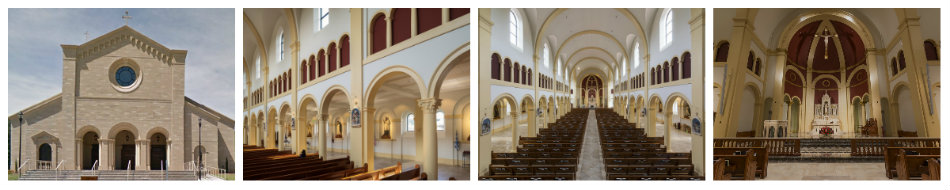 After we left the restaurant, I decided to stop by St. Catherine of Sienna in Wake Forest that is pictured above. I wanted my sister to see the beauty of the inside of a Catholic Church. She was attentive as I explained several things and she enjoyed the beauty pictured above.
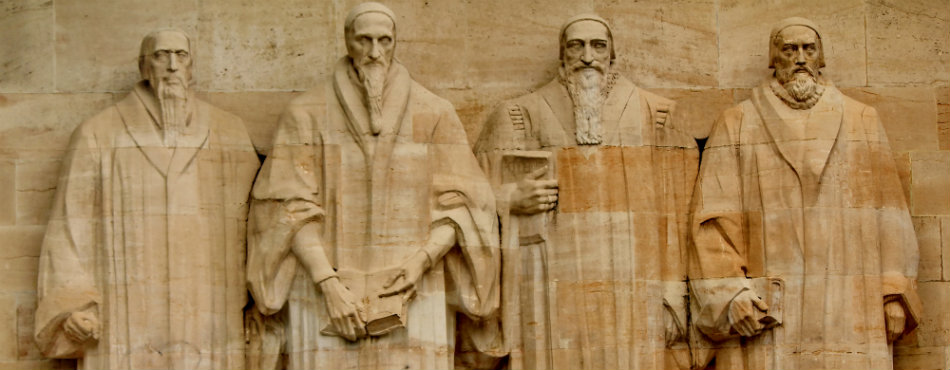
 I don’t know about you, but I have had my battles with being judgmental of other professing Christians. Old habits are hard to break, but my Catholic journey has taught me to be more loving and less judgmental.